

Avoid a 50–70% Winter Drop: Cold Weather Solar for Off Grid Systems
Avoid a 50–70% Winter Drop: Cold Weather Solar for Off Grid Systems
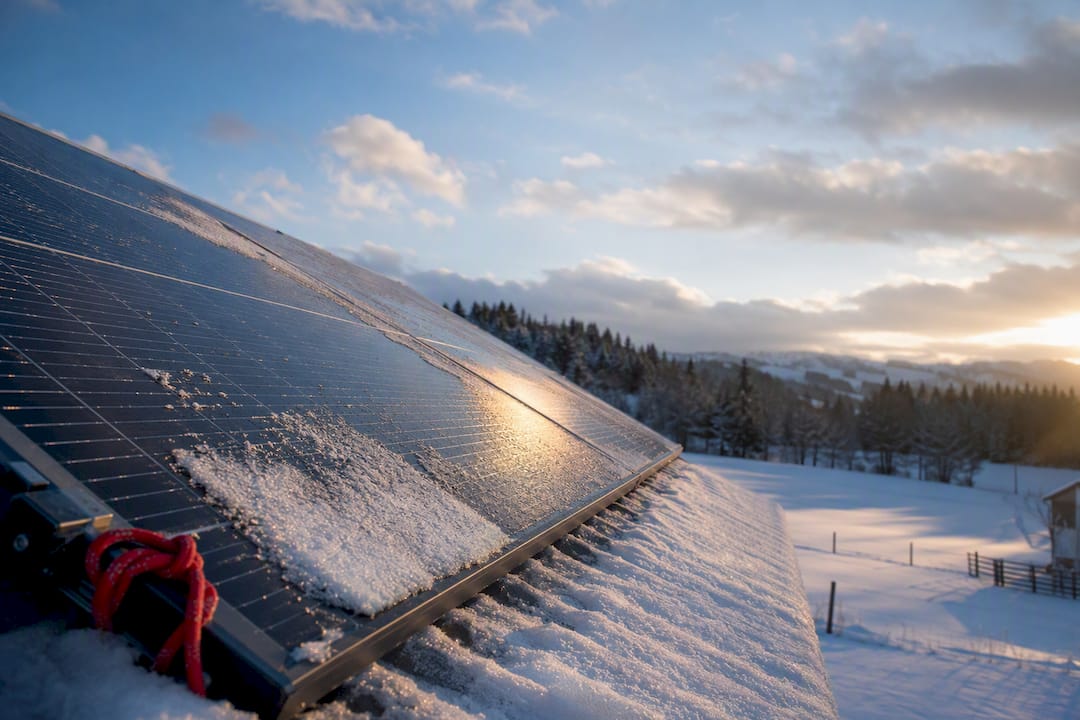
Yes, solar panels produce electricity in cold and snowy weather. Cold air actually helps: panels run more efficiently when temperatures drop, thanks to a wiring and electronics effect built into every crystalline module. What cuts winter energy is not the cold itself. It’s shorter daylight, a lower sun angle, and snow sitting on the glass.
TL;DR:
- Cold-weather performance benefits panels through increased efficiency, but actual gains depend on technology, sunlight quality, and snow reflectivity.
- Total winter output remains significantly lower than summer, typically 50% to 70% due to shorter days, lower sun angles, and overcast skies.
- Heavy snow accumulation can block sunlight and add weight, but snow on tilted panels usually slides off within one or two days, especially with proper tilt.
- Proper system design, such as using a winter tilt angle of latitude plus 15 degrees, and verifying cold Voc limits, are essential to prevent equipment damage.
- Winter system sizing should focus on low-production days and accurate modeling, especially for off-grid applications reliant on batteries during periods of low solar insolation.
Table of Contents
- Do Cold Weather Solar Panels Actually Perform Better in Winter?
- Why Winter Energy Output Still Drops Despite the Efficiency Boost
- What Snow and Ice Do to a Solar Array
- Getting Tilt and Mounting Right for a Cold Climate
- Cold-Weather Electrical Design: Voc, Controllers, and Stringing
- Winter Maintenance Checklist and Post-Storm Recovery
- Sizing Storage and Modeling Winter Yield Correctly
- How Western Harmonics Approaches Cold-Climate System Design
- Where to Read More on Winter Solar Performance
- What Actually Moves the Needle on Winter Performance
- Sources
Do Cold Weather Solar Panels Actually Perform Better in Winter?
Every solar panel carries a rating called Standard Test Conditions, or STC, and it’s measured at exactly 25°C. That’s a lab number, not a real-world one. Once the cell temperature drops below that mark, output climbs. This is the temperature coefficient at work, and it’s printed on every datasheet whether a buyer notices it or not.
Crystalline silicon panels typically gain about 0.4% to 0.5% in efficiency for every degree Celsius below 25°C. A panel rated at 300 watts might genuinely push closer to 350 watts on a bright, frigid morning.
A few things shape how much of that gain you actually see:
- Panel technology matters at the margins. PERC, TOPCon, and heterojunction (HJT) cells all carry slightly different temperature coefficients, with newer HJT designs generally losing less performance as heat rises and gaining a bit less in extreme cold.
- Clear cold air helps twice. Less humidity and haze mean more direct sunlight reaches the cells per hour, on top of the coefficient gain, according to modeling guidance on winter solar output.
- The gain is per hour, not per day. This is where most people get the story backward, and it leads straight into why total winter production still falls.
Why Winter Energy Output Still Drops Despite the Efficiency Boost
The temperature coefficient improves how hard a panel works during the hours it’s actually producing. It does nothing about how few of those hours exist in December.
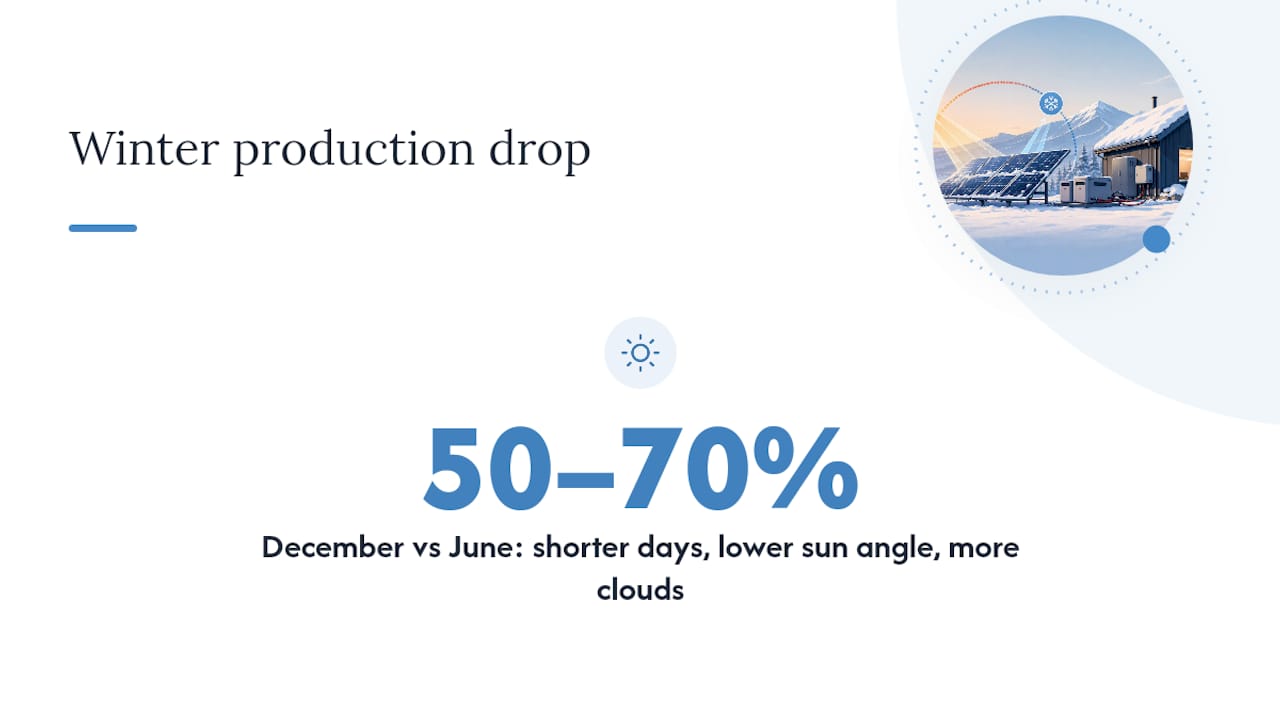
In many U.S. locations, systems produce roughly 50% to 70% of their June output in December. That gap comes from three forces stacking on top of each other: fewer daylight hours, a lower sun angle that spreads the same light over more atmosphere, and a higher chance of overcast skies depending on region.
Snow cover on the ground isn’t always a loss, either. Fresh snow reflects a lot of light back upward, a property called albedo, and that reflected light can boost irradiance on a tilted panel by 5% to 30% depending on coverage and angle. A clear day with snow on the ground and none on the panel can outperform a clear day with bare, dark ground beneath it.
What Snow and Ice Do to a Solar Array
A light dusting barely matters. Wind and gravity usually clear it within hours, and thin coverage lets enough light through for panels to keep working, if weakly. Heavy accumulation is a different problem entirely: it blocks light outright, and on flatter-mounted arrays or older racking, it adds real weight the structure has to hold.
Most snow slides off panels tilted between 20 and 45 degrees within one to two days, especially once sunlight starts warming the glass surface even slightly. Steeper tilts shed faster. Flatter roof-mounted systems can hold snow for a week or more in a stretch of overcast, sub-freezing weather.
Federal resilience guidance recommends classifying racking systems as ice-sensitive during design, and inspecting arrays after any major storm rather than assuming everything survived intact.
If you need to clear an array yourself:
- Use a soft-bristled roof rake or a snow removal tool designed for solar glass, never a metal shovel or ice scraper.
- Work from the ground or a ladder when the panel is within safe reach; don’t walk on a snow-loaded roof.
- Push snow off in the direction of the panel’s tilt rather than scraping against the surface.
- Leave anything you can’t reach safely. A day or two of lost production beats a fall or a cracked panel.
Pro Tip: Anti-ice and anti-snow coatings are not interchangeable products. The wrong coating can trap moisture against the glass and actually worsen ice adhesion, so check product data closely before applying anything to panel surfaces.
When accumulation is heavy and doesn’t clear on its own within a few days, or if you notice sagging, cracked glass, or racking that’s shifted, that’s the point to call a professional rather than climb up with a broom.
Getting Tilt and Mounting Right for a Cold Climate
Site design does more for winter output than any panel spec. The federal guidance on this is specific: aim for a winter tilt angle of latitude plus 15 degrees, which squares the panel face more directly against a lower winter sun and speeds up snow shedding at the same time. Our tilt angle guide walks through the math for different latitudes if you’re setting up a seasonal-adjust rack or a fixed off-grid array.
A few mounting details are worth getting right before winter, not during it:
- Panels tilted above roughly 35 degrees shed snow noticeably faster than lower-angle installs.
- Leave an air gap under ground-mounted or pole-mounted arrays. It reduces snow buildup underneath and helps cold air circulate rather than trap moisture against the frame.
- Roof mounts and ground mounts carry different ice risk. Roof arrays inherit whatever load rating the roof structure allows; ground mounts need their own footing depth for frost heave.
Steeper winter tilt comes with a trade-off. A panel angled aggressively into the wind catches more uplift force in a storm, so any seasonal-tilt retrofit should get its clamp hardware and ballast weight reviewed rather than assumed adequate from the summer setup.
Cold-Weather Electrical Design: Voc, Controllers, and Stringing
This is the part most DIY off-grid builders miss, and it’s the one that actually damages equipment. Open-circuit voltage, or Voc, rises as panel temperature drops, the same physics behind the efficiency gain working in reverse on the voltage side.
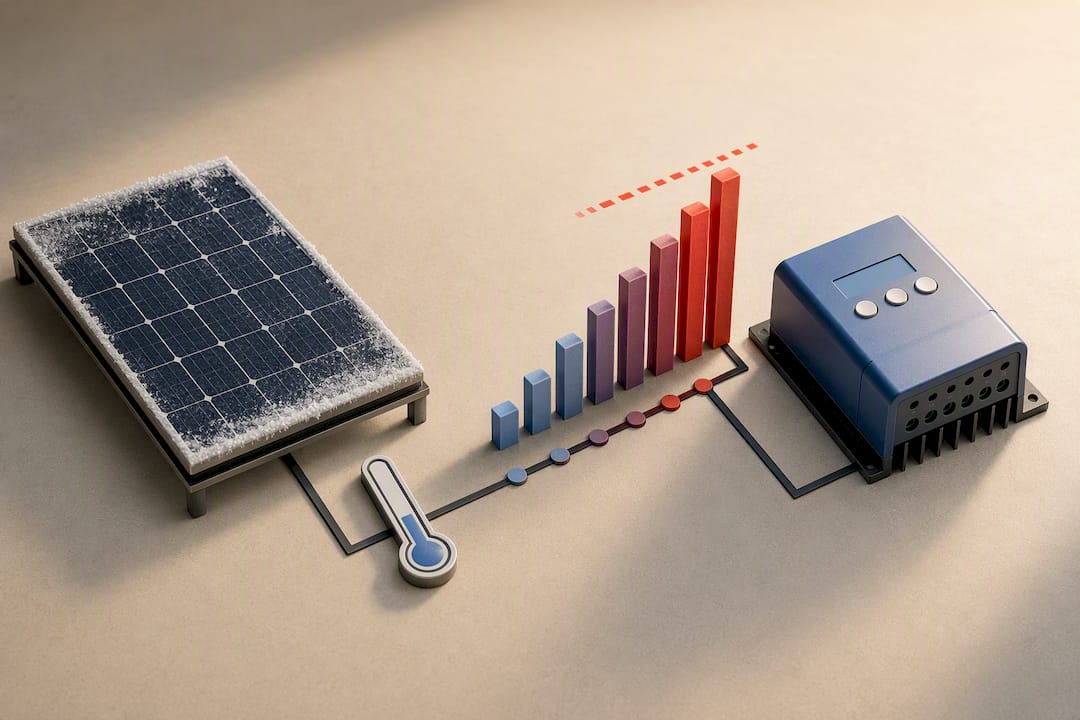
On a clear, very cold morning, an array’s cold Voc can climb close to a charge controller’s or inverter’s maximum input rating, even if that same array ran comfortably under its limit all summer. Sub-3 kW systems are particularly exposed here because builders often size strings around nameplate voltage without rechecking the cold-temperature correction factor.
A few design habits prevent this:
- Calculate cold Voc using the panel’s temperature coefficient at your region’s realistic low temperature, not just the rated Voc at 25°C.
- Favor shorter series strings with more parallel groups in colder climates, since series wiring is what stacks voltage toward controller limits.
- Recheck cold Voc during final system acceptance testing, not just at the design stage, since a summer install can pass every test and still exceed limits the first hard freeze.
- Module-level power electronics, like power optimizers, add value mainly on arrays with mixed shading or partial snow coverage, where they keep unshaded panels producing at full output instead of the whole string throttling down.
Our microgrid components guide covers stringing choices for small off-grid setups in more detail.
Winter Maintenance Checklist and Post-Storm Recovery
A short seasonal routine catches most problems before they become expensive ones.
- Walk the array visually before the first hard freeze: check for loose mounts, worn cable routing, and clear any debris or overhanging branches.
- Clean gutters and roof valleys near roof-mounted arrays so meltwater doesn’t refreeze and back up under panel edges.
- After any major snow or ice storm, isolate or power down the system if you see visible damage, then inspect for cracked glass, warped frames, or scorched connectors before restoring power.
- Clear ground-level snow near ground-mount arrays. It helps shed snow and reduces the reflected glare that can sometimes overheat lower cell rows.
- Use a soft broom or dedicated roof rake for surface snow. Avoid shovels, ice scrapers, or anything with a hard edge.
Pro Tip: Keep a phone photo log of your array from the same angle every fall. It makes spotting frame shifts or new damage after a storm much faster than trying to remember what “normal” looked like.
For arrays that took a hard hit from hail or heavy ice, our hail-resistant panel guide covers what structural damage actually looks like versus cosmetic wear.
Sizing Storage and Modeling Winter Yield Correctly
Annual production averages hide the exact problem a winter storm creates: a run of low-sun days when a battery bank needs to carry real load. Model winter months specifically, using a tool like PVWatts, rather than dividing an annual estimate by twelve. A practical winter-production breakdown is a useful reality check against whatever a sales quote promised.
For sizing storage:
- Resilience-focused systems (barns, remote cabins, backup power) should size batteries around several consecutive low-production days, not the seasonal average.
- Economics-focused systems grid-tied for cost savings can tolerate a lower winter reserve since utility power fills the gap.
- Homes relying on electric heating need extra caution. Heating load spikes exactly when solar output is lowest, so pairing solid insulation with a hybrid heat source often does more for winter reliability than oversizing the battery bank.
A proper shading analysis done before installation also catches low winter sun angles that a summer site visit would miss entirely, since a tree that clears the roofline in July can shadow half an array in January.
How Western Harmonics Approaches Cold-Climate System Design
Some companies in the solar cooling hardware market have experience with equipment tested in barns, greenhouses, and rural buildings where winter reliability is important. That background carries directly into cold-weather electrical design: Voc limits, ice-sensitive racking, and tilt choices aren’t abstract concerns for us, they’re what our own hardware has to survive.
Our microgrid design tools help walk sub-3 kW builders through winter sizing questions without guesswork, and we compare directly against other solar systems design software built for DC and low-voltage systems so you can see how PowerMosaics.com stacks up for small off-grid projects specifically.
Where to Read More on Winter Solar Performance
The Department of Energy’s resilience guidance covers hardening and post-storm best practices in more depth. Energy.gov’s performance overview explains STC ratings and real-world derating. For hands-on snow behavior, energy.gov’s snow and solar piece is worth the five minutes.
What Actually Moves the Needle on Winter Performance
Most advice on cold-weather solar spends too much time reassuring people that panels won’t die in the snow and not enough time on the design choices that separate a system that limps through January from one that just works. The physics of the temperature coefficient is the easy part. It’s real, it’s measurable, and it’s genuinely good news, but it’s also the part that gets repeated everywhere while the harder questions get skipped.
The conventional advice tends to stop at “panels work fine in cold weather,” which is true and also incomplete. The bigger risk for small off-grid and low-voltage builders isn’t underperformance. It’s a cold Voc spike that a summer acceptance test never caught, or racking that was never rated for the ice load a bad February storm delivers. Those are design failures, not weather failures, and they’re preventable with the right calculations up front.
If you’re building or retrofitting a sub-3 kW system, prioritize the boring parts first: recheck cold Voc against your controller’s actual limit, confirm your racking’s ice rating, and model winter months specifically instead of leaning on an annual average. The tilt angle and the panel brand matter less than most people assume once those three things are handled correctly.
— Chris
## Sources
- [Solar Production in Winter: How Much Do Panels Output in Cold Months? | Green Energy Calculators](https://greenenergycalc.com/guides/solar-production-in-winter/)

## Recommended

- [Solar Cooling Without Electricity for Off-Grid Homes](https://westernharmonics.com/blog/cooling-without-electricity)
- [Greenhouse Ventilation That Runs Without Grid Power: A Real Install](https://westernharmonics.com/blog/greenhouse-ventilation-off-grid-real-install)
- [Greenhouse Thermostat Control for Off-Grid Solar Systems](https://westernharmonics.com/blog/greenhouse-thermostat-control)
- [Greenhouse Solar Power: A Practical Guide for Hobbyists](https://blog.westernharmonics.com/blog/greenhouse-solar-power)