

Hail Resistant Solar Panels: What to Check Before You Buy
Hail Resistant Solar Panels: What to Check Before You Buy
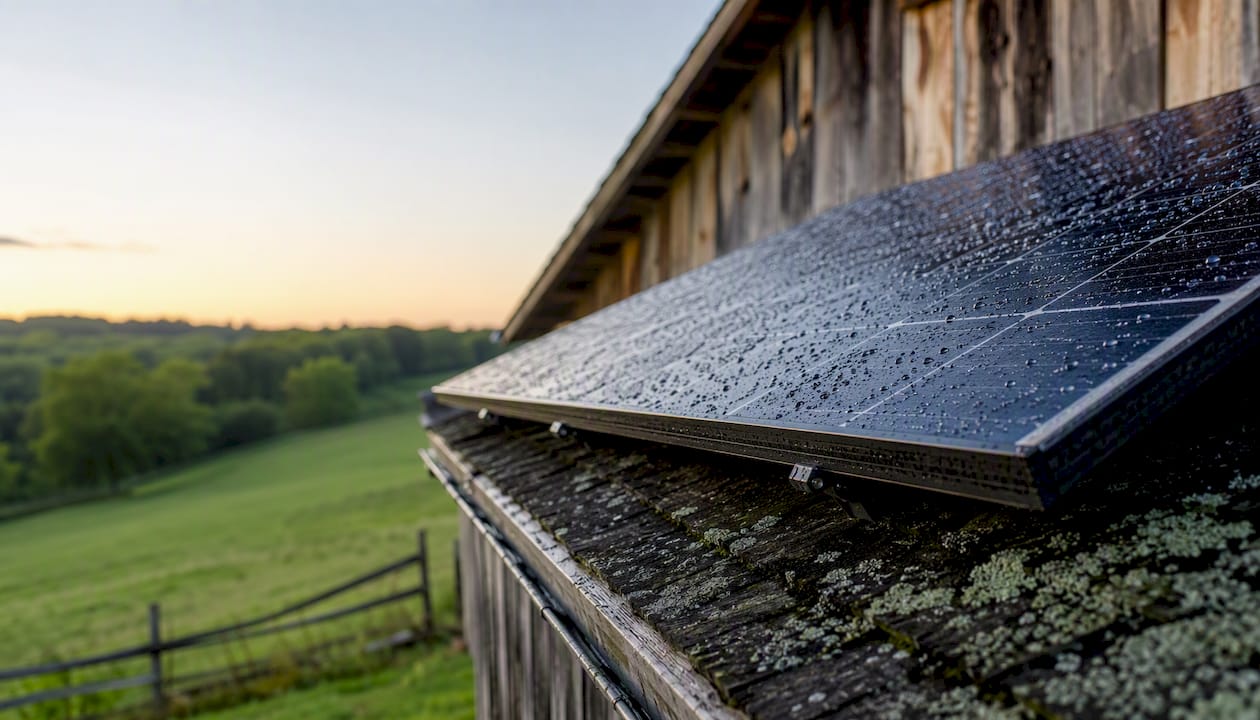
Yes, hail-resistant solar panels and hardened system designs exist, and they can meaningfully reduce storm damage risk. According to DOE national lab findings, most modules survive typical hail events, but extreme storms can exceed baseline test conditions and cause real damage. Before you sign off on any panel or proposal, run through this checklist:
- Third-party test reports: Look for IEC 61215 / IEC 61730 compliance plus independent lab reports from Kiwa PVEL or Consumer Reports, not just manufacturer PDFs.
- Hail diameter rating: Baseline IEC tests use 25 mm ice balls. For hail-prone U.S. regions, prioritize modules rated for 45 mm or larger.
- Glass type and thickness: Tempered front glass at 3.2 mm is the floor; 4.0 mm or higher is better. Glass-glass construction adds another layer of protection.
- Frame thickness and edge seal: Heavier frame profiles (35 mm or wider) and robust edge seals improve mechanical stiffness.
- Warranty and insurance language: Confirm the warranty explicitly covers hail-related damage and note any post-storm inspection requirements.
Key Takeaways
Certified hail resistance requires third-party test evidence, not marketing claims, paired with system-level design choices that match your site’s actual storm exposure.
| Point | Details |
|---|---|
| Verify test reports, not headlines | Require third-party lab reports (Kiwa PVEL or equivalent) for ≥45 mm stone ratings in hail-prone U.S. regions. |
| Glass thickness is the passive baseline | Front glass of 4.0 mm or higher, or glass-glass construction, meaningfully improves impact survivability over standard 3.2 mm. |
| Stow angle beats glass thickness at scale | Dynamic stowing to shallow angles can cut farm-wide damage by roughly 80% in modeled scenarios for tracker systems. |
| Document damage immediately | Timestamped photos, video, and a NOAA storm report are the foundation of any successful insurance or warranty claim. |
| EL inspection reveals hidden damage | Microcracks degrade output over months or years; only electroluminescence imaging confirms whether intact-looking panels are actually healthy. |
Table of Contents
- How hail actually damages solar panels
- What makes a solar panel genuinely hail resistant
- Which certifications and test reports actually mean something
- Manufacturer claims worth knowing, and how to vet them
- System-level choices that reduce hail risk across your whole array
- What to do immediately after a hailstorm
- What research says about compliance testing versus real resilience
- What owners and facility managers consistently overlook
- Sources
How hail actually damages solar panels
The root cause is kinetic energy: a hailstone’s mass multiplied by its velocity squared. Larger, faster stones deliver outsized force to a relatively small contact point on the front glass. A pea-sized stone (roughly 5 mm) rarely causes structural damage. A marble-sized stone (roughly 15 mm) can crack cells and initiate microcracks. A large hailstone can shatter front glass outright. You can use FEMA’s National Risk Index and NOAA SPC climatology data to check how frequently large hail hits your specific location.
What makes hail damage tricky is that the worst damage is often invisible. A comprehensive literature review published in MDPI found that modules may appear intact after impact but suffer microcracks in the silicon cells that degrade output over months or years. These microcracks disrupt current flow, create hot spots, and accelerate moisture ingress through compromised lamination. Front-glass fractures are obvious; cell-level damage requires electroluminescence (EL) imaging to detect.
Key failure modes to know: Microcracks and delamination are the hidden killers. A panel that looks fine after a storm may experience reduced output within a year if cell interconnects were stressed.
Impact angle matters too. Research shows that grazing impacts at shallow angles require significantly more energy to initiate glass failure than near-normal (direct) hits. This is why tracker stow strategies, covered in the system design section below, are a legitimate engineering control.
What makes a solar panel genuinely hail resistant
Module-level design choices determine how much punishment a panel can absorb before failing. Here is what to look for on datasheets:
- Front glass thickness: Standard modules ship with 3.2 mm tempered glass. Industry analysis confirms that thicker front glass, 4.0 mm or higher, meaningfully improves impact resistance and is the right call for hail-prone installations.
- Glass-glass vs. glass-backsheet construction: Glass-glass modules replace the polymer backsheet with a second glass layer. This adds rigidity, reduces flex under impact, and cuts moisture ingress risk. It also adds weight, which affects mounting loads.
- Encapsulation and lamination quality: High-quality EVA or POE encapsulants cushion cells from shock and slow moisture penetration after minor surface damage. Poor lamination accelerates degradation after any impact event.
- Cell and interconnect design: Modules with more busbars or mesh-style interconnects (multi-busbar and shingled designs) maintain electrical continuity even when individual cells crack. Redundant paths mean a local microcrack does not kill a whole string.
- Frame profile: A 35 mm or wider aluminum frame adds mechanical stiffness and reduces panel flex during high-wind hail events. Thinner frames transfer more stress to the glass and cells.
- Module format: Smaller-format modules distribute impact energy across a stiffer structure. Large-format panels (700 W+ class) cover more area per unit, which can increase exposure at the same glass thickness.
Pro Tip: Ask your installer to show you the actual datasheet glass thickness spec, not just the marketing headline. “Tempered glass” without a stated thickness tells you almost nothing about hail performance.
Which certifications and test reports actually mean something
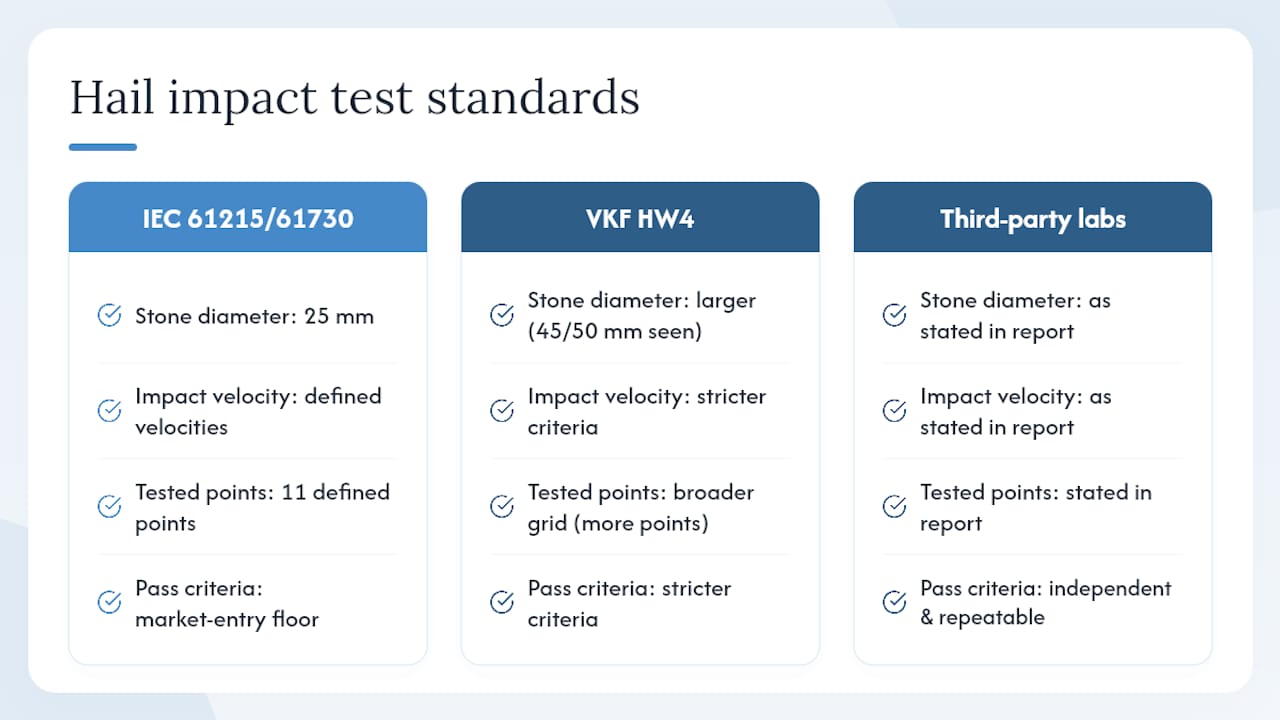
IEC 61215 and IEC 61730 are the baseline market-entry standards. Both require impact testing with 25 mm ice balls at defined velocities. Passing them confirms a module meets the floor for market entry, but it is not a guarantee against the golf-ball-sized hail that hits parts of Texas, Colorado, and the Great Plains every spring.
Enhanced standards fill that gap. The Swiss VKF HW4 standard and similar regional protocols test with larger ice balls and stricter pass criteria. SolarQuotes explains that manufacturers publishing ratings for 45 mm or 50 mm stone sizes are signaling tougher testing regimes, but you still need to verify which lab ran the test and what the sample size was.
Third-party lab reports from Kiwa PVEL and independent consumer testing from Consumer Reports use independent samples and repeatable methodology. Consumer Reports partnered with an outside lab to test 10 popular panel models for electrical output, high-temperature performance, and physical defects. That kind of independent scrutiny also surfaces manufacturing or shipping defects that can worsen hail vulnerability over time.
When reading any test report, check these four things: the lab name, the stated stone diameter and velocity, the number of impact points tested (the IEC standard specifies 11 defined points; broader grids are more rigorous), and whether electrical performance was measured after impacts, not just visual inspection.
Manufacturer claims worth knowing, and how to vet them
Several manufacturers have published enhanced hail ratings or built hail-specific product lines. Here is how to approach the most commonly cited names:
Lumos Vision Modules market frameless glass-glass construction specifically for durability. Glass-glass design does improve rigidity and moisture resistance. Request the third-party lab report to confirm the stated hail diameter and test protocol.
Jinko Solar and Trina Solar both publish IEC 61215-compliant datasheets and, for select product lines, claim enhanced impact ratings. Both are large-volume manufacturers with broad installer networks in the U.S. Verify which specific product line carries the enhanced rating, since it does not apply to every SKU.
Hyundai solar panels appear in U.S. residential installations and carry standard IEC certifications. Check the datasheet for glass thickness and ask your installer whether the specific model has been independently tested beyond the 25 mm baseline.
JA Solar produces glass-glass bifacial modules in its DeepBlue series that carry thicker front glass specs. As with any manufacturer claim, confirm the test report source.
Kiwa PVEL’s Scorecard program and Consumer Reports’ lab testing are the two most accessible independent benchmarks for U.S. buyers. Neither replaces a site-specific risk assessment, but both give you a starting point that is not controlled by the manufacturer.
System-level choices that reduce hail risk across your whole array
Choosing a well-rated module is only part of the equation. How you mount, orient, and manage the array matters just as much.
Pro Tip: Before finalizing your array layout, pull your location’s hail history from NOAA’s SWDI maps and cross-reference with FEMA’s risk index. A site that sees golf-ball hail every three years needs a different design strategy than one that sees pea-sized hail occasionally.
Mounting and framing choices affect how much mechanical stress transfers to the glass during a storm. Closer mid-clamp spacing reduces panel flex. Stronger racking profiles (heavier wall thickness, wider rail) keep the module from vibrating and twisting under wind-driven hail. DOE FEMP guidance recommends system-level mitigation alongside careful module selection for hail-prone zones.
For tracker-based systems, dynamic stowing is the single most effective farm-level control available. Modeling published in ScienceDirect shows that tilting trackers to shallow angles during a hail event can cut farm-wide damage by roughly 80% compared with flat-mounted panels, because impact angle controls energy transfer more than glass thickness alone.
For fixed-tilt residential and commercial rooftop systems, layout choices matter. Placing lower-cost or sacrificial panels at the most exposed edges, avoiding large uninterrupted panel swaths, and using protective mesh covers in extreme-risk zones are all practical options. Glass-glass modules and thicker front glass remain the passive mitigation baseline.
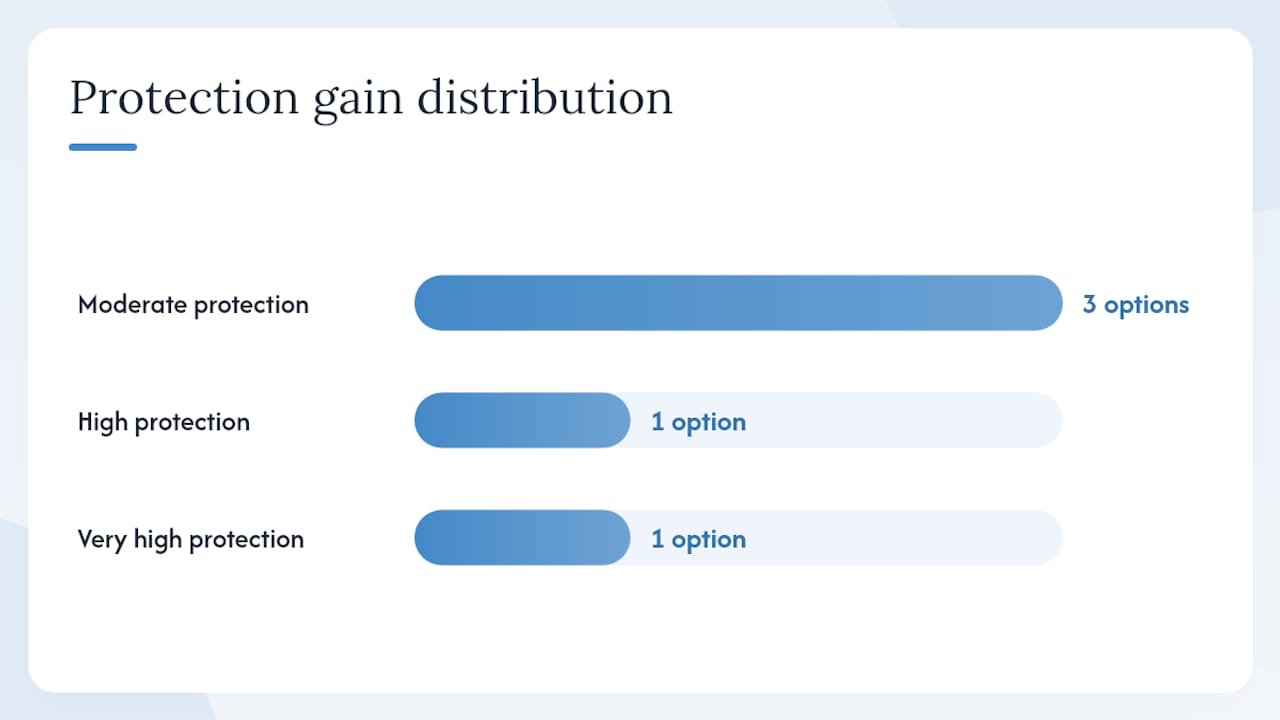
| Mitigation option | Incremental cost | Expected protection gain | Maintenance impact |
|---|---|---|---|
| 4.0 mm front glass | Low to moderate | Moderate improvement over 3.2 mm | None |
| Glass-glass construction | Moderate | High: rigidity + moisture resistance | Slightly heavier racking loads |
| Stronger frame profiles | Low | Moderate: reduces flex and stress transfer | None |
| Dynamic stow (trackers only) | Requires tracker hardware | Very high at farm scale | Requires storm detection integration |
| Protective mesh covers | Moderate to high | Moderate: limits direct impact energy | Periodic inspection needed |
What to do immediately after a hailstorm
Follow these steps in order. Do not skip the safety check.
- Stay off the roof and away from damaged panels. Broken glass and compromised wiring create shock and laceration hazards. Wait for a qualified PV technician before anyone touches the array.
- Document the weather event. Pull the NOAA storm report for your location and date. Screenshot it, save the PDF, and note the reported hail size. This corroborates your insurance claim.
- Photograph the array from the ground. Wide shots of the full array, then close-ups of any visible damage. Capture panel serial numbers if accessible. Timestamp everything.
- Record a video walkthrough. A continuous video showing the array condition is harder to dispute than individual photos and captures context a single frame misses.
- Check for visible roof penetrations or debris. Look from the ground or through an upper window. Do not attempt to clear debris yourself until the system is de-energized by a technician.
- Call your insurer first. Report the claim promptly. Ask specifically whether they require a third-party inspection report or EL imaging for replacement authorization, and get that requirement in writing.
- Contact your installer and the manufacturer. Open a warranty inquiry in parallel with the insurance claim. Note any post-storm inspection timelines stated in your warranty documents.
- Schedule a professional EL or IR inspection. Electroluminescence imaging reveals microcracks invisible to the naked eye. This is the only way to know whether panels that look intact are actually degraded.
- Keep all originals. Preserve original photos, weather reports, written estimates, and correspondence. Request written estimates from any contractor before authorizing repairs.
What research says about compliance testing versus real resilience
The gap between baseline test compliance and real-world resilience is well documented. The MDPI literature review covering damage mechanisms and testing standards through recent years finds that IEC 61215’s 25 mm ice-ball test is necessary for market entry but routinely understates risk from the large hail events common across the U.S. Great Plains and Southeast. Advanced evaluations using 45–55 mm stones, or full impact-energy curves, give a more honest picture for severe-hail regions.
The ScienceDirect stow-angle study reinforces a point that often gets buried in module-spec debates: impact angle frequently controls damage more than glass thickness. Grazing impacts at shallow angles can require 3–5 times more energy to initiate glass failure than near-normal hits. For tracker owners, that finding translates directly into a storm-response protocol.
The practical recommendation from DOE guidance, independent lab testing, and peer-reviewed modeling converges on three actions: prioritize modules with documented third-party test data for larger stone sizes, pair module selection with system-level mitigation (mounting, stow strategy, layout), and use independent EL or thermal imaging inspections after severe events rather than relying on visual checks alone.
What owners and facility managers consistently overlook
Most procurement mistakes we see come down to one thing: buying on headline efficiency and wattage without asking for verified impact-resistance evidence. A 430 W panel with a glossy “Class 4 hail resistant” sticker and no third-party report behind it is a liability in a hail-prone county. A 415 W panel with a documented Kiwa PVEL test report for 45 mm stones and a 35 mm frame profile is a real asset.
The operational mindset shift is equally important. Hail scenarios belong in your site risk assessment before installation, not after the first storm. Budget for targeted hardening, whether that means thicker glass, glass-glass modules, or stronger racking, in regions where FEMA’s hail risk data shows meaningful exposure. Plan for post-storm inspection as a recurring line item, not an emergency expense. The panels that hold up over a 25-year system life are the ones whose owners treated resilience as an engineering requirement from day one.
Sources
- Hail: No, national labs say solar panels survive severe storm
- Hailstorm impact on photovoltaic modules: damage mechanisms, testing standards, and diagnostic techniques
- Mitigating hail damage in solar modules: A study on the efficacy of dynamic impact angle
- Best solar panels — Consumer Reports
- FEMA | National Risk Index — Hail
- NOAA SPC — Weather and Climate Monitoring
- Protecting solar panels from hail—the thicker the glass, the better
- How hail-resistant are solar panels really? — SolarQuotes