

10 Meters Cuts Risk: Code Backed Battery Safety for Barn Owners
10 Meters Cuts Risk: Code Backed Battery Safety for Barn Owners
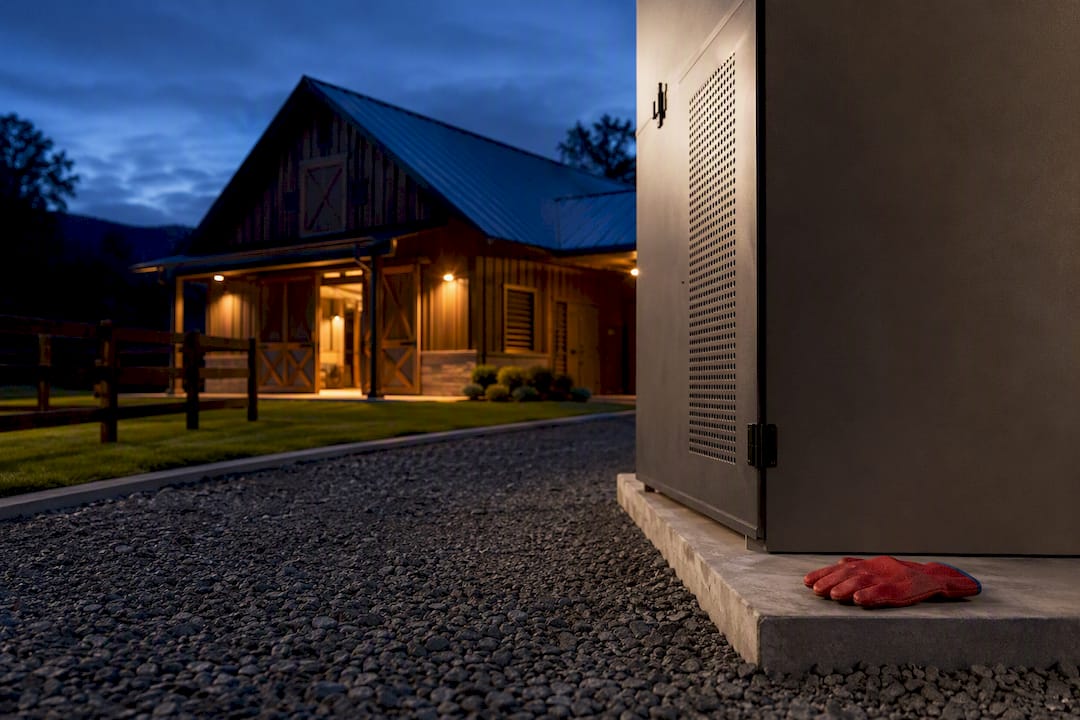
If a battery in your barn shows swelling, heat, odor, hissing, or leaking, stop using it, isolate it from chargers and combustibles, and move people and animals away. Then call the fire department if there’s any smoke or heat runaway. Battery safety in barns comes down to that one rule: ventilated, code-compliant storage and zero tolerance for damaged cells. Standards from NFPA, NEC, and IEEE back this up, and resources like Westernharmonics exist specifically to help you build it right the first time.
TL;DR:
- Keeping batteries outside the barn at least 10 meters away reduces the risk of fire spreading to hay, livestock, and structures.
- Always store damaged batteries separately in fire-rated compartments and route them for recycling immediately to prevent escalation.
- Charging batteries in cold barns below 32°F or above 105°F can initiate failures, so use certified chargers and control charging times carefully.
- Ventilation systems must be tailored to battery chemistry, with hydrogen detectors at ceiling level for lead-acid and thermal alarms for lithium-ion, to ensure safety.
- Small, distributed battery units are safer than large single banks, as they limit failure points and simplify isolation during emergencies.
Table of Contents
- Quick Safety Checklist for Barns
- Where Should You Store Barn Batteries?
- How Do You Charge Batteries Safely in a Barn?
- What Ventilation Do Battery Rooms Need?
- What Wiring Rules Apply to Barn Battery Systems?
- What Should You Do If a Battery Starts Smoking?
- How Often Should You Inspect and Maintain Barn Batteries?
- How Do You Plan an Evacuation for People and Livestock?
- Designing Safer Off-Grid Barn Battery Systems
- How Westernharmonics Can Help You Get This Right
- Westernharmonics’ Take: Small Batteries, Distributed Design
- Sources
- FAQ
Quick Safety Checklist for Barns
Most barn battery fires start small and get missed until it’s too late. A weekly walk-through catches the warning signs before they become an evacuation.
- Check weekly for swelling, sour or acrid odor, unusual heat, hissing, or visible leaking.
- Store spare batteries away from hay, bedding, shavings, and any combustible material.
- Charge only under supervision, using certified chargers matched to the battery, with posted signage warning against unattended charging in combustible zones.
- Label every battery bank clearly and keep PPE (gloves, eye protection) and spill-neutralizing baking soda on hand for lead-acid units.
- Pull any battery showing damage from service immediately and route it to recycling, never the trash.
Pro Tip: Keep a laminated card taped inside your electrical panel listing battery type, install date, and last inspection. When something looks wrong, you won’t be guessing what you’re dealing with.
Where Should You Store Barn Batteries?
The safest battery is one that’s outside the building entirely. Verzekeraars’ fire-prevention research recommends placing battery storage outside the main structure with roughly 10 meters of separation when the site allows it. That distance alone removes most of the risk a battery fire poses to your hay, your livestock, and your building frame.
When outdoor placement isn’t practical, indoor storage needs real compartmenting, not just a corner of the tack room. Follow this sequence to decide:
- Ask whether an outdoor pad or weatherproof housing is feasible. If yes, that’s your default answer.
- If indoor storage is unavoidable, isolate the battery in a 60-minute fire-rated compartment separated from hay, feed, and equipment storage.
- Install sealed, ventilated cabinetry with automatic thermal alarms tied to a monitored circuit.
- Use a concrete pad or fire-rated battery box rather than wood shelving or a plastic bin.
- Confirm the cabinet or box locks, keeping curious animals and kids away from terminals.
A weatherproof fan housing on the exterior wall can pull heat and gas away from an outdoor battery box without running power through the barn itself, which is one reason more owners are moving batteries outside altogether.
How Do You Charge Batteries Safely in a Barn?
Charging is where most avoidable battery fires start, and cold barns make it worse. USFA guidance is specific here: don’t charge lithium-ion cells below 32°F or above 105°F, and always follow the manufacturer’s stated limits over generic advice.
- Use a certified charger sized correctly for the battery. A bargain charger from an unrelated brand is a common cause of overcharge failures.
- Never leave a battery charging unattended in a space with hay, sawdust, or fuel nearby.
- Install a timer or charge controller so charging stops automatically rather than relying on someone remembering to unplug it.
- In winter, bring batteries into a heated (but still ventilated) space before charging, and let them come up to temperature slowly rather than charging cold cells straight off a frozen pad.
Cheap chargers and skipped temperature checks account for a disproportionate share of the failures we hear about from barn owners. It’s a five-minute fix with real consequences if ignored.
What Ventilation Do Battery Rooms Need?
Ventilation needs to depend entirely on battery chemistry, and treating every battery the same is where a lot of barn setups go wrong. Lead-acid batteries vent hydrogen during charging, and that gas rises, so detectors belong at the highest point of the room, not at eye level. IEEE guidance on stationary battery installations makes the chemistry distinction explicit: vented lead-acid systems need mechanical exhaust and gas monitoring, while lithium-ion systems need thermal detection and suppression planning instead.
Modern electrochemical energy storage code requirements now call for exhaust ventilation, gas detection, explosion control, and spill containment as a package, not optional add-ons. UpCodes’ summary of these provisions notes that ventilation systems in supervised installations often run on standby power so airflow continues even during a grid outage.
Key ventilation and gas-management points:
- Locate hydrogen detectors near the ceiling; hydrogen is lighter than air and pools at high points.
- Size mechanical exhaust to keep flammable gas concentration below code thresholds, following NEC Article 480 and NFPA guidance.
- For lithium-ion banks, install thermal alarms rather than relying on gas detection alone, since thermal runaway is the primary hazard.
- Consult a licensed electrician or fire-protection engineer before finalizing room design if you’re running more than a small backup bank.
A properly designed battery room isn’t complicated, but it’s not something to eyeball either. A significant portion of a battery fire’s severity depends on how fast heat and gas can escape, which is exactly what ventilation design controls.
What Wiring Rules Apply to Barn Battery Systems?
NEC Article 480 governs storage battery installations, and it’s the reference point any electrician will use when wiring your barn’s battery bank or solar system. Pair it with general NFPA guidance on ventilation and you have most of what applies to a small off-grid setup.
- Route and secure cables away from foot traffic, livestock, and anything that could chew or crush insulation.
- Install rated disconnects and breakers sized to the battery’s output, not just to the wire gauge.
- Ground the system according to code and confirm overcurrent protection is in place before the first charge cycle.
- Check with your local building department. Permits and inspections are often required for battery banks over a modest capacity, even in ag buildings.
Westernharmonics has a detailed walkthrough of these rules in its barn solar wiring guide, which covers the NEC provisions most barn owners miss on a first install.
What Should You Do If a Battery Starts Smoking?
Detection and first response matter more than suppression in most barn battery incidents, because by the time you’re fighting an active lithium fire, you’re mostly managing exposure rather than putting it out.
- Prioritize thermal and gas detectors over smoke alone. Smoke detectors catch fire late; thermal sensors catch a failing cell early.
- Isolate the charger and disconnect the battery from its circuit the moment you notice heat, swelling, or odor.
- Evacuate people first, then move livestock to a staging area well clear of the storage location.
- Call 911 and tell dispatchers the battery chemistry (lead-acid or lithium-ion) so firefighters know what they’re facing before they arrive.
- Leave actual extinguishing to professionals if the fire is active. Water on an energized lithium-ion fire can spread the hazard rather than contain it.
Pro Tip: Post battery chemistry and location on a card near your barn’s main entrance. Firefighters arriving at 2 a.m. shouldn’t have to guess what’s burning.
How Often Should You Inspect and Maintain Barn Batteries?
Inspection is the cheapest insurance you’ll ever buy for barn battery safety. A monthly check takes ten minutes; a missed one can cost you the building.
- Check terminals for corrosion, case integrity for cracks, and vent caps for damage every month.
- For lead-acid batteries, water only with distilled water, wearing gloves and eye protection, and never overfill above the plate level.
- For lithium-ion banks, do a visual check for swelling or discoloration and track charge cycles against manufacturer limits.
- Neutralize any acid spill immediately with baking soda, contain it, and dispose of the residue per local hazardous-waste rules.
- Recycle end-of-life batteries through a certified channel and keep the receipt. Inspectors and insurers sometimes ask for it.
How Do You Plan an Evacuation for People and Livestock?
A battery fire plan only works if everyone in the barn knows their job before smoke shows up. Write it down, practice it twice a year, and keep it short enough that panic doesn’t erase it.
- Designate one person to call 911 and one to cut power at the main disconnect the moment an alarm sounds.
- Assign someone specifically to animal evacuation, since livestock resist moving toward smoke and need a calm, practiced handler.
- Stage evacuated animals in a paddock or lot far enough from battery storage that a secondary flare-up doesn’t reach them.
- Run a drill at least twice a year, and update the plan whenever you add or relocate a battery bank.
- Keep a one-page summary posted near the entrance listing battery locations and chemistry for responders.
Rutgers’ extension research on farm fire prevention backs this structure directly, pointing to removing ignition sources and pre-planning evacuation as two of the highest-value steps any barn owner can take.
Designing Safer Off-Grid Barn Battery Systems
Westernharmonics built the first solar fan kit sold in the United States, and that history shaped how we think about barn power. Every design decision traces back to one question: what happens to this system in a real barn, in real weather, with a battery involved?
That’s why we favor ventilated DC micro-power units over sealed indoor packs, remote battery pads set apart from the main structure, and thermal alarm integration on anything we ship with a battery backup. Small, distributed power beats one large indoor bank almost every time in a barn setting. It’s easier to ventilate, easier to isolate if something goes wrong, and it doesn’t force you to carve a fire-rated room out of your tack area.
Our barn wiring guide and ventilation resources walk through how these choices play out in an actual installation, not just on paper.
How Westernharmonics Can Help You Get This Right
If you’re comparing system-design tools before you commit to hardware, most current options fall into two camps: enterprise energy-modeling software built for utility-scale projects, and generic solar calculators that were never built with barn loads, DC micro-power, or under-3kW systems in mind. Neither is designed for the reader planning a small, low-voltage off-grid setup for a barn or workshop.

Westernharmonics’ solar and battery systems are built specifically for that scale. Our fan kits, from the 10W entry-level system to the 200W hanging fan kit with battery backup, pair ventilation with battery management in a single unit rather than leaving you to bolt separate systems together. That’s the practical advantage over generic design software: you’re not modeling a hypothetical system, you’re buying one engineered for barn conditions from day one.
Start by downloading our barn wiring guide, walk your barn with the checklist above, then browse the full catalog to find the kit sized to your space. If your setup is unusual, reach out for custom advice before you buy.

Westernharmonics’ Take: Small Batteries, Distributed Design
Most barn fire coverage focuses on the dramatic failure, the lithium pack that erupts without warning. That’s real, but it’s not the biggest risk we see. The bigger risk is a battery bank sized and placed the way someone would size a house battery, then dropped into a barn where hay dust, temperature swings, and animal traffic change every assumption that sizing was based on.
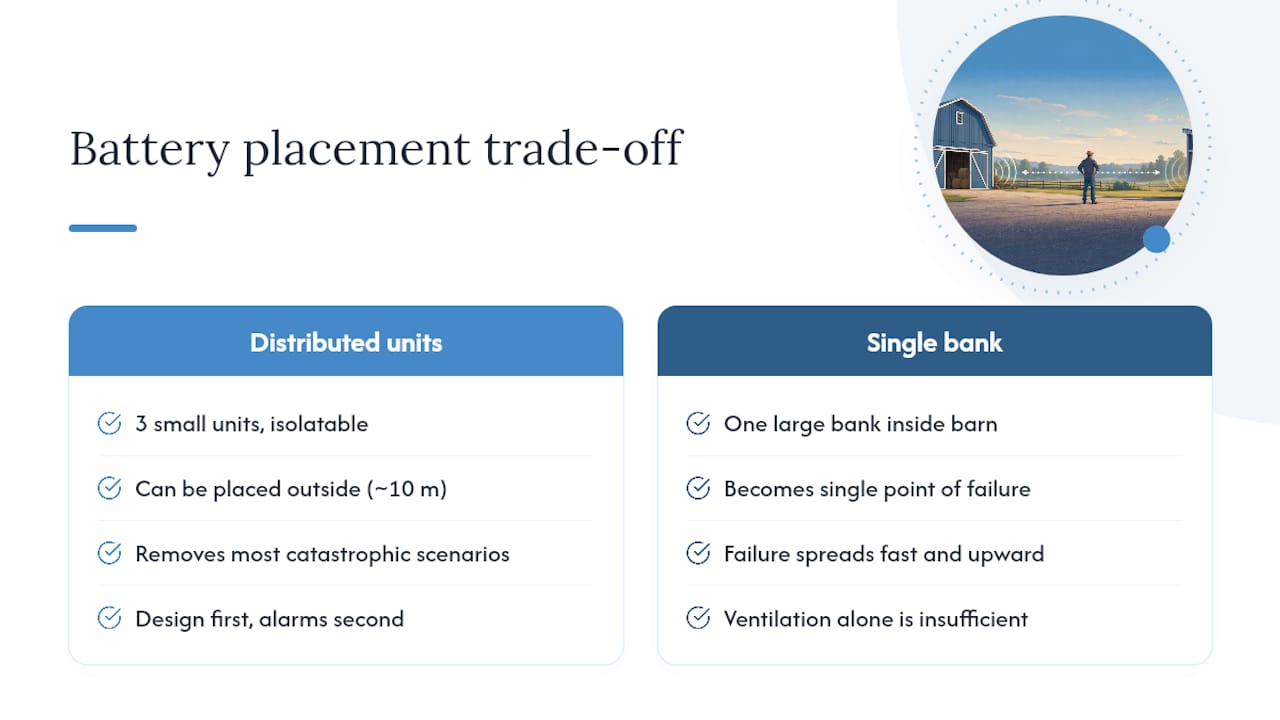
The conventional advice to “just ventilate it properly” undersells how much placement does before ventilation ever matters. A battery outside the structure, even a modest 10 meters away, removes most of the catastrophic scenarios before you’ve spent a dollar on detection equipment. We’d rather see a barn owner buy three small, distributed battery units they can isolate individually than one large bank that becomes a single point of failure for the whole structure.
That’s not a sales pitch for smaller hardware. It’s an observation about how failure actually spreads in a barn: fast, upward, and toward whatever combustible material is closest. Design against that reality first, then layer on the alarms and extinguishers.
— Chris
Sources
For code language and thresholds, go straight to the source: NFPA and NEC Article 480 for wiring and ventilation, IEEE 1635 for thermal and gas management, USFA for consumer battery handling rules, and Rutgers’ farm fire prevention guide for barn-specific evacuation planning.
- Battery Fire Safety - USFA
- Fire Prevention And Safety Measures Around The Farm - Rutgers
- IEEE guidance on ventilation and thermal management for stationary battery installations
- Electrochemical ESS technology-specific protection - UpCodes
FAQ
What Are the OSHA Battery Safety Requirements?
OSHA requirements focus on ventilation, PPE, and safe handling for vented batteries in workplaces, including barns with commercial operations, requiring proper ventilation and spill-response equipment for lead-acid battery charging areas.
Can a Lithium Battery Catch Fire if It’s Not Plugged In?
Yes. A damaged or defective lithium-ion cell can enter thermal runaway on its own, which is why USFA guidance says to stop using any battery showing swelling, heat, or odor regardless of whether it’s charging.
What Is the Most Common Cause of Barn Fires?
Electrical failures and heating equipment are consistently cited as leading causes, with extension research pointing to ignition sources near combustible bedding and hay as the pattern behind most preventable barn fires.
What Are the Safety Precautions for Batteries?
Store batteries in ventilated, code-compliant locations away from combustibles, charge only within manufacturer temperature limits, inspect weekly for damage, and stop use immediately if you see swelling, heat, or leaking. Some fan kits and battery systems are designed around principles suitable for barn-scale use.