

Pick Axial or Centrifugal by Static Pressure: Axial <500 Pa, Solar/DC
Pick Axial or Centrifugal by Static Pressure: Axial <500 Pa, Solar/DC
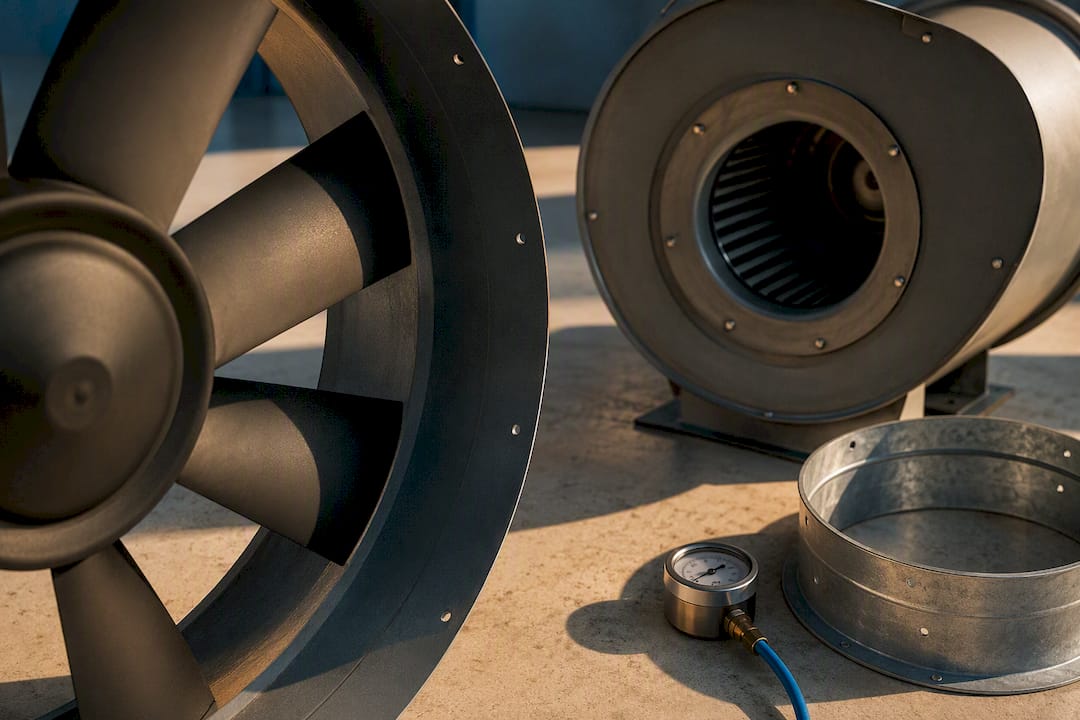
Choose an axial fan when your system’s static pressure sits below roughly 375 to 500 Pa and you need to move large air volumes cheaply. Choose centrifugal once resistance climbs past that band, since tube-axial and vaneaxial units stall and lose efficiency under duct loads they weren’t built for. Mixed-flow and vaneaxial designs bridge some of the gap, but the checklist below settles the edge cases.
TL;DR:
- Fans operating below 375 to 500 Pa are best suited for axial types, while higher resistance systems require centrifugal designs to avoid stall and efficiency loss.
- Backward-curved centrifugal fans maintain high efficiency and low motor overload risk across a wider pressure range than axial fans.
- For ducted systems exceeding 375 Pa, centrifugal options outperform axial fans in both performance and reliability.
- Off-grid solar fans should be matched carefully to static pressure to minimize power consumption, with low-resistance applications suitable for low-wattage axial models.
- Proper system sizing and matching avoid early fan failure, unnecessary noise, and excessive electrical draw, especially in complex or high-resistance installations.
Table of Contents
- Axial vs Centrifugal Fan: What Actually Separates Them
- How Do Static Pressure and Efficiency Compare?
- Where Each Fan Type Actually Gets Used
- How to Choose the Right Fan for Your System
- What This Means for Solar and DC Off-Grid Fan Sizing
- Static Pressure Decides the Fan. Everything Else Refines It.
- Match Your Fan Choice to a DC System Built for It
- Sources
Axial vs Centrifugal Fan: What Actually Separates Them
An axial fan pushes air in a straight line along the motor shaft, the same way a household box fan or a car radiator fan does. Blades shaped like small airplane wings generate lift, and that lift shoves air forward parallel to the hub. A centrifugal fan does something mechanically different: it pulls air into the center of a spinning impeller and slings it outward using centrifugal force, then the volute housing catches that high-velocity air and converts it into static pressure. That conversion step is why centrifugal fans handle ducted, high-resistance systems that axial fans can’t.
The failure mode tells you everything about why pressure ratings differ so much. Push an axial fan past its aerodynamic limit and the airflow over the blades separates, a centrifugal recirculation pattern forms inside the fan itself, and you get stall: a sudden spike in noise, a drop in delivered airflow, and accelerated wear on the bearings and motor. ebm-papst’s engineering notes point to this as one of the most common causes of premature axial fan failure in the field. Centrifugal impellers don’t have this cliff edge. As resistance rises, output tapers more gradually along the curve instead of collapsing.
Subtype geometry matters as much as the axial/centrifugal split itself:
- Propeller fans move huge volumes at almost no pressure and cost the least to build.
- Tube-axial fans add a cylindrical housing for modest pressure gains over open propellers.
- Vaneaxial fans add guide vanes downstream of the blades, straightening swirl and pushing the pressure ceiling higher than any other axial subtype.
- Forward-curved centrifugal impellers run compact and quiet but at lower peak efficiency.
- Backward-curved and airfoil impellers cost more to manufacture but deliver the best efficiency and the highest pressures in the category.
Knowing which subtype you’re actually comparing (not just “axial” vs “centrifugal” as a blanket label) is where most spec mistakes get made.
How Do Static Pressure and Efficiency Compare?
Numbers make the selection call easier than guesswork ever will. Enginist’s engineering comparison gives useful bands for placing your duty point:
Pro Tip: Don’t just size for CFM. A fan that hits your target airflow at zero resistance will fall well short once it’s fighting real duct losses, filters, and hoods.
- Propeller axial fans: typically under 125 Pa of static pressure.
- Tube-axial fans: up to roughly 375 Pa.
- Vaneaxial fans: up to roughly 750 Pa, the top of the axial range.
- Forward-curved centrifugal fans: roughly 250 to 1,500 Pa.
- Backward-curved and airfoil centrifugal fans: roughly 750 Pa to 3,000+ Pa.
The overlap zone between 375 and 750 Pa is where vaneaxial and forward-curved centrifugal units compete directly, and that’s usually where an engineer earns their fee sorting out the right call.
Efficiency behaves differently across the two families too. Backward-curved and airfoil centrifugal impellers post the highest peak efficiencies of any fan type, and they hold that efficiency across a wider slice of their operating range than axial designs do. Axial fans peak sharply at one point on the curve and fall off fast on either side of it, which is fine if your system resistance never changes but a problem if it does.
Motor loading follows the same pattern. Backward-curved centrifugal fans are largely non-overloading: as static pressure rises, motor power draw actually decreases, which protects the motor from surprises. Forward-curved centrifugal and most axial fans are overloading types, meaning power draw keeps climbing as pressure increases, and an undersized motor can cook itself if the system curve shifts after installation (a clogged filter is the classic culprit).
Noise splits along similar lines. Axial fans tend toward broadband, whooshing noise that gets harsh near stall. Centrifugal fans generally run smoother and quieter at a comparable duty point, particularly backward-curved and airfoil designs. If acoustic limits matter, that’s a real point in the centrifugal column even outside the pressure argument.
Where Each Fan Type Actually Gets Used
Real installations sort themselves out fast once you know the pressure rule. Here’s how the split plays out on the ground:
- Cooling towers and condenser coils run wide-open airflow across a coil with almost no ductwork, which is textbook low-resistance, high-volume axial territory.
- Large building exhaust and roof ventilators move enormous air volumes through short, unobstructed paths, another strong axial fit.
- Air handling units with long duct runs stack up resistance from turns, filters, and diffusers fast, which is why AHUs default to centrifugal.
- Process exhaust and industrial scrubbers need engineered selection against a specific resistance curve, and centrifugal designs dominate here for pressure headroom alone.
- Dust, particulate, or corrosive gas streams favor centrifugal housings, since backward-curved and radial-blade impellers shed particulate better than an axial blade pack and hold up longer against abrasive or chemical wear.
- Hot flue gas and high-temperature process air typically call for radial or backward-curved centrifugal wheels engineered for thermal expansion, something axial hubs handle less gracefully at scale.
How to Choose the Right Fan for Your System
Work through this in order, and don’t skip a step because the fan you already like happens to be cheap.
- Step 1: Measure or calculate your required CFM and total system static pressure, including ducts, filters, hoods, and dampers, not just the open-air rating.
- Step 2: Check that number against the axial bands above. Above roughly 375 to 500 Pa, rule axial out unless you’re specifically speccing a vaneaxial unit built for that range.
- Step 3: Plot your duty point against the actual fan curve and motor curve, not the catalog’s best-case number, and confirm VFD compatibility if the system runs variable loads. System resistance and gas properties should drive that curve, not a guess.
- Step 4: Weigh noise limits, footprint, and how easily a technician can reach the bearings for service, since a centrifugal housing bolted into a tight mechanical room is a maintenance headache waiting to happen.
Pro Tip: Watch for stalling sounds, unusual bearing heat, or a sudden noise change after startup. Those three red flags almost always mean the fan is fighting more resistance than it was sized for.
What This Means for Solar and DC Off-Grid Fan Sizing
The pressure rule doesn’t change when you switch to solar power, but the stakes go up, because every extra watt the fan draws is a watt your panel and battery have to supply. DC brushless motors paired with a fan matched to the actual duty (not an oversized unit “just in case”) stretch a modest solar array much further, and that’s the whole engineering premise behind Westernharmonics’ solar-powered fan lineup.
Static pressure and duty cycle together decide your panel wattage and whether you need battery backup at all. A field test of a PV-driven solar chimney fan found ventilation rates around 15 to 50 cubic meters per hour and indoor temperature drops of 1 to 3°C, proof that a right-sized, low-resistance axial setup can do real work on modest solar input.
- Low-resistance barn and greenhouse exhaust: axial, DC brushless, minimal panel wattage.
- Ducted or filtered off-grid runs: expect higher draw, size the panel and battery accordingly.
- Read the greenhouse ventilation guide for duty-matched examples.
Static Pressure Decides the Fan. Everything Else Refines It.
Static pressure is the first filter, efficiency and noise are the second, and everyone who skips straight to price ends up replacing a fan within a year. If your system sits cleanly under 375 Pa, a well-built axial or vaneaxial unit will serve you fine and save you money. Above that, stop shopping axial catalogs and start comparing backward-curved centrifugal options instead.
Standard products cover most residential and small commercial jobs. Complex ducting, hazardous gas streams, or tight energy codes are where an engineer plotting your actual system curve earns their fee, not a spec sheet skim. For off-grid ventilation projects, Westernharmonics has already done that duty-matching work on the DC side.
— Chris
Match Your Fan Choice to a DC System Built for It
Traditional systems design software for DC, low-voltage, and under-3kW setups forces you to model panel wattage, battery capacity, and fan draw as three separate calculations, then hope they reconcile. Westernharmonics builds that duty-matching directly into its product line: every kit pairs a DC brushless fan sized to a known static pressure range with a panel rated to actually run it, so you’re not guessing whether a 10W array can carry a fan that needs 25W under load.

If your duty point lands in axial territory (barns, greenhouses, open exhaust runs), the 10W Solar Powered Fan Kit covers low-resistance jobs without oversized hardware. Heavier or filtered airflow needs call for the 200W Solar Hanging Fan Kit with battery backup, which adds storage for cloudy days or overnight runtime. Browse the full solar fan catalog to match your static pressure numbers to a kit built around them, and if solar sizing questions come up along the way, Alpha Solar Solutions’ overview of solar energy tradeoffs is a solid outside reference for panel basics. Start by measuring your system’s resistance, then pick the kit rated for it.
Sources
- Axial vs centrifugal fan comparison | Enginist
- Axial, diagonal, centrifugal: which fan fits which application? | ebm‑papst mag
- Performance study of a solar chimney with PV-powered fan (SCW-PV)
- Comparing axial fans and centrifugal fans | DigiKey