

How to Size an Off-Grid Battery for DC Fans and Small Loads
How to Size an Off-Grid Battery for DC Fans and Small Loads
The battery you need comes down to one formula: Battery Wh = (daily Wh × days of autonomy) ÷ usable depth of discharge (DoD). Run your loads through this math before you buy anything, and you’ll stop guessing at capacity.
For a barn fan, greenhouse vent, or workshop microgrid under about 3 kW, most owners land on 1 to 3 days of autonomy. Convert the resulting watt-hour figure to amp-hours by dividing by your system voltage (Wh ÷ V = Ah), since that’s how batteries are actually labeled and sold.
- Formula: Wh needed = (daily Wh × autonomy days) ÷ usable DoD
- Rule of thumb: 1 to 3 days of autonomy covers most small DC setups
- Convert to shopping units: Ah = Wh ÷ system voltage (12V, 24V, or 48V)
Quick math: a load drawing 300 Wh per day, sized for 2 days of autonomy at 80% usable DoD, needs 750 Wh of battery capacity, or about 62.5 Ah at 12V according to the OffGridAuthority sizing method.
TL;DR:
- Most small off-grid DC loads can be adequately supported with 1 to 3 days of autonomy, depending on load criticality.
- The sizing formula relies on accurate load audits, including margins for measurement errors and future growth, and varies with battery chemistry and temperature conditions.
- Lithium Iron Phosphate batteries offer higher usable capacity and longer lifespan, but require derating in cold weather, especially if unheated.
- Converting watt-hours to amp-hours involves dividing by system voltage, with 12V, 24V, and 48V systems each impacting current and wiring choices.
- Charging sources must be sized to fully replenish daily consumption within available sun hours to prevent chronic undercharging and reduced battery life.
Table of Contents
- How Do You Size an Off-Grid Battery With a Load Audit?
- What’s the Battery Bank Sizing Formula for Off-Grid Systems?
- Which Battery Chemistry Fits Small DC Off-Grid Loads?
- How Do You Convert Watt-Hours to Amp-Hours for Your Battery?
- How Much Extra Capacity Should You Add for Temperature and Aging?
- How Do You Size Wire and Fuses for 12V DC Fans and Pumps?
- Worked Example: Sizing a Battery for a Small Greenhouse
- How Do Western Harmonics and PowerMosaics Support These Calculations?
- How Do Solar Panels, Wind, and Generators Affect Battery Size?
- Why Do Round-Trip Losses Matter for Battery Sizing?
- What About AGM, Gel, and Other Battery Types?
- What Maintenance Should You Expect Based on Battery Size?
- How Does Inverter Capacity Affect Battery Sizing?
- What the Data Actually Tells Us About Sizing Small Off-Grid Systems
- Match Your Battery Math to a Western Harmonics Kit
- Key Takeaways
- Sources
How Do You Size an Off-Grid Battery With a Load Audit?
Every sizing calculation starts with an honest count of what you’re actually running. Skip this step and every number after it is fiction.
- List every device and note its wattage (check the nameplate or a clamp meter) and how many hours a day it actually runs.
- Separate DC-native loads from AC loads. A 12V fan wired straight to the battery loses nothing. The same fan run through an inverter from an AC outlet loses 10 to 15% to conversion, so add that penalty only where an inverter is actually in the circuit.
- Add phantom loads. Controllers, BMS electronics, and standby draw from sensors add up quietly over 24 hours, even when nothing looks like it’s running.
- Build in a margin. Add 10 to 20% on top of your raw total to cover measurement error and future loads you haven’t accounted for yet.
A 20-watt DC vent fan running 10 hours a day pulls 200 Wh. A small 12V water pump cycling 30 minutes a day at 60 watts adds another 30 Wh. Add margin, and you’re already past 250 Wh before you’ve touched lighting or sensors.
What’s the Battery Bank Sizing Formula for Off-Grid Systems?
Once you know your daily Wh, the bank sizing formula does the rest of the work: Battery Wh = (daily Wh × days of autonomy) ÷ usable DoD, a method confirmed across OffGridAuthority’s step-by-step approach.
Say your load audit lands on 400 Wh per day.
- 1 day of autonomy works for loads with reliable daily sun and low consequence if they go dark overnight (a single greenhouse vent fan).
- 2 days is the sensible default for most barn, workshop, and homestead setups, covering one cloudy day without stress.
- 3 days make sense for critical loads like livestock ventilation or water pumps where downtime has real cost.
DoD is where budgets get eaten alive. VoltCalcs’ sizing data confirms flooded lead-acid tops out around 50% usable DoD while LiFePO4 routinely reaches 80 to 90%.
Which Battery Chemistry Fits Small DC Off-Grid Loads?
Chemistry decides how much of the rated capacity you actually get to use, and that single number changes every calculation downstream.
VoltCalcs notes LiFePO4 delivers far more usable energy per rated kWh and lasts many times longer than lead-acid, which usually makes it the better long-term value for small off-grid loads even at a higher upfront cost. The tradeoff shows up in winter. Cold weather cuts LiFePO4’s usable capacity by roughly 10 to 20%, and most battery management systems refuse to charge below freezing to protect the cells. If your fan or pump runs in an unheated barn through winter, that behavior belongs in your math, not as a surprise in January.
How Do You Convert Watt-Hours to Amp-Hours for Your Battery?
Batteries are sold in amp-hours, not watt-hours, so you need one more conversion before you shop: Ah = Wh ÷ system voltage.
- A 1,000 Wh target at 12V requires about 83 Ah.
- The same 1,000 Wh at 24V requires about 42 Ah, roughly half the current and wire size.
- At 48V, it drops to about 21 Ah, though that voltage is usually overkill below 3 kW.
VoltCalcs’ voltage guidance recommends 12V for genuinely tiny loads like a single fan, but treats 24V as the practical default for most systems under roughly 1 to 3 kW. Higher voltage means lower current for the same power, and lower current means thinner wire and smaller fuses, which saves real money on a multi-device barn or greenhouse system.
How Much Extra Capacity Should You Add for Temperature and Aging?
Your nominal battery number is a starting point, not a finish line. Two forces eat into real-world performance: temperature and time.
- Cold-climate derate: add 10 to 20% capacity if the battery sits in an unheated space through winter, based on the LiFePO4 cold-weather data.
- Aging headroom: add another 10 to 20% if you want the system to still meet your needs after a few years of cycle wear.
- BMS lockouts: confirm your battery’s low-temperature charge cutoff before you rely on it through a hard freeze.
Pro Tip: If your battery lives in an insulated enclosure or heated utility space, you can often skip the cold derate entirely and put that budget toward autonomy days instead.
How Do You Size Wire and Fuses for 12V DC Fans and Pumps?
Undersized wire and the wrong fuse are the two most common ways small DC systems fail, usually quietly, sometimes dangerously.
- Size the conductor to at least 125% of the continuous current draw, and aim for no more than about 3% voltage drop on critical runs, per OffGridFoundry’s wiring guidance.
- Size the fuse at 1.25 times the continuous current. A 12V fan pulling 3 amps continuous needs a fuse rated at roughly 3.75 amps, so round up to the nearest standard size, typically 4 or 5 amps.
- Use a slow-blow fuse for motor loads like pumps and fans, since motor-starting inrush can trip a fast-acting fuse the moment the motor spins up.
- Install overcurrent protection at the battery positive terminal, using terminal hardware and a fuse holder rated for the current you’re protecting.
Worked Example: Sizing a Battery for a Small Greenhouse
Here’s the full method run start to finish, using numbers you can swap for your own.
- Load audit: one 20W DC vent fan (10 hrs/day = 200 Wh), one 15W circulation fan (8 hrs/day = 120 Wh), plus 30 Wh of phantom/controller draw. Total: 350 Wh/day. Add a 15% margin: ~400 Wh/day.
- Autonomy: 2 days, since a cloudy stretch shouldn’t kill your ventilation.
- DoD: choosing LiFePO4 at 85% usable DoD.
- Battery Wh: (400 × 2) ÷ 0.85 = 941 Wh, rounded to ~1,000 Wh for a standard module size.
- Cold derate: add 15% for an unheated greenhouse in shoulder seasons: ~1,150 Wh final target.
- Convert to Ah at 24V: 1,150 ÷ 24 = ~48 Ah, rounding up to a 50 Ah or 100 Ah module depending on what’s available, following the rounding conventions common to sizing calculators.
| Step | Result |
|---|---|
| Daily load with margin | ~400 Wh |
| Autonomy target | 2 days |
| Nominal battery need (85% DoD) | ~941 Wh |
| Final target with cold derate | ~1,150 Wh (~48 Ah at 24V) |
How Do Western Harmonics and PowerMosaics Support These Calculations?
Westernharmonics has built solar fan kits and off-grid cooling hardware for barns, greenhouses, and workshops since before the category had competitors worth mentioning, and every kit is built around the same math walked through above.
- Battery-ready hanging fan kits and the PowerJam portable power unit are sized for exactly the DC loads this article covers.
- PowerMosaics.com is Westernharmonics’s automated microgrid design tool, and it maps directly to this workflow: enter your loads, and it runs the load audit, battery Wh, autonomy, and DoD math for you instead of a spreadsheet.
- For hands-on installation, the guide to adding a battery to a fan kit and the microgrid components overview cover the wiring and part selection side of the job.
Compared to generic solar sizing calculators built for whole-house battery banks, PowerMosaics.com is scoped to the same small-system range this article addresses: DC fans, pumps, and microgrids under roughly 3 kW, without forcing you through fields meant for a 10 kWh home battery wall.
How Do Solar Panels, Wind, and Generators Affect Battery Size?
Your battery bank is only half the equation. Its size has to match what your charging source can actually deliver, or you’ll spend days in a deficit no matter how carefully you sized the Wh target.
A 100W solar panel in decent sun might deliver 300 to 400 Wh on a good day after system losses, which comfortably recharges a 400 Wh daily load with a single sunny day. Undersize the panel relative to the battery, and you build a bank that never fully recovers, chronically running at partial charge and shortening its life regardless of chemistry.
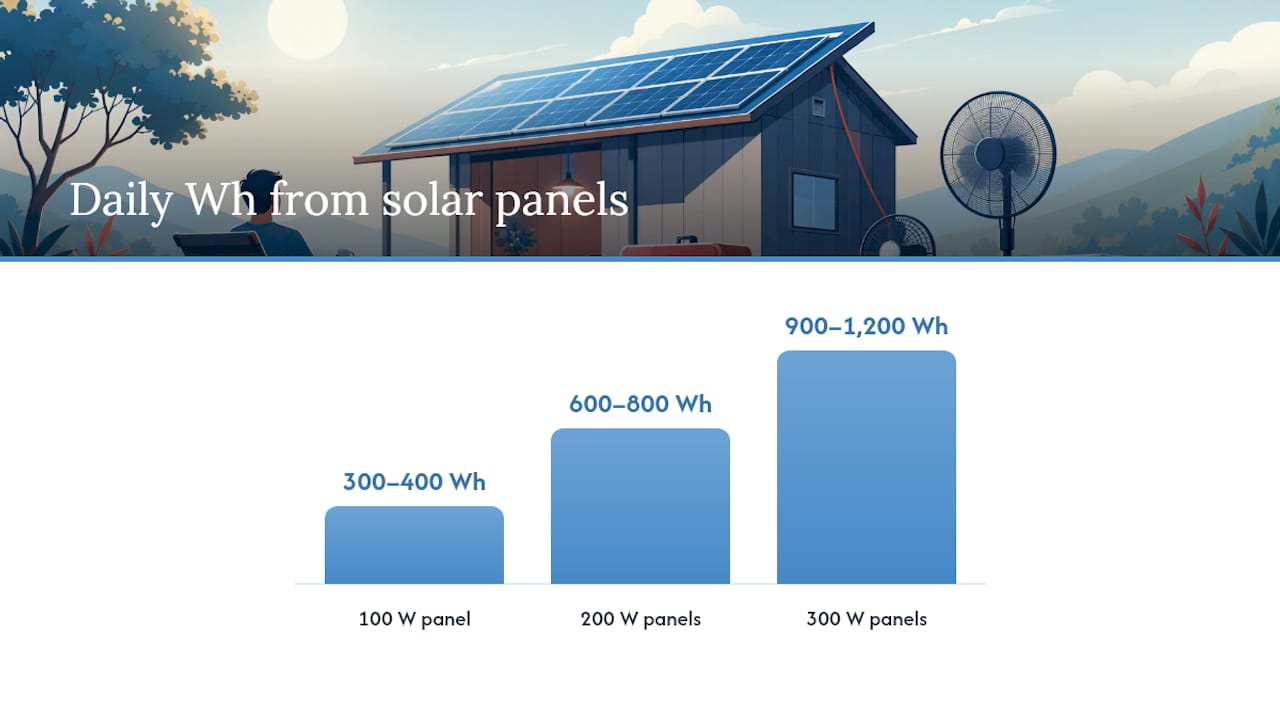
Solar panels are the default for small DC systems because they scale down cleanly. A single 100W panel can support a fan or pump load; stacking two or three panels covers a small workshop or multi-fan greenhouse without a full redesign.
Wind turbines make sense only where consistent wind exists independent of sun, useful as a supplement in cloudy climates but rarely a primary source for a barn or greenhouse sitting in a wind shadow.
Generators work as backup for extended low-sun stretches, but running one daily to fill a battery gap usually signals the battery or solar array was undersized for the load. If you find yourself reaching for a generator more than a few times a month, revisit your panel wattage before you revisit your battery.
The rule that matters: size your charging source to fully replace your daily Wh draw within your available sun hours, then size the battery around autonomy days on top of that.
Why Do Round-Trip Losses Matter for Battery Sizing?
Some gets lost as heat during charging and discharging, and that loss has to be built into your capacity target or you’ll come up short even with correct math everywhere else.
That gap alone is another reason lithium chemistry tends to win for small DC systems: less of your solar harvest disappears as heat before it ever reaches your fan or pump.
Inverters add a second loss point, but only for AC loads. A DC-native fan wired straight to the battery skips this entirely, which is one more argument for keeping small loads DC-first instead of running everything through an inverter out of habit.
In practice, round-trip losses are already baked into the DoD and derating numbers used earlier in this guide, since usable DoD figures account for real-world efficiency, not theoretical capacity. Skipping this step is a common reason a “correctly sized” battery still seems to run out early.
What About AGM, Gel, and Other Battery Types?
LiFePO4 and flooded lead-acid aren’t the only options on the shelf, and a few other chemistries show up regularly in small off-grid setups.
AGM (absorbed glass mat) batteries are sealed lead-acid, maintenance-free, and tolerate vibration and mounting angle better than flooded cells, which makes them common in mobile or shed-mounted setups.
Gel batteries are another sealed lead-acid variant, built for slow, steady discharge rather than the current spikes a motor draws on startup. They’re a poor match for fans and pumps with inrush current, and most small DC setups are better served by AGM or LiFePO4 instead.
Lithium-ion variants outside LiFePO4, like NMC (nickel manganese cobalt) chemistries, show up in some portable power stations. They pack more energy into less weight but tolerate heat and overcharging worse than LiFePO4, and rarely include the same built-in BMS protection. For a stationary barn or greenhouse installation where weight doesn’t matter, LiFePO4 remains the more forgiving and longer-lived choice.
The sizing formula doesn’t change across chemistries. Only the usable DoD input does, so once you know a battery’s real DoD, you plug it into the same equation used throughout this guide.
What Maintenance Should You Expect Based on Battery Size?
A bigger battery isn’t automatically a lower-maintenance battery, and size choices shape the upkeep you’ll actually deal with for years.
Flooded lead-acid demands regular watering, terminal cleaning, and equalization charges to prevent stratification, and undersizing one to save money often means deeper, more frequent discharge cycles that accelerate degradation. AGM and gel cut the watering requirement but still degrade faster under regular deep discharge than LiFePO4.
LiFePO4 needs essentially no routine maintenance beyond periodic terminal checks and occasionally verifying BMS function, and its flatter discharge curve means it tolerates the deeper, more frequent cycles typical of a fan or pump running daily. A bank sized with adequate autonomy headroom, rather than run right at its edge, also ages more gracefully across every chemistry, since shallower average discharge extends cycle life regardless of the battery type you chose.
How Does Inverter Capacity Affect Battery Sizing?
If every load in your system is DC-native, you can skip an inverter entirely, and that’s the simplest, most efficient path for small fans and pumps. The moment you add even one AC device, inverter capacity becomes part of the battery math.
Inverters need surge capacity well above their continuous rating to handle motor startup, so a 300W continuous inverter might need a 600 to 900W surge rating to start an AC pump motor without tripping. That surge draw comes straight from the battery, and undersized batteries can sag in voltage badly enough to trigger a low-voltage cutoff during the exact moment you need power most.
Size the inverter to comfortably cover your highest simultaneous AC load with headroom for surge, then confirm your battery bank’s discharge rating (measured in continuous amps or a C rating) can supply that peak without excessive voltage sag.
What the Data Actually Tells Us About Sizing Small Off-Grid Systems
Most sizing advice online is written for whole-house battery walls, and it shows. The guidance about 20 to 30 kWh banks, three-phase inverters, and generator interlocks simply doesn’t apply to a barn fan or a greenhouse pump, and forcing that framework onto a 3 kW system leads people to oversize batteries out of confusion rather than need.
The real lesson from the math in this guide is that chemistry choice moves the needle more than almost any other decision.
The advice that gets skipped most often is temperature derating. People size for a sunny July afternoon and wonder why their fan struggles in February. Build in the cold buffer from day one, size your voltage to match your actual load count rather than defaulting to 12V out of habit, and keep DC loads DC wherever you can. That’s a more honest starting point than any generic autonomy number.
— Chris
Match Your Battery Math to a Western Harmonics Kit
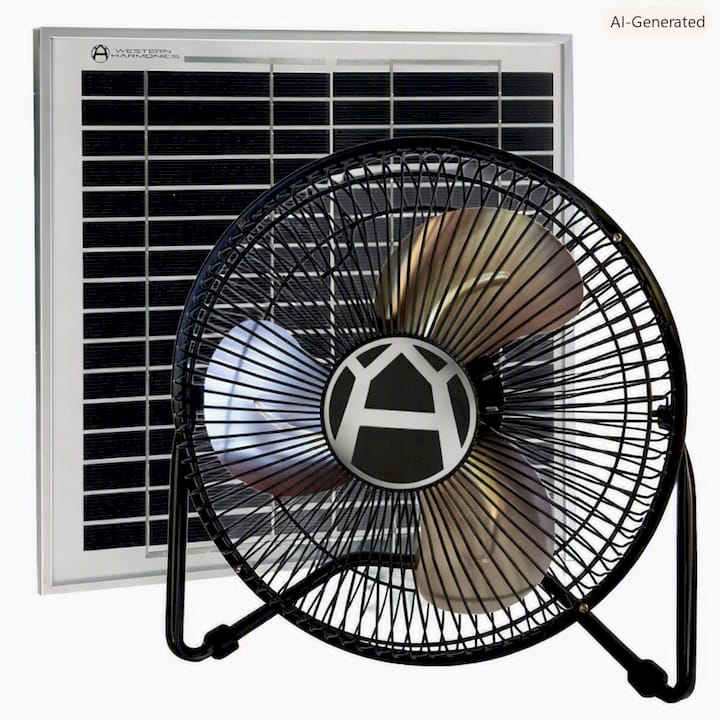
Once you’ve run the numbers, the fastest path forward is matching your Ah/Wh target to hardware built for exactly this job. The Westernharmonics 20 inch solar hanging fan with 100W solar panel ships with a wall plug-in adapter as backup power, delivers the same airflow as any high-velocity plug-in fan, and cuts your power bill by running on solar instead of grid electricity around the clock.

If your worked example landed near the 1,000 Wh / 48 Ah range from earlier in this guide, the 200W Solar Hanging Fan Kit with Battery Backup is sized to match that target directly, while smaller single-fan loads fit the 100W solar floor fan kit. Browse the full solar and battery systems catalog to compare configurations against your own calculated Wh number, or start from the complete Western Harmonics catalog if you’re still deciding between fan-only and battery-backed options.
Key Takeaways
Battery size for small off-grid DC systems comes down to daily Wh, chosen autonomy days, and usable DoD, with chemistry and temperature deciding how much margin to add.
| Point | Details |
|---|---|
| Core formula | Battery Wh = (daily Wh × autonomy days) ÷ usable DoD; convert to Ah by dividing by system voltage. |
| Autonomy target | Most small off-grid loads need 1 to 3 days of autonomy depending on how critical the load is. |
| Chemistry changes everything | LiFePO4’s 80 to 90% usable DoD needs roughly 40% less nominal capacity than lead-acid’s ~50% for the same job. |
| Derate for cold and aging | Add 10 to 20% for cold climates and another 10 to 20% for long-term aging headroom. |
| Match hardware to your math | Western Harmonics fan kits and the PowerMosaics.com design tool align directly with the Ah/Wh targets this method produces. |
Sources
- How to Size an Off-Grid Solar System — The Complete 6-Step Method (2026)
- Solar Battery Bank Size Calculator — VoltCalcs (2026)
- How to Size Off-Grid Solar Batteries (Never Run Out) – OffGridFoundry (2026)
- How cold weather affects LiFePO4 batteries — Neexgent
- Off-Grid Solar Sizing Calculator: Step-by-Step (2026) | SurgePV