

Series vs Parallel Solar Panels: 2026 Wiring Guide
Series vs Parallel Solar Panels: 2026 Wiring Guide
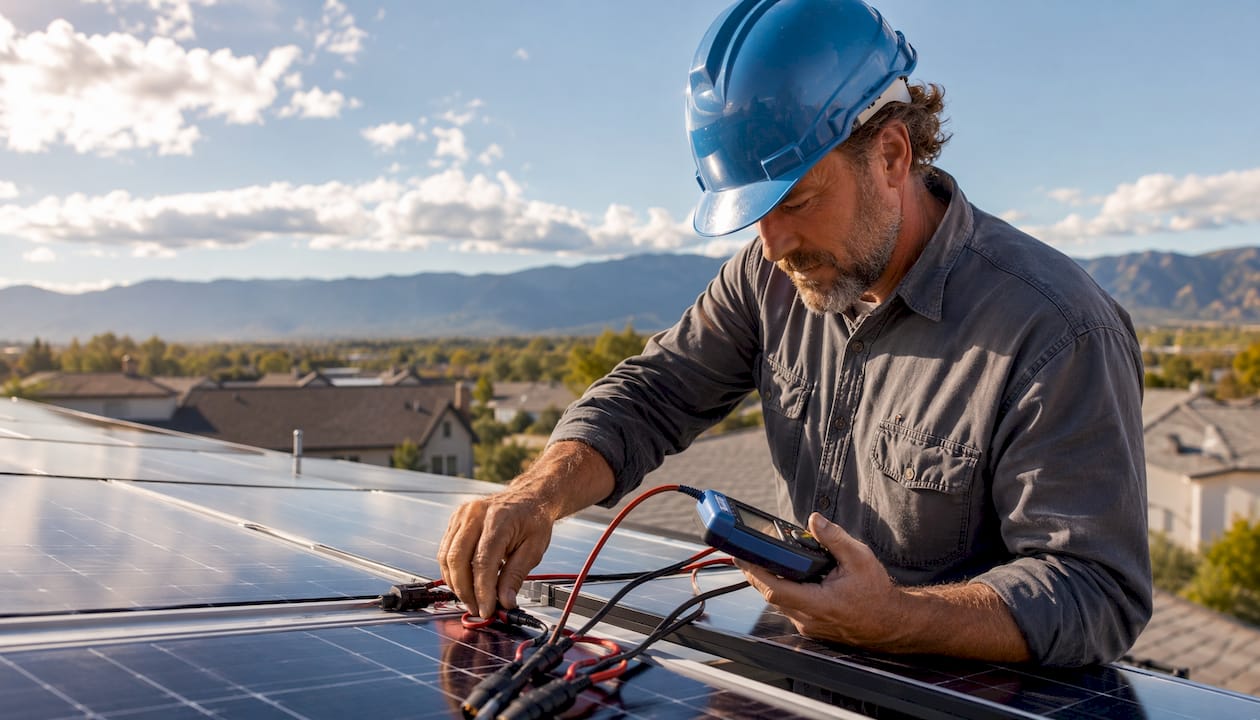
What’s the real difference between series and parallel solar panel wiring?
Series wiring adds voltage while keeping current constant. Parallel wiring adds current while keeping voltage constant. That single distinction drives every decision about wire sizing, charge controller selection, shading tolerance, and long-term system cost.
Four solar panels wired in series produce a voltage that is the sum of each panel’s voltage while keeping current constant. The same panels wired in parallel produce a current that is the sum of each panel’s current while keeping voltage constant. Total power is identical either way. What changes is how that power travels through your wiring and how well your charge controller handles it.
For most off-grid and rural installations, series wiring is often the preferred choice. Higher voltage means lower current, which allows thinner wire, reduces resistive loss, and lowers installation cost over longer wire runs. The exception is real: if your panels face consistent partial shading, or you’re locked into a PWM charge controller, parallel wiring deserves a serious look.
- Series: positive terminal of one panel connects to the negative of the next; voltage adds, current stays the same
- Parallel: all positives connect together, all negatives connect together; current adds, voltage stays the same
- Series advantage: lower current allows smaller wire gauges and reduces power loss on long runs
- Parallel advantage: shading on one panel affects only that panel, not the entire array
- Modern best practice: series wiring paired with an MPPT charge controller for most off-grid systems
How series wiring actually works in a solar system
Series connections run positive to negative through each panel in a chain. The voltages stack with every panel added; the current stays fixed at whatever a single panel produces. Three 30V panels in series deliver 90V at the same amperage as one panel alone.
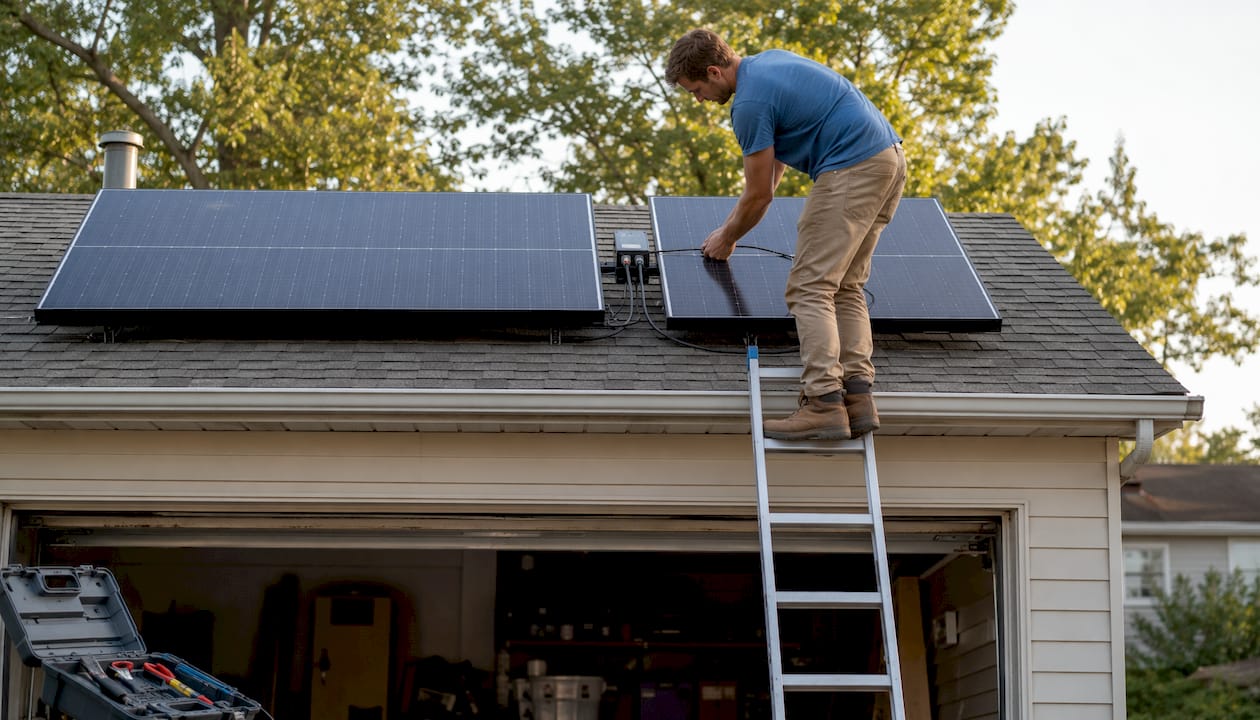
This behavior has a direct effect on your charge controller and inverter. Modern MPPT controllers are designed to accept high-voltage DC input and convert it efficiently to the battery voltage you need. Series strings give MPPT controllers the voltage headroom to find the optimal power point, especially on hot days when panel voltage naturally drops. String inverters used in grid-tied systems typically require MPPT windows starting at 150–200V, which means you need series strings just to reach minimum operating voltage.
Wire sizing is where series wiring pays off most visibly. A 400W parallel setup at 12V draws roughly 22A and requires 6 AWG wire over a 20-foot run. The same 400W in series at 48V draws about 5.5A and needs only 14 AWG wire. That’s a meaningful difference in copper cost and installation labor, especially across a barn or greenhouse where runs can stretch 50 feet or more.
- Voltage addition: each panel’s voltage adds to the string total
- Current stays constant at the level of the weakest panel in the string
- Lower current reduces heat at every connector and terminal
- MPPT controllers work more efficiently with higher voltage input
- Thinner wire gauges lower material cost on runs over 10 feet
Series vs parallel solar panels: pros, cons, and key comparisons
Both configurations produce the same total wattage. The difference is in how that power behaves across your system.
| Factor | Series wiring | Parallel wiring |
|---|---|---|
| Voltage behavior | Adds with each panel | Stays constant (one panel level) |
| Current behavior | Stays constant (one panel level) | Adds with each panel |
| Shading impact | One shaded panel limits entire string | Shaded panel affects only itself |
| Wire gauge required | Thinner, lower cost | Thicker, higher cost |
| Charge controller fit | MPPT preferred | PWM compatible; MPPT also works |
| System complexity | Fewer connections, simpler layout | More wiring, combiner boxes needed |
| Best application | Long runs, MPPT systems, unshaded arrays | PWM systems, shaded sites, mixed panels |
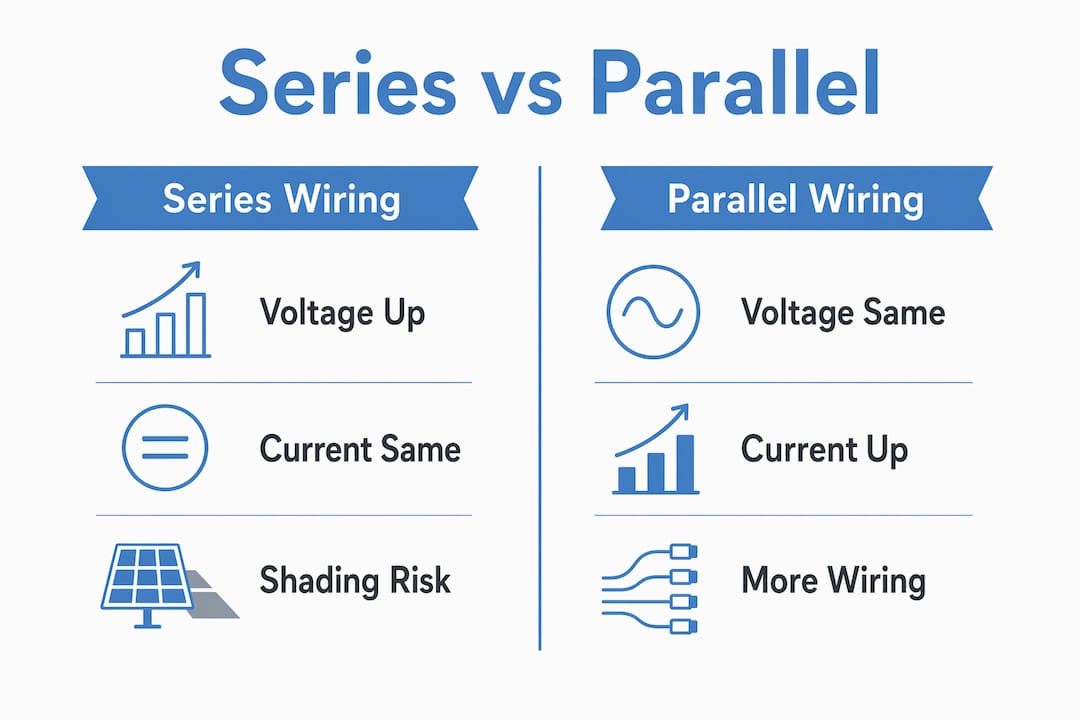
Shading is the biggest practical risk with series wiring. Bypass diodes in modern panels reduce but do not eliminate the problem. Under partial shading, a series string can lose 30–50% of its output because the current through the entire string is limited by the weakest panel. Parallel wiring localizes that loss. If one panel in a four-panel parallel array is half-shaded, the other three keep producing at full power.
Cost and complexity cut the other way. Parallel setups require more wire, heavier connectors, and often a combiner box to manage the higher current safely. Series wiring uses fewer connections, which also means fewer points of potential failure over years of outdoor exposure.
How to choose the right wiring configuration for your installation
The right choice comes down to four factors: your charge controller type, shading conditions, wire run length, and whether your panels are identical.
- Use series wiring when you have an MPPT charge controller, your panels get consistent unobstructed sun, and your wire runs exceed 10 feet
- Use parallel wiring when you’re using a PWM controller, panels face different directions, or shading is a persistent daily issue
- Use series-parallel when your array has four or more panels and you need to balance voltage for your inverter’s MPPT window while scaling up power capacity
- Always use identical panels in a series string; mismatched current ratings force the entire string to operate at the lowest panel’s output
- Check cold-weather voltage before finalizing string count; panel voltage rises in cold temperatures and can exceed your inverter’s maximum input rating
Pro Tip: Before finalizing your string design, pull up your inverter’s MPPT voltage window from the spec sheet and calculate your string’s cold-weather open-circuit voltage (Voc). Multiply each panel’s Voc by the temperature correction factor for your coldest expected day. If that number exceeds the inverter’s maximum input, drop one panel from the string.
PWM controllers are a real constraint. A series string producing 148V feeding a 12V battery through a PWM controller wastes most of that voltage as heat. If you’re running PWM, parallel wiring keeps voltage at one-panel level and lets the controller work within its design limits. That said, MPPT controllers have become affordable enough that upgrading often makes more financial sense than designing your whole array around PWM limitations.
For very short cable runs under 10 feet, the wire savings from series wiring are minimal. In compact installations where panels sit right next to the charge controller, parallel wiring’s simplicity can be a practical advantage.
How to identify whether your panels are wired in series or parallel
You can determine your existing wiring configuration through visual inspection and a basic voltage measurement, without disconnecting anything.
- Locate the wiring between panels. Trace the cables from panel to panel before they reach the charge controller or combiner box.
- Check the connection pattern. If the positive terminal of one panel connects to the negative terminal of the next, the panels are in series. If all positive terminals connect to a shared positive wire and all negatives to a shared negative wire, they are in parallel.
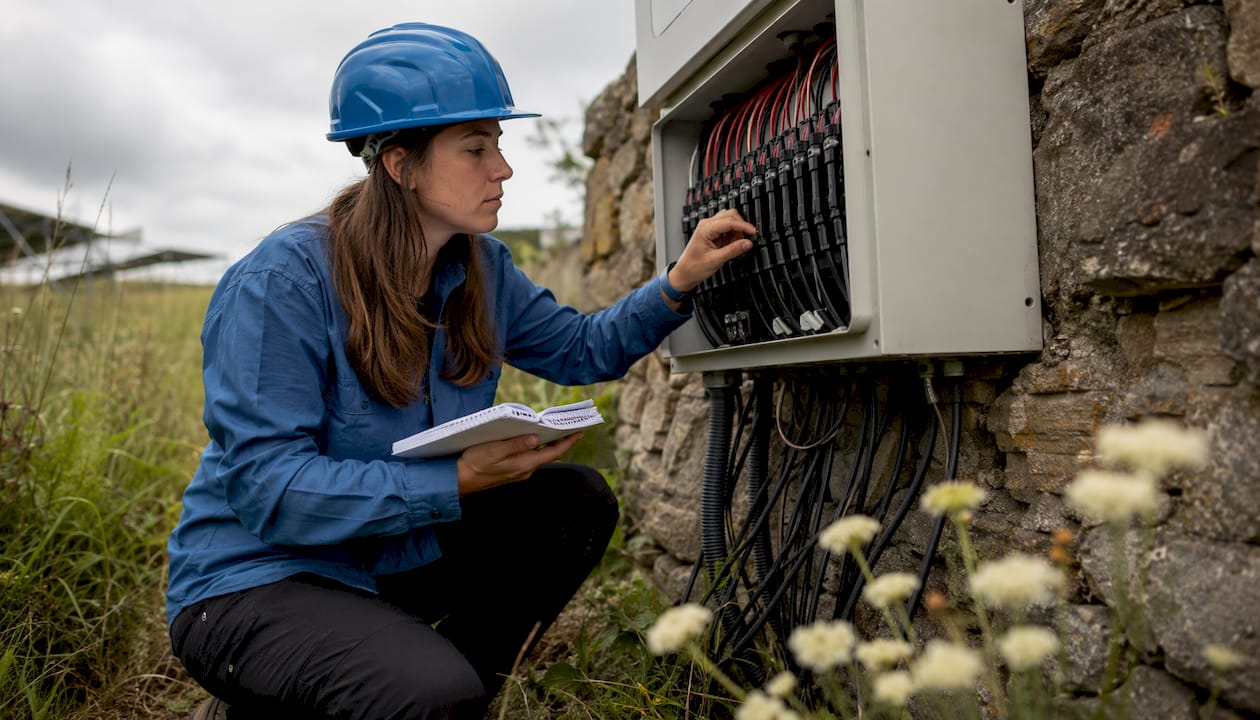
- Look for a combiner box. A combiner box with multiple input pairs feeding a single output pair is a strong indicator of parallel wiring or a series-parallel hybrid.
- Measure open-circuit voltage at the array output. Disconnect the array from the charge controller first. If the measured voltage is roughly equal to one panel’s Voc, the panels are in parallel. If it’s a multiple of one panel’s Voc, they’re in series.
- Measure short-circuit current (Isc) with a clamp meter. High current at low voltage confirms parallel wiring. Low current at high voltage confirms series.
Safety note: Always wear insulated gloves and use a meter rated for DC voltage before touching any terminals. Solar panels generate power whenever light hits them. There is no “off switch” on a panel in sunlight.
Visual inspection of wiring paths and combiner box identification are the fastest methods for most residential and barn installations. If the wiring is enclosed in conduit, voltage measurement at the array output is your most reliable approach.
Why Westernharmonics builds around these wiring principles
At Westernharmonics, we’ve been engineering solar-powered systems for off-grid American environments since before most of the copycat products in this market existed. We pioneered the solar-powered fan kit category in the United States, and every product we build reflects the same wiring fundamentals covered in this guide.
Our solar ventilation systems, DC micro-power units, and off-grid cooling hardware for barns, greenhouses, and workshops are designed around series wiring with MPPT-compatible DC circuits. That means lower current through every connector, less heat buildup in dusty and humid environments, and longer service life where grid power isn’t an option.
- Solar fan kits engineered for reliable DC operation in barns, stables, and rural outbuildings
- DC micro-power units sized for off-grid loads where wire run length and current matter
- Automated microgrid design tools that help you plan the right wiring configuration before you buy a single panel
- Expanding product line including the PowerJam, built on the same engineering-first approach
We know that a barn in July with no airflow is a real problem, not a theoretical one. Getting the wiring right from the start is what separates a system that runs for ten years from one that needs troubleshooting every season. Explore our solar systems to see how we apply these principles in hardware built for real working environments.

Key Takeaways
Series wiring outperforms parallel for most solar installations by raising voltage, cutting current, and reducing wire costs, but parallel wiring remains the right choice when shading is persistent or a PWM controller is in use.
| Point | Details |
|---|---|
| Series raises voltage | Four solar panels wired in series produce a voltage that sums each panel’s voltage while current stays constant; wired in parallel, current sums while voltage stays constant. |
| Wire savings are real | Higher voltage series configurations allow the use of thinner wire gauges compared to lower voltage parallel setups, which require thicker wiring due to higher current. |
| Shading hits series hard | Partial shading on one panel in a series string reduces the output of the entire string significantly, while parallel wiring localizes performance loss to the shaded panel. |
| Controller type drives the choice | MPPT controllers favor series wiring; PWM controllers require parallel to stay within voltage limits. |
| Series-parallel scales large arrays | Multiple series strings wired in parallel balance voltage and current for four-panel-plus systems. |