

Size and Install Solar Pump House Cooling Using a 7 Step CFM Method
Size and Install Solar Pump House Cooling Using a 7 Step CFM Method
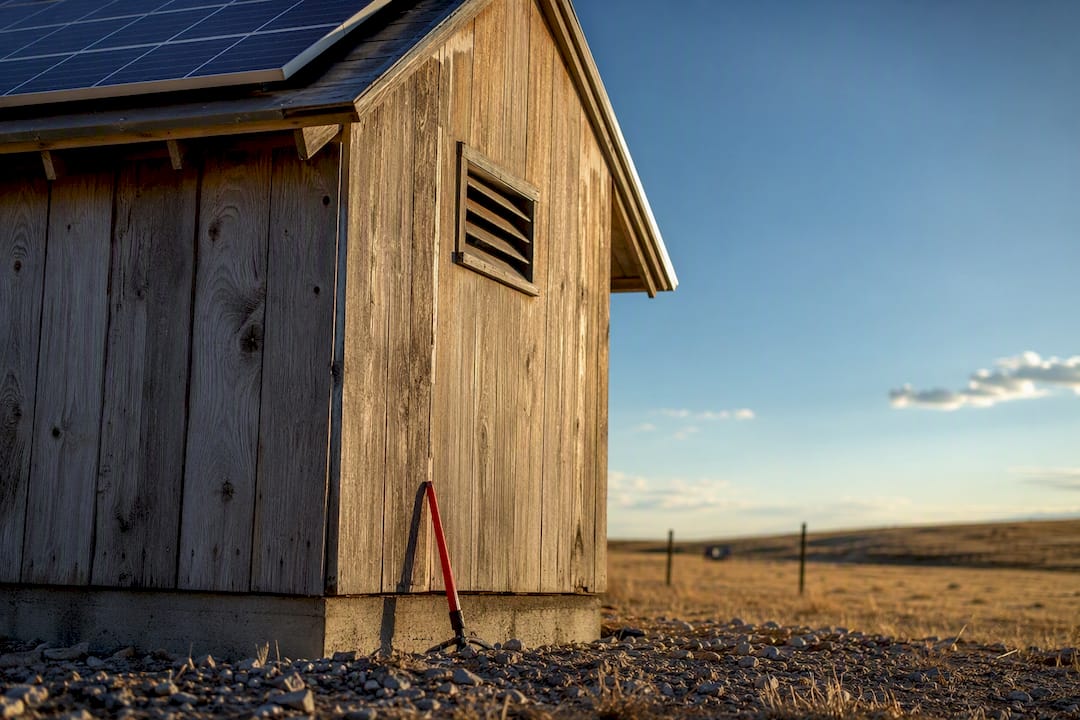
For most remote pump houses, a direct-coupled DC solar fan kit is the simplest, lowest-cost way to cut heat during the day. Add a battery only when you need overnight or continuous airflow, or step up to evaporative cooling where humidity stays low. Western Harmonics has built its entire product line around this exact logic, and it holds up for barns, greenhouses, and workshops too.
TL;DR:
- A 10W to 50W PV panel is sufficient for daytime-only pump house ventilation, but larger systems should include batteries for continuous airflow.
- Proper placement of exhaust and intake fans is critical, with high exhaust vents and low intakes to maximize airflow efficiency.
- Using thermostats with hysteresis and automation reduces battery use, extends fan lifespan, and maintains consistent cooling in remote pump houses.
- Dust, high temperatures, and cold climates impact system performance and longevity, requiring specific component choices and regular maintenance.
- Off-grid solar ventilation offers reliable cooling without grid dependence, with simple sizing based on building volume and desired air exchange rate.
Table of Contents
- What to Include in an Off-Grid Pump House Cooling System
- How Do You Calculate CFM and Panel Size for a Pump House?
- Field-Tested Installation Tips for Pump House Fans and Panels
- Using Thermostats and Automation for Reliable Pump House Cooling
- What Results and Costs Should You Expect?
- Real-World Proof: How Western Harmonics Solves Pump House Cooling
- Noise Levels and How to Quiet a Pump House Fan
- Safety and Code Compliance for Pump House Electrical Systems
- Environmental Factors Beyond Humidity That Shape System Design
- Maintenance and Troubleshooting for Pump House Cooling Systems
- Why Off-Grid Cooling Beats Grid-Tied Assumptions
- Matching Your Pump House to the Right Western Harmonics Kit
- Sources
What to Include in an Off-Grid Pump House Cooling System
A working system for pump house cooling comes down to five parts, and each one has a job that doesn’t overlap with the others. Skip a part or undersize it, and the whole system underperforms no matter how good the fan is.
- PV panels: Small arrays in the 10W to 50W range handle single-fan daytime setups; anything larger than that usually points toward a battery-backed design.
- DC fans: Brushless axial exhaust fans dominate this category because they draw less current, run quieter, and last longer than brushed motors under continuous cycling.
- Charge controllers: PWM controllers work fine for small arrays under 100W; MPPT earns its higher price once you’re pushing 150W or more, since it recovers more usable power from partial-shade or cooler mornings.
- Batteries: Lead-acid is cheaper up front but shorter-lived; LiFePO4 costs more initially but tolerates deeper discharge cycles and handles heat better, which matters inside a metal-roofed structure.
- Evaporative components: Cooling pads, a small circulation pump, and a water reservoir turn a basic ventilation kit into an evaporative system, but only where humidity supports it.
These component roles echo what shows up repeatedly in engineering studies on solar poultry ventilation, where the same five-part architecture (panel, controller, battery, fan, wiring) recurs across nearly every small-scale design. If you’re trying to decide between a fan-only setup and a battery-backed one, the AC vs DC fan comparison breaks down the tradeoffs in more depth.
How Do You Calculate CFM and Panel Size for a Pump House?
Sizing a pump house cooling system isn’t guesswork if you follow a consistent process. Here’s the sequence that works whether you’re cooling a 150 square foot shed or a 400 square foot pump house.
- Find your building volume. Multiply floor area by ceiling height.
- Pick a target air exchange rate. Most small utility buildings need 4 to 8 air changes per hour depending on heat load and equipment inside.
- Convert to CFM. Multiply volume by air changes per hour, then divide by 60.
- Match CFM to fan wattage. Small fans (30 to 50 watts) typically move 300 to 800 CFM depending on blade design and static pressure.
- Calculate daily watt-hours. Multiply fan wattage by expected daily runtime hours.
- Size the panel with a buffer. Divide daily watt-hours by average sun hours for your region, then add 20 to 25 percent to cover cloudy days and panel degradation.
- Size the battery if needed. Multiply watt-hours required by days of autonomy, then divide by usable depth of discharge (50% for lead-acid, 80% for LiFePO4).
Quick Reference: A single 50W panel comfortably runs a 30 to 50 watt fan for daytime-only cooling, while commercial exhaust fans in the 150 to 200 watt range generally require battery support to stay reliable through variable sun conditions.
Worked example: A 300 square foot pump house with a 9-foot ceiling holds 2,700 cubic feet. At 6 air changes per hour, that’s 16,200 cubic feet per hour, or 270 CFM.
Field-Tested Installation Tips for Pump House Fans and Panels
Placement decides half the outcome before you even power anything on. Heat rises, so the exhaust fan belongs high on a gable wall or roof vent where hot air pools. The intake should sit low and on the opposite wall, pulling cooler air across the equipment rather than short-circuiting the airflow path near the ceiling.
Panel mounting depends on your roof pitch and orientation. Ground mounts work well when the roof faces the wrong direction or when snow load is a concern; roof mounts save space but need proper flashing to avoid leaks. Angle the panel close to your latitude for balanced year-round output, tilting slightly steeper if winter ventilation matters more than summer.
- Fuse the panel-to-controller and controller-to-battery runs separately.
- Mount the charge controller indoors, away from direct sun and moisture.
- Run wiring through conduit and seal every wall penetration against rodents and rain.
- Inspect connections twice a year, more often in dusty or coastal environments.
Pro Tip: Seal wire penetrations with expanding foam or silicone before mounting the cover plate. Mice chew through unsealed gaps faster than most owners expect, and a chewed wire in a remote pump house can mean a dead battery you won’t discover for weeks.
Using Thermostats and Automation for Reliable Pump House Cooling
A fan that runs constantly wastes battery capacity and wears out faster than one that cycles on demand. Thermostat control with a defined setpoint and a few degrees of hysteresis solves that: the fan kicks on at, say, 85°F and shuts off once the space drops back to 80°F, rather than chattering on and off at a single threshold.
Automation does more than save wear. It’s essential for pump houses nobody visits daily.
- A low-battery cutoff protects the battery from deep discharge during extended cloudy stretches.
- Charge controllers with load-disconnect features coordinate directly with the thermostat to prevent conflicting draws.
- Remote monitoring or a simple alarm output alerts you if the fan stops cycling or the battery voltage drops below a safe threshold.
- Controlled runtime lowers your sizing needs, since the fan isn’t drawing power around the clock.
That last point matters for anyone comparing kits: a well-automated 40-watt fan running six hours a day needs a smaller panel than the same fan running continuously, which is where good controls pay for themselves in reduced hardware cost. If you’re weighing whether your setup needs a battery at all, the battery-backed solar fan guide walks through that decision in more detail.
What Results and Costs Should You Expect?
Solar ventilation systems don’t work miracles, but the research backs real, measurable gains. One implementation of a solar-powered air control system in closed-house farming reported energy savings up to 10% while holding environmental parameters steady and cutting grid dependence. That’s a modest number, and it should set your expectations accordingly: solar ventilation cuts costs, it doesn’t eliminate them entirely unless you’re already off-grid.
Temperature drop depends heavily on insulation, ambient humidity, and fan CFM relative to building volume. A well-insulated, well-sized system in a dry climate will outperform an underinsulated one in the same location running a bigger fan.
On economics, a technical-economic analysis of PV ventilation for livestock housing found a positive net present value and payback periods running several years when sized correctly. Direct PV kits without batteries stay cheapest and simplest; batteries or evaporative add-ons make sense once continuous ventilation or humidity-driven cooling becomes a real requirement, not a nice-to-have.
Real-World Proof: How Western Harmonics Solves Pump House Cooling
An Arizona horse-owner installed a Western Harmonics direct-coupled fan kit on a small pump house feeding her barn’s water system. No trenching for grid power, no monthly utility bill, just a panel and fan that kept the pump motor from overheating through the summer.
The building ran cooler through peak heat, and the only ongoing cost was the one-time hardware purchase. Zero monthly electric bill for a structure that used to need a grid tie-in just to run a fan.
That kind of outcome isn’t unusual for Western Harmonics customers, and it traces back to a few consistent engineering choices:
- Western Harmonics pioneered the U.S. solar fan kit category and has kept refining it since.
- The PowerJam line extends the same DC-first philosophy into broader off-grid power applications.
- The Minicooler 1000 brings evaporative cooling to the same rugged, no-grid-tie design standard.
DC-first design means fewer conversion losses and simpler wiring, which matters when the nearest service technician is an hour away. For a similar real install on a different building type, the greenhouse ventilation case study shows the same mounting and wiring approach applied at a larger scale.
Noise Levels and How to Quiet a Pump House Fan
DC brushless fans run quieter than most AC alternatives, typically in the 35 to 55 decibel range depending on blade size and RPM, comparable to a quiet conversation or a running refrigerator. That’s low enough that noise rarely bothers anyone in a standalone pump house, but it can matter if the structure sits close to a home or a barn where animals startle easily.
A few adjustments cut noise further without sacrificing airflow. Larger, slower-turning fans move the same CFM as small, fast ones while generating less noise, since sound output rises sharply with blade tip speed. Rubber isolation mounts between the fan housing and the wall or roof panel stop vibration from transferring into the structure itself, which is often the source of a rattling or buzzing complaint rather than the fan motor itself.
Loose mounting hardware is the most common noise culprit reported in the field, not the fan or motor. A fan that developed a new rattle after months of quiet operation almost always points to a bolt that worked itself loose, not a failing motor. Check mounting screws during routine inspections, and add lock washers if vibration is a recurring issue in your climate. Dust buildup on blades can also throw them slightly out of balance over time, adding a whine that a simple cleaning resolves.
Safety and Code Compliance for Pump House Electrical Systems
Electrical work on a pump house cooling system, even a small DC setup, still needs to follow basic code practices. Fusing between the panel and charge controller, and again between the controller and battery, protects against short circuits and reverse current. Skipping fuses to save a few dollars is the single most common corner-cutting mistake in DIY off-grid installs.
Grounding matters even in low-voltage DC systems, particularly for metal-roofed structures where a panel frame or mounting rail could become energized during a fault. Bond the panel frame and mounting hardware to a grounding rod per standard electrical practice, and don’t assume a 12-volt system is too small to bother.
Structural considerations apply to panel mounts and fan housings alike. Wind load on a roof-mounted panel can exceed what a typical shed roof was designed to carry, especially in open rural areas without windbreaks. Ground mounts sidestep that risk entirely and are often the safer choice for older or lighter-framed structures. Local building codes may require permits for structural roof penetrations even on small utility buildings, so check before mounting anything that requires new roof holes. Battery enclosures should be ventilated, especially for lead-acid batteries that can off-gas hydrogen during charging, and kept clear of any spark-producing equipment.
Environmental Factors Beyond Humidity That Shape System Design
Humidity gets most of the attention in cooling discussions, but temperature extremes and dust often matter more for long-term reliability. In desert climates, PV panels and batteries both face performance tradeoffs from sustained high heat: panel output actually drops slightly as cell temperature rises, even though solar generation depends on daylight, not ambient warmth. That’s a useful property for cold, sunny climates where a system will keep producing even when the air outside is freezing.
Dust is the quieter threat. Fine agricultural or desert dust works into fan bearings and settles on panel surfaces, cutting output gradually enough that owners often don’t notice until performance has dropped 10 to 20%. Sealed or shielded bearing fans hold up better in dusty environments than open-frame designs, and a simple monthly panel wipe-down recovers most of the lost output in high-dust regions.
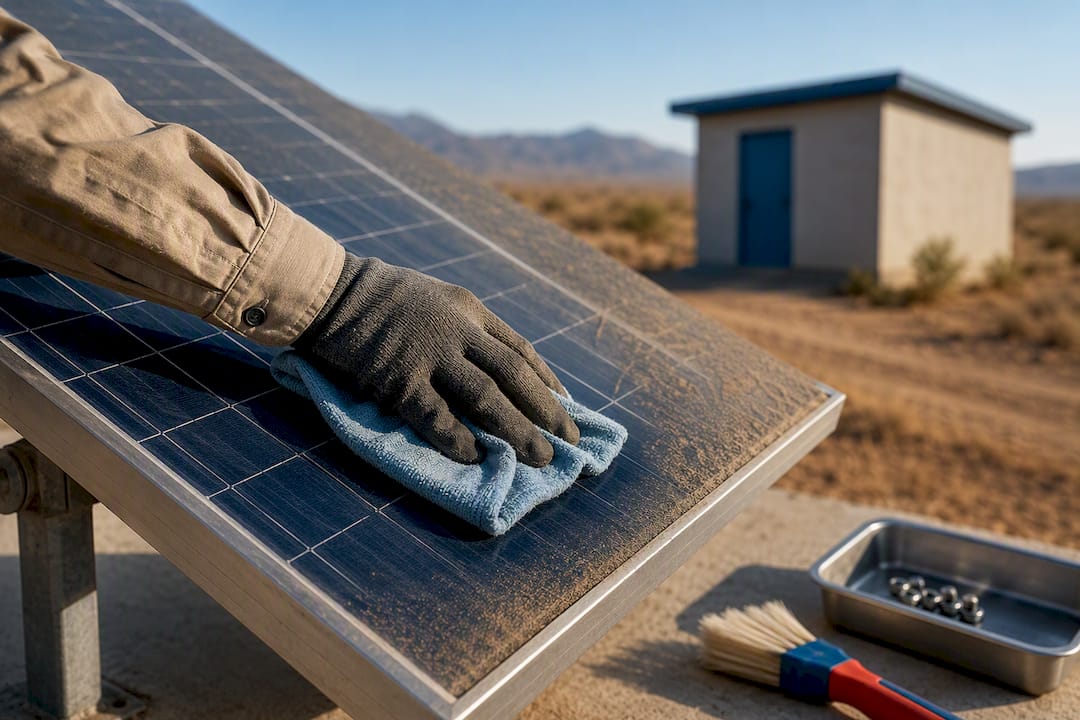
Cold-climate installations face a different problem: battery capacity drops sharply in freezing temperatures, particularly for lead-acid chemistries. LiFePO4 batteries handle cold better but still need protection from extreme swings, ideally housed inside an insulated enclosure rather than left exposed on an exterior wall. None of these factors are dealbreakers, but they change which components make sense for your specific site.
Maintenance and Troubleshooting for Pump House Cooling Systems
A basic maintenance routine catches most problems before they become failures. Check panel surfaces for dust, bird droppings, or leaf debris every month during high-use season, and clean with plain water rather than harsh chemicals that can degrade the anti-reflective coating. Inspect fan blades for dust buildup and wiring connections for corrosion twice a year.
The most common troubleshooting scenarios owners run into:
- Fan not running despite sunlight: Check the charge controller display for fault codes, then verify the fuse hasn’t blown.
- Reduced airflow over time: Usually dust on the blades or a partially blocked intake screen, not a motor problem.
- Battery not holding charge: Test the charge controller’s absorption and float voltages against the battery manufacturer’s spec, since a mismatched controller setting shortens battery life significantly.
- Fan cycling erratically: Often a loose thermostat sensor wire or a setpoint that’s too close to ambient temperature, causing constant on/off switching.
Keep a simple log of panel output and battery voltage readings if you can, even just a phone photo of the controller display once a month. That record makes it far easier to spot gradual decline before it becomes a full failure during the hottest week of summer.
Why Off-Grid Cooling Beats Grid-Tied Assumptions
The conventional wisdom on pump house cooling treats it as a grid-power afterthought, something you wire in when you run electric to the pump anyway. That assumption costs owners money and reliability. A pump house often sits at the edge of a property specifically because that’s where the well or water source is, which is exactly where grid extension is most expensive and least reliable.
What the research actually supports is narrower and more useful than most guides admit: direct-coupled solar ventilation handles the vast majority of daytime cooling needs without batteries, complexity, or ongoing cost. The 10% energy savings figure from broiler-house studies sounds modest, but that’s measured against systems that already had grid infrastructure. Off-grid, the comparison isn’t 10% savings, it’s the entire cost of trenching power to a remote structure.
Where I’d push back on the more casual advice column: sizing matters more than shopping. Buying the biggest fan you can afford, then discovering your panel can’t keep it charged through cloudy stretches, is the single most common mistake I see discussed in owner forums. Do the CFM math first. The kit selection is the easy part.
— Chris
Matching Your Pump House to the Right Western Harmonics Kit
If you’ve worked through the sizing math above, you already know roughly what you need. A small daytime-only pump house with a 30 to 50 watt fan load fits the Kit# 1505-HG 10W Solar Powered Fan Kit or its higher-airflow sibling, both direct-coupled and simple to install without an electrician.

Structures that need overnight or continuous airflow, like pump houses feeding livestock watering systems around the clock, call for the 200W Solar Hanging Fan Kit with Battery Backup. And where humidity stays moderate to low, the Minicooler 1000 solar evaporative cooler drops temperatures further than airflow alone can manage.
Not sure which category fits your building? Browse the full Western Harmonics catalog to compare specs side by side, or work through a custom plan with the automated microgrid design tool before you buy anything. Owners weighing a professionally installed battery system alongside a DIY kit can also get local install guidance from partners like San Diego Solar’s off-grid systems team.
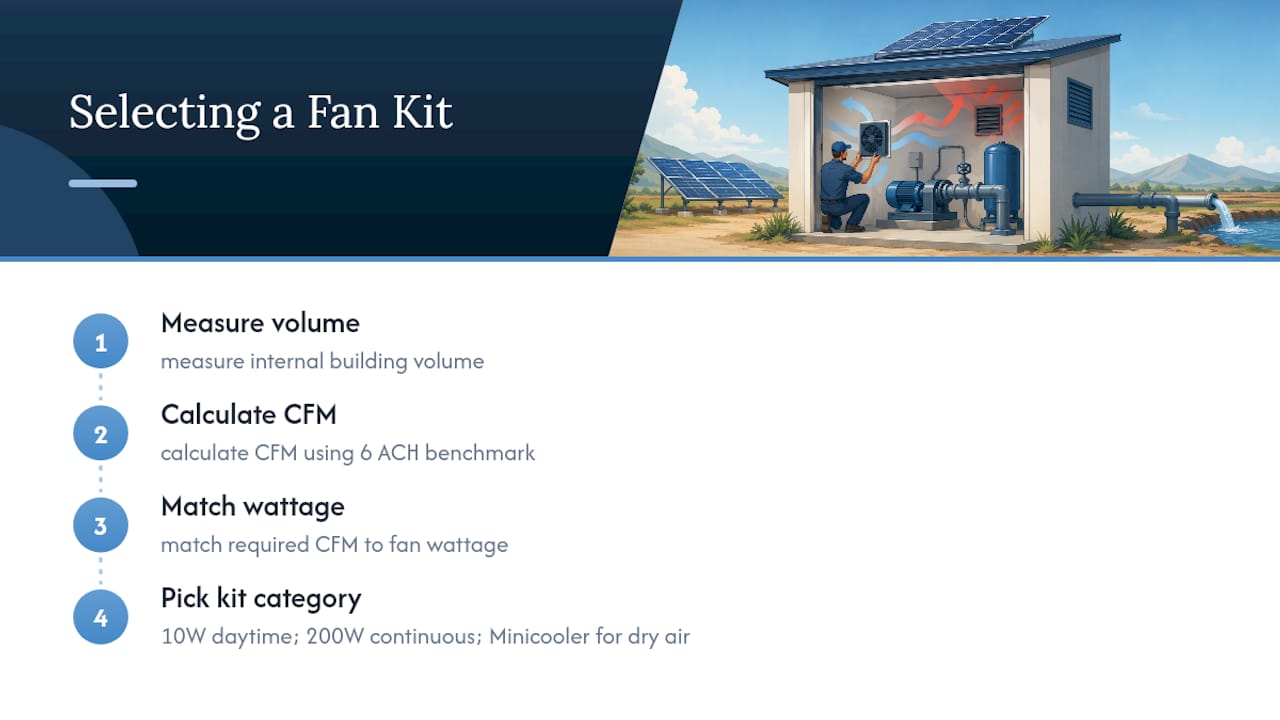
Before ordering, run this checklist once: measure your building’s volume, calculate CFM using the six air-changes-per-hour benchmark, match that CFM to a fan wattage, then pick the kit category that fits your runtime needs. From there, installation is a weekend project for most owners, or a quick job for a local electrician if you’d rather hand it off.
Sources
- Implementation of a Solar-Powered Air Control System in Broiler Chicken Closed House Farming
- Application of a Solar Photovoltaic System for Ventilation of a Livestock Farm in Southern Perú
- Design and Development of Solar Power Poultry Shed Ventilation System