

Growers, Stop Dead Zones: HAF Fan Placement With 10–15 ft Endwall
Growers, Stop Dead Zones: HAF Fan Placement With 10–15 ft Endwall

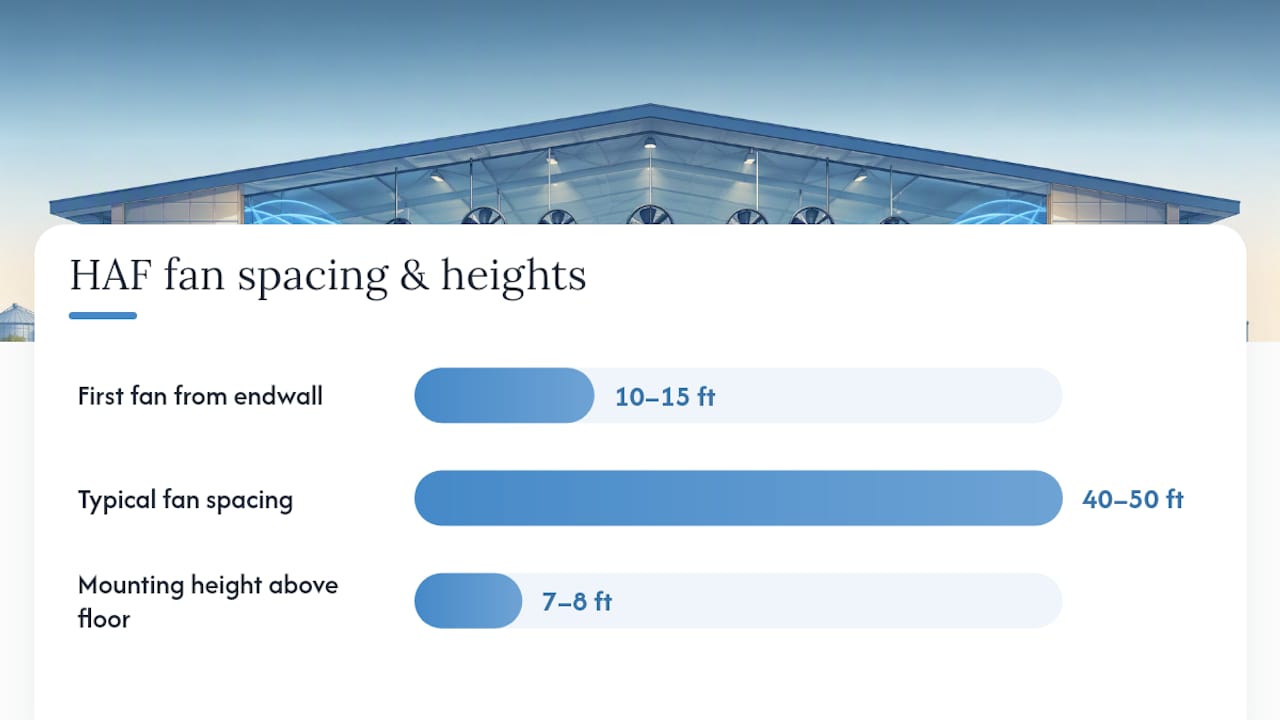
Set your first circulation fan 10 to 15 feet from the endwall, space the rest 40 to 50 feet apart, mount them 7 to 8 feet above the crop, and size total capacity at roughly 2 cfm per square foot of floor area to hit a 50 to 100 feet-per-minute canopy velocity. Run exhaust high on one endwall with intake low and opposite. Test with smoke or ribbons before you call the job finished.
TL;DR:
- Correct fan placement involves spacing fans 40 to 50 feet apart and mounting them 7 to 8 feet above the crop to ensure uniform airflow.
- An effective horizontal air flow system keeps temperature differences within 2°F, preventing hot spots and uneven crop development.
- Proper air circulation relies on combining inside-moving fans and exhausts, with intake on the opposite side, to improve climate control and reduce disease risk.
- Adjust fan height and positioning as crops mature or when managing energy curtains to maintain airflow efficiency and avoid leaf drying or dead zones.
- Off-grid solar or DC fans follow the same placement rules, but wiring and restraint are critical to ensure long-term, reliable circulation, especially during power outages.
Table of Contents
- Why Greenhouse Fan Placement Matters More Than Fan Power
- How Do You Calculate HAF Fan Spacing and Height?
- Should You Push or Pull Air Through the House?
- How Does Greenhouse Shape Change Fan Placement?
- What Placement Mistakes Kill Airflow Performance?
- How Do You Test and Verify Fan Placement?
- Adjusting Fan Placement for Season and Crop Load
- Should You Add a Fan or Just Move One?
- Off-Grid Fan Placement: What Solar and DC Systems Change
- An Editor’s Take on Where Growers Waste Money
- A Practical Next Step for Off-Grid Fan Placement
- Sources
Why Greenhouse Fan Placement Matters More Than Fan Power
A grower can spend real money on a top-tier fan and still get uneven crops if that fan sits in the wrong spot. Placement decides whether the whole house shares one climate or splits into hot corners and cold pockets, and that split shows up in your yield before you ever check a thermometer.
The benchmark worth building toward: a correctly installed horizontal air flow (HAF) system holds temperature differentials to about 2°F anywhere in the house, versus 10 to 15°F without it. That gap between 2 and 15 degrees is the difference between uniform bloom timing and a bench where one end finishes a week ahead of the other.
Circulation and exhaust do different jobs, and mixing them up is where a lot of layouts go wrong:
- HAF fans mix air inside the house, moving heat and moisture around so no zone gets left behind.
- Exhaust and intake fans exchange air with the outside, pulling in fresh air and pushing out heat or humidity load.
- Both working together prevent the leaf-surface moisture that fuels fungal disease, since air moving across the canopy dries leaf surfaces faster than still air does.
Get the placement right and you are not just chasing comfort. You are managing disease pressure and energy cost at the same time.
How Do You Calculate HAF Fan Spacing and Height?
The HAF “racetrack” pattern is the backbone of greenhouse air circulation, and the numbers behind it are specific enough to apply directly to your house.
- Set the first fan 10 to 15 feet from the endwall. This keeps the air stream from bouncing off the wall before it develops a coherent loop.
- Space every fan after that 40 to 50 feet apart, or use the tighter technical rule of 25 to 30 times the fan’s diameter if you are running smaller units.
- Mount fans 7 to 8 feet above the floor or bench, above the mature canopy, so the discharge sweeps over the crop rather than blasting directly into foliage.
- Keep at least 4 to 5 fan diameters of clearance between the discharge side and any post, hanging basket, or curtain hardware.
- Restrain each fan with a chain or bracket kit rated for the mounting point, since drift in aim is one of the most common reasons a properly bought fan underperforms.
Statistic Callout: Design for 50 to 100 feet per minute of air movement at canopy height, using about 2 cubic feet per minute per square foot of floor area as your sizing baseline.
Here is the math worked out for a 30 by 100 foot house, a common single-span size. Floor area comes to 3,000 square feet. At 2 cfm per square foot, you need 6,000 cfm of total moving capacity.
Fan throw matters as much as fan count. A wider house needs fans with a longer effective throw, or you will short-circuit the racetrack before it reaches the far sidewall. HAF works by keeping a large air mass moving at modest speed, not by generating a stiff breeze, so oversized high-velocity fans usually waste energy without improving uniformity.
Should You Push or Pull Air Through the House?
Push (positive pressure) forces air in and lets it escape through vents or louvers. Pull (negative pressure) uses exhaust fans to draw air out, which pulls fresh air in through intake openings elsewhere. Most commercial and hobby greenhouses use negative pressure exhaust ventilation because it gives more control over where fresh air actually enters.
Placement rules follow logically from that choice:
- Mount exhaust fans high on an endwall, ideally on the leeward side, since that is where hot air naturally collects.
- Put intake openings low and on the opposite end, which forces incoming air to travel the full length of the house and pick up heat and moisture along the way.
- Choose AMCA-rated fans sized for the static pressure your setup demands, especially if you are running evaporative pads or insect screens, both of which add resistance the fan has to push against.
- Keep louvers and shutters upstream of the fan blade, not downstream, so they open freely under suction rather than fighting the airflow.
How Does Greenhouse Shape Change Fan Placement?
The racetrack pattern is a starting template, not a fixed blueprint. Your house’s shape decides how you bend it.
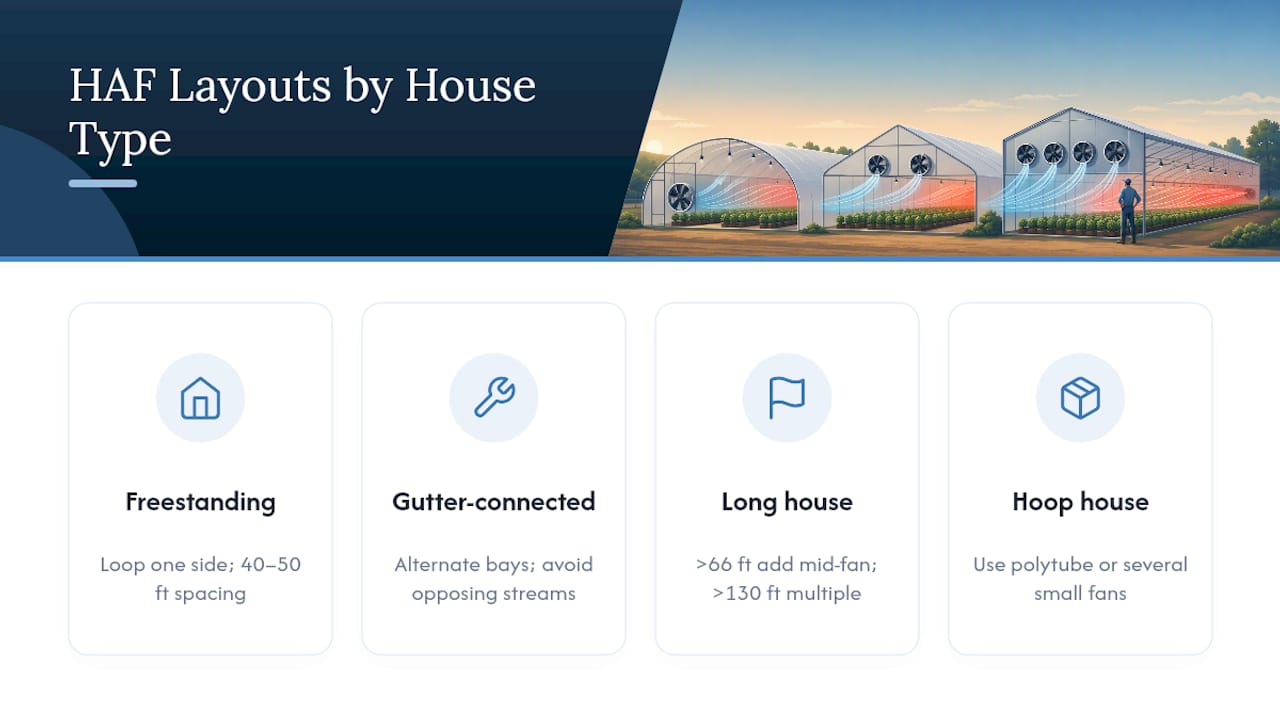
Freestanding houses are the simplest case: run the loop down one side of the structure and back up the other, staying inside the 40 to 50 foot spacing rule.
Gutter-connected houses need a modification. Rather than fighting two opposing air streams down adjacent bays, route air down one bay and back through the next bay over. This cuts the friction that builds when two circulation loops collide at a gutter line.
Long houses cross a threshold around 66 feet (20 meters). Past that length, add a mid-house fan or a second pair to keep the loop from losing momentum before it completes the circuit. Houses running past 130 feet often need multiple midpoints staged at regular intervals, not just one booster fan in the center.
Hoop houses present a different mounting challenge because there is often no flat wall section at the right height. Growers here frequently choose polytube distribution or several small point fans over one large unit, since a single big fan in a curved structure tends to create dead air in the corners.
What Placement Mistakes Kill Airflow Performance?
Most airflow complaints trace back to one of a small handful of setup errors, and nearly all of them are fixable without buying new equipment.
- Fans spaced too far apart cause short-circuiting, where the air stream breaks up before reaching the next fan. Tighten the spacing or add a fan at the midpoint.
- Mounted too high or too low sends air over the canopy or straight into it. Re-aim to sweep just above the crop line, not through it.
- Loose or drifted mounts let a correctly placed fan slowly rotate off its intended angle. A bracket or chain restraint fixes this permanently instead of temporarily.
- Obstructions in the discharge path (posts, hanging baskets, curtain motors) break up the air mass. Move the obstruction or relocate the fan by a few feet.
- Undersized fans paired with pads or screens run into static pressure they were not rated for, dropping actual output well below the fan’s rated cfm.
Pro Tip: Walk the house with a lit incense stick or a strip of tissue taped to a pole. If the smoke stalls or curls back on itself anywhere along the racetrack, that is your short-circuit point, and it is usually within 10 feet of the actual fix.
How Do You Test and Verify Fan Placement?
Confirming a layout works takes under an hour and needs nothing more advanced than a handheld anemometer and a notebook.
- Run a smoke or tissue test along the intended racetrack path to visualize whether the air loop actually completes or breaks down somewhere.
- Tape ribbons or tissue strips at canopy height every 20 to 30 feet to spot-check local movement without instruments.
- Take anemometer readings and compare them against the 50 to 100 fpm target; readings above 200 feet per minute at foliage level risk drying leaves too fast and stressing the crop.
- Map temperature at three or four points across the house floor plan and confirm the spread stays within about 2°F.
Statistic Callout: A 2°F spread across the whole house is a good pass mark. Anything wider points to a dead zone or a short-circuit that needs re-spacing, re-aiming, or an added fan.
Adjusting Fan Placement for Season and Crop Load
A layout that worked for seedlings in March can fail once the crop fills the bench in July. Dense or tall canopies block airflow that used to pass freely underneath, so growers often need to raise fan height or add a supplemental unit as plants mature.
Energy curtains add another layer. Circulation fans need to sit below the curtain, not above it, so nighttime mixing continues without punching a hole in the curtain’s heat retention.
- Run HAF fans continuously at low speed for humidity control during cool, humid stretches.
- Reserve exhaust fans for intermittent use during heat events rather than constant operation.
- Coordinate fan cycles with any combustion heater so intake fans never draw exhaust gases back into the growing space, a real risk in tightly sealed winter houses.
Read more on balancing these systems in this greenhouse humidity control guide.
Should You Add a Fan or Just Move One?
The decision usually comes down to whether the problem is coverage or aim. If dead zones stretch beyond what a single fan’s throw can reach, adding a fan solves it. If the issue is one localized dead spot near an obstruction or a drifted mount, moving or re-bracketing the existing fan is the cheaper fix.
- Multiple dead spots across the house point to a coverage gap. Add a mid-house fan.
- One recurring local problem points to aim or obstruction. Re-mount instead of buying new equipment.
- Two smaller fans sometimes outperform one large unit, particularly near energy curtain zones where a lower-power fan is easier to control at night without disturbing curtain seals.
Off-Grid Fan Placement: What Solar and DC Systems Change
Solar and DC circulation fans follow the identical HAF spacing and height math covered above. The physics of moving an air mass does not care what powers the motor. What changes is resilience: a battery-backed kit keeps night mixing running under an energy curtain even during a cloudy stretch, something a grid-tied fan on a shaky rural line cannot always promise.
From installer experience, the details that matter most are restraint (bracket every fan, no exceptions), a slight downward tilt to shed dust and extend motor life, and keeping louvers upstream of the blade rather than downstream. A quick seasonal check of mounting hardware catches drift before it becomes a dead zone.
An Editor’s Take on Where Growers Waste Money
The industry sells fan power as the solution to airflow problems, and that framing costs growers money. A correctly placed 1,500 cfm fan running the racetrack pattern outperforms an oversized unit mounted wrong, every time. Prioritize the racetrack layout, get spacing and height right, run the smoke test, and check mounts twice a year. If you are sizing an off-grid system or something outside standard rules, reach out to Western Harmonics before you guess.
— Chris
A Practical Next Step for Off-Grid Fan Placement
Everything above assumes you have power to run the fan. If your greenhouse sits past the end of a reliable line, or you just want circulation that survives a grid outage without missing a beat, solar fan kits designed around these exact HAF spacing and mounting rules are available.

Measure your floor area first, then match capacity to it. The 10W solar fan kit suits small hobby houses and seedling benches. Larger single-span structures often do better with the Solar Power 2 Fan System split across two mounting points to satisfy the 40 to 50 foot spacing rule without one oversized unit. For houses running energy curtains that need continuous night mixing, the 200W Solar Hanging Fan Kit with battery backup keeps circulation running after sundown without drawing on grid power at all. If you are also planning panel tilt and mounting for a rooftop or ground-mount array feeding these kits, this solar installation planning resource covers siting fundamentals worth reviewing first. Visit the Western Harmonics catalog to compare specs and find the kit sized to your square footage.
Sources
- Horizontal air flow is best for greenhouse air circulation – UMass Amherst
- Horizontal air flow systems – UConn Extension
- Greenhouse ventilation guide – IFAS/University of Florida (AE030)
- ASAE / CEAC greenhouse heating, ventilating and cooling guidance