

Federal Solar Tax Credit: 2026 Guide for Rural and Off-Grid Users
Federal Solar Tax Credit: 2026 Guide for Rural and Off-Grid Users

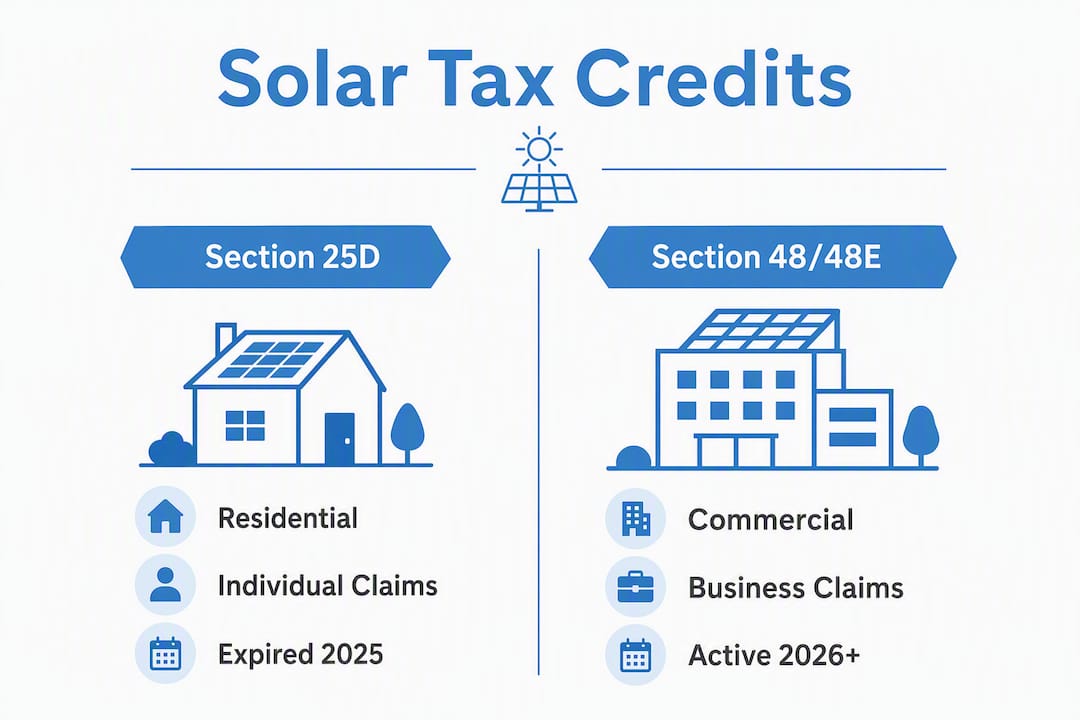
Most small solar ventilation and cooling devices installed after December 31, 2025, do not qualify for the residential federal solar tax credit. The residential clean energy credit under Section 25D dropped to 0% for property placed in service after that date, ending the credit available through 2025. If your system was operational on or before December 31, 2025, you may still claim the credit on your 2025 return. For installations after that date, a commercial pathway under Section 48/48E remains available, but it comes with different rules, documentation requirements, and compliance thresholds.
The distinction that matters most here is not what the device looks like. It is whether the equipment generates electricity, when it was placed in service, and whether it is connected to a qualifying dwelling unit. A solar-powered barn exhaust fan running off a small PV panel is not automatically a qualifying energy system. The IRS tests the whole configuration, not just the presence of a solar component.
- Placed in service on or before 12/31/2025: File Form 5695 to claim the 30% residential clean energy credit.
- Placed in service after 12/31/2025: Residential Section 25D credit is no longer broadly available; explore Section 48/48E commercial pathways or state incentives.
- Equipment type matters: The device must be qualifying photovoltaic generating equipment, a solar water heater, battery storage (≥3 kWh), or similar IRS-defined property.
Pro Tip: The date your system became fully operational, not the date you ordered or paid for it, determines which tax year you claim. If your install straddled year-end, get a dated inspection sign-off or commissioning certificate.
Table of Contents
- Does your installation pass the minimum eligibility tests?
- Which solar ventilation and cooling hardware can actually qualify?
- How does Section 25D differ from Section 48/48E for barns and off-grid sites?
- How to document your installation and claim the credit correctly
- What rural and off-grid owners should do right now
- How Westernharmonics hardware fits the IRS framework
- Common mistakes that create audit risk on small solar installs
- Key Takeaways
- Why getting this right matters more than most people realize
- Westernharmonics solar hardware for rural and off-grid cooling
- Useful sources and further reading
Does your installation pass the minimum eligibility tests?
Run through this checklist before assuming your system qualifies for any federal solar credit.
- Placed-in-service date: Confirm the exact date the system was installed and operational. This is the date that determines your tax year and which credit rules apply.
- Dwelling unit connection: The IRS requires that qualifying property be used in connection with a dwelling unit in the United States. A detached barn or standalone greenhouse that has no functional tie to your home risks being treated as a commercial or non-qualifying structure.
- Ownership: You must own the system. Leased equipment generally does not qualify for the residential credit.
- New equipment only: Used or refurbished systems do not qualify.
- Device type: The IRS covers solar electric (PV) panels, qualifying solar water heaters, small wind turbines, geothermal heat pumps, and battery storage with a capacity of at least 3 kWh. A fan that simply runs on a solar charger is not automatically qualifying equipment.
- Eligible costs: Hardware and onsite installation labor count. Loan origination fees and interest do not.
“The home doesn’t have to be your main home, but qualifying property must be connected to a home used by the taxpayer in the United States.” — IRS guidance on claiming the residential clean energy credit
Pro Tip: If your barn or workshop is attached to your home’s electrical system and you use it as part of your primary residence, document that connection explicitly. It can support a dwelling-unit argument if the IRS asks.
Which solar ventilation and cooling hardware can actually qualify?
The IRS defines eligible property by function, not by marketing label. Here is how the categories map to the hardware rural and off-grid buyers typically purchase.
Historically eligible categories under Section 25D:
- Solar electric (photovoltaic) panels and systems
- Solar water heaters (must meet certification requirements)
- Small wind energy property
- Geothermal heat pumps
- Battery storage technology with capacity of at least 3 kWh
- Fuel cell property
Where ventilation hardware gets complicated:
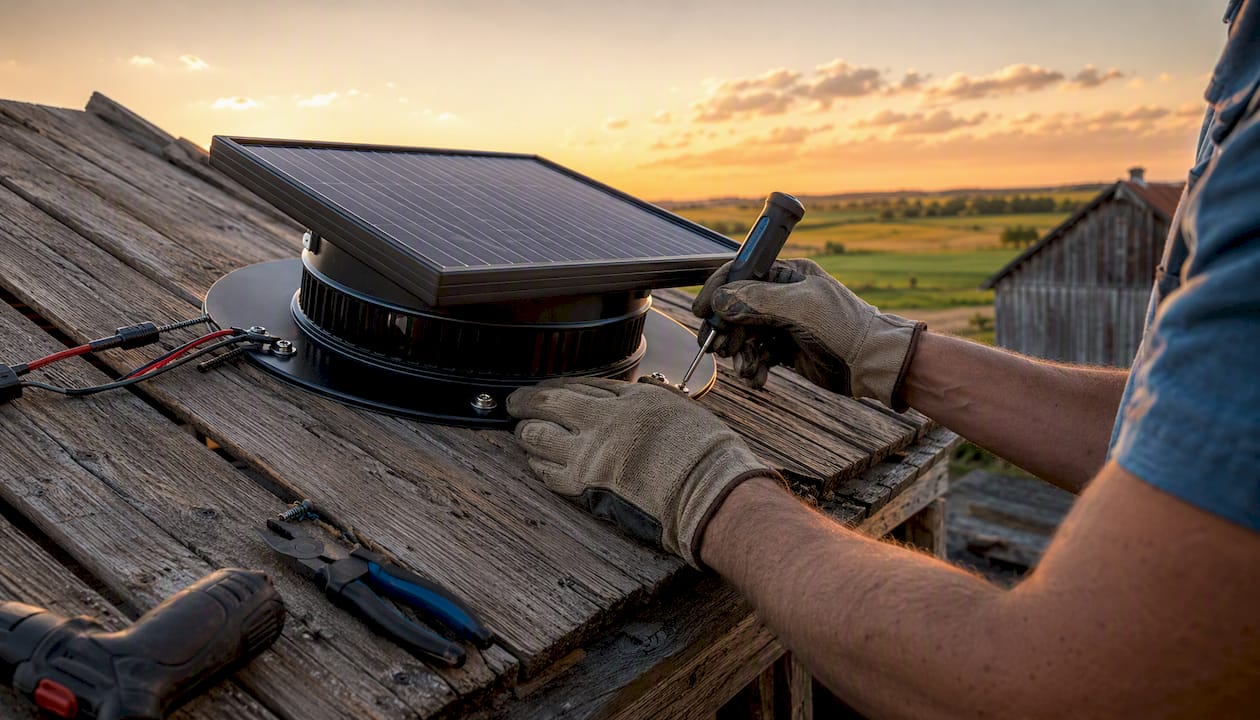
A standalone solar-powered ventilation fan, the kind that mounts on a roof or gable and runs directly off a small integrated panel, is typically a mechanical device, not a generating system. It does not produce electricity for use elsewhere. The IRS tests whether the equipment generates usable electrical energy, not whether it has a solar panel attached to it.
A barn exhaust fan tied to a dedicated PV array that feeds a charge controller and battery bank is a different configuration. If that battery bank meets the 3 kWh threshold and the PV array is properly sized and documented as a generating system, the PV and battery components may qualify. The fan itself is still just a load.
Solar roofing tiles and shingles that perform both as structural roofing and as photovoltaic collectors can qualify; ordinary structural components that only serve a roofing function do not.
For readers comparing solar attic fans versus electric alternatives, the key question is always whether the solar component generates electricity for the broader system or simply powers a single mechanical load directly.
Practical warning: Do not assume qualification based on a product’s name or a seller’s claim. Request the technical specification sheet, confirm the system’s generating capacity, and verify whether the configuration meets IRS definitions before filing.
How does Section 25D differ from Section 48/48E for barns and off-grid sites?
The residential and commercial credit frameworks are built on different logic, and for rural property owners, the classification of a structure can change everything.
| Feature | Section 25D (Residential) | Section 48/48E (Commercial) |
|---|---|---|
| Who claims it | Individual homeowner | Business entity or commercial owner |
| 2026 credit rate | 0% (expired 12/31/2025) | Up to 30% for projects that begin construction by July 4, 2026 and meet prevailing wage/apprenticeship requirements |
| Base rate without wage requirements | N/A | 6% |
| Eligible structures | Dwelling units in the U.S. | Commercial, agricultural, non-residential |
| Battery storage threshold | ≥3 kWh | Separate rules apply |
| Deadline to begin construction | N/A | July 4, 2026 for 30% rate |
Industry analysis from SurgePV confirms that the 30% residential credit expired on December 31, 2025, and that commercial projects under Section 48E can still reach 30% if construction begins by July 4, 2026, and they meet prevailing-wage and apprenticeship requirements. Projects over 1 MW AC face additional compliance tests.
For a detached barn or greenhouse, the critical question is whether the structure functions as part of a dwelling unit or as a business asset. A barn used exclusively for livestock or crop storage is almost certainly a commercial or agricultural structure, not a residential one. That means Section 25D does not apply, but Section 48/48E might, provided the installation is structured and documented as a commercial project.
Distinguishing between ‘residence’ and ‘commercial/agricultural infrastructure’ is critical. Classification can change the tax treatment completely for barn, greenhouse, or off-grid installs. — IRS FAQ on residential clean energy credits
Pro Tip: If you operate a farm or rural business, talk to your tax professional about whether your barn or greenhouse installation can be structured as a Section 48/48E commercial project. The documentation requirements are more demanding, but the credit rate can still reach 30%.
How to document your installation and claim the credit correctly
Getting the paperwork right is as important as getting the hardware right. The IRS does not require you to submit documentation with your return, but you must be able to produce it on request.
Step-by-step documentation checklist:
- Record the placed-in-service date with a dated inspection sign-off, commissioning certificate, or utility interconnection approval.
- Retain all hardware invoices showing model numbers, serial numbers, and purchase prices.
- Retain all labor invoices for onsite installation work.
- Photograph the completed installation with a date-stamped camera or phone.
- Keep technical specification sheets confirming the system’s generating capacity and, for battery storage, its kWh rating.
- Confirm the property address is in the United States and document its use as a dwelling unit (or commercial structure, if applicable).
For residential claims (systems placed in service on or before 12/31/2025):
- File Form 5695 with your federal return for the tax year the system was placed in service.
- The credit is nonrefundable; any excess can be carried forward to future tax years.
- Eligible costs include hardware and onsite labor. Exclude loan origination fees and interest.
“You claim the credit for the tax year the system was fully installed and operational; documentation is not required with filing but must be kept for audits.” — IRS Residential Clean Energy Credit guidance
For commercial claims under Section 48/48E, follow IRS guidance specific to that section and consult a tax professional. The compliance requirements, including prevailing-wage and apprenticeship documentation, are substantially more involved than Form 5695.
What rural and off-grid owners should do right now
If you have a solar ventilation or cooling system already installed, or you are planning one, here is the practical order of operations.
- Confirm your placed-in-service date. If the system was operational on or before December 31, 2025, gather your documentation and file Form 5695 with your 2025 return.
- Verify your equipment specs. Pull the technical specification sheet for every component. Confirm whether the PV array is a generating system and whether any battery storage meets the 3 kWh threshold.
- Gather your invoices and inspection records. Hardware receipts, labor invoices, and dated photographs are the minimum. Serial numbers matter.
- Consult a tax professional for any borderline case. Detached structures, mixed-use properties, and off-grid systems that serve both residential and agricultural functions all carry classification risk.
When the residential credit does not apply, these alternatives are worth pursuing:
- State solar tax credits and rebates (many state programs continued operating in 2026 and can be stacked with commercial credits in some cases)
- Utility rebates for rural electrification or demand reduction
- Property tax exemptions for solar installations (available in many states)
- USDA Rural Energy for America Program (REAP) grants for agricultural operations
- Third-party ownership models (leases or power purchase agreements), where a commercial entity claims the Section 48/48E credit and passes savings to you through lower energy costs
For solar barn ventilation projects that serve a working farm, REAP grants in particular deserve a close look before assuming the federal credit is the only path.
Pro Tip: Installers and sellers should adjust their proposals now. Quoting a 30% federal residential credit on a 2026 installation is a compliance error, not just a sales mistake. Build state incentives and commercial pathways into your project math instead.
How Westernharmonics hardware fits the IRS framework
Westernharmonics designs and manufactures solar-powered ventilation systems, DC micro-power units, and off-grid cooling hardware built for exactly the environments where these tax questions arise: barns, greenhouses, workshops, and rural infrastructure with no reliable grid connection.
Here is what that means practically for customers navigating the tax rules:
- Fan kits tied to PV arrays: Westernharmonics fan kits that are integrated with a dedicated photovoltaic array and charge controller are configured as generating systems. The PV and storage components of those systems are the elements most likely to meet IRS generating-equipment definitions. The fan itself is a load on that system.
- Standalone solar charger configurations: A fan powered directly by a small integrated solar panel, with no separate PV array or battery bank, is a mechanical device. It does not meet the IRS definition of qualifying solar electric property on its own.
- Battery-backed configurations: Systems that include battery storage should have the battery’s kWh capacity confirmed in writing. The 3 kWh threshold is a hard IRS requirement for battery storage to qualify.
Documentation Westernharmonics customers should request and retain:
- Model and specification sheets for every component (fan, controller, PV panels, battery)
- Serial numbers for all hardware
- Installation statements or commissioning notes
- Photographs of the completed installation
For customers planning microgrid components that include PV generation and storage, the system design documentation becomes especially important for supporting any commercial credit claim.
Pro Tip: Contact Westernharmonics directly if you need product specification sheets or installation documentation for a tax filing or professional consultation. We keep records and can support your paperwork process.
Common mistakes that create audit risk on small solar installs
These are the errors we see most often, and the ones the IRS is most likely to question.
- Assuming the 30% residential credit still applies in 2026. Many homeowners and sales leads still carry this misconception, and it creates real compliance exposure. The residential credit expired for post-2025 installations.
- Using the purchase date instead of the placed-in-service date. The date you ordered or paid for the system is irrelevant. The operational date is what the IRS uses.
- Claiming a detached barn or greenhouse as a residential structure without documentation. If the structure has no functional connection to your dwelling unit, the residential credit does not apply. Undocumented use claims are a common audit trigger.
- Including financing fees in the eligible cost basis. Loan origination fees and interest are explicitly excluded. Only hardware and onsite labor count.
- Claiming a rebate-reduced system at full cost. If a utility rebate reduced your out-of-pocket cost, your eligible credit basis is typically reduced accordingly. Check IRS guidance on how rebates affect qualified expenditures.
- Missing serial numbers or incomplete invoices. The IRS expects you to be able to identify the specific equipment you claimed. Generic receipts without model or serial numbers are a gap.
“The IRS recommends retaining receipts, installation records, and technical specifications for audits.” — IRS Residential Clean Energy Credit
For off-grid and rural installs, the most common audit trigger is ambiguous use: a system that could be residential or agricultural, with no documentation to support either classification clearly.
Key Takeaways
The residential federal solar tax credit expired for systems placed in service after December 31, 2025; commercial Section 48/48E pathways remain available, but require additional documentation and compliance steps.
| Point | Details |
|---|---|
| Residential credit expired | Section 25D dropped to 0% for systems placed in service after 12/31/2025; the 30% rate was available for systems operational on or before that date. |
| Placed-in-service date controls | The operational date, not the purchase date, determines your tax year and which credit rules apply. |
| Equipment must generate electricity | PV arrays, qualifying solar water heaters, and battery storage ≥3 kWh qualify; fans powered by solar chargers alone do not. |
| Barns and outbuildings need documentation | Detached structures must be tied to a dwelling unit for Section 25D; otherwise, pursue Section 48/48E or state incentives. |
| Westernharmonics supports your paperwork | Request spec sheets, serial numbers, and installation statements from Westernharmonics to substantiate any credit claim or tax consultation. |
Why getting this right matters more than most people realize
The 2025-to-2026 transition in federal solar incentives is one of the most consequential policy shifts rural property owners have faced in years, and most of the information circulating online still reflects the old rules. We have seen proposals quoting 30% federal credits on 2026 installations, and that is not a minor error. It is the kind of mistake that creates IRS exposure for the buyer and liability for the seller.
What gets underestimated here is the classification question. Rural properties are rarely clean-cut residential or commercial. A homestead with a barn, a greenhouse, and an off-grid workshop is all three at once, and the tax treatment of a solar installation on any one of those structures depends on how it is classified and documented. The IRS does not make that determination for you. You make it, and you defend it with records.
The practical takeaway is not to avoid solar investment. The commercial pathway under Section 48/48E still offers meaningful incentives for agricultural and off-grid infrastructure. State programs, REAP grants, and third-party ownership models can fill gaps the federal residential credit used to cover. The work is in understanding which path fits your property and building the documentation to support it.
Consult a qualified tax professional before filing any claim involving a detached structure, mixed-use property, or off-grid system. The rules are specific, the stakes are real, and the right answer depends on facts that are unique to your installation.
Westernharmonics solar hardware for rural and off-grid cooling

Westernharmonics builds the hardware rural and off-grid owners actually need: solar-powered fan kits, DC micro-power units, the PowerJam portable solar device, and automated microgrid design tools that make off-grid planning accessible without an engineering degree. Every product is designed for the environments where grid power is unreliable or simply not there, from livestock barns to remote greenhouses to working workshops.
For customers navigating the tax rules, Westernharmonics provides model and specification sheets, serial number records, and installation documentation that support conversations with tax professionals. Whether your system qualifies for a federal credit or you are building the case for a state incentive or commercial pathway, having clean paperwork from the manufacturer matters.
Visit westernharmonics.com to browse solar ventilation systems, request product documentation, or start a microgrid design for your property.
Useful sources and further reading
- Residential Clean Energy Credit | Internal Revenue Service
- Instructions for Form 5695 (2025) | Internal Revenue Service
- How to claim a residential clean energy tax credit | Internal Revenue Service
- Frequently asked questions about energy efficient home improvements and residential clean energy property credits | Internal Revenue Service
- Home energy tax credits | Internal Revenue Service
- Solar Energy Systems Tax Credit | ENERGY STAR
- 26 USC 25D: Residential clean energy credit | U.S. House of Representatives
- Solar Tax Credit 2026: What Expired, What Remains, and How to Sell | SurgePV
This article provides general information about federal tax incentives and is not tax or legal advice. Confirm current rules with the IRS or a qualified tax professional before filing any claim.