

Corrosion Resistant Fans for Solar Off-Grid Use
Corrosion Resistant Fans for Solar Off-Grid Use
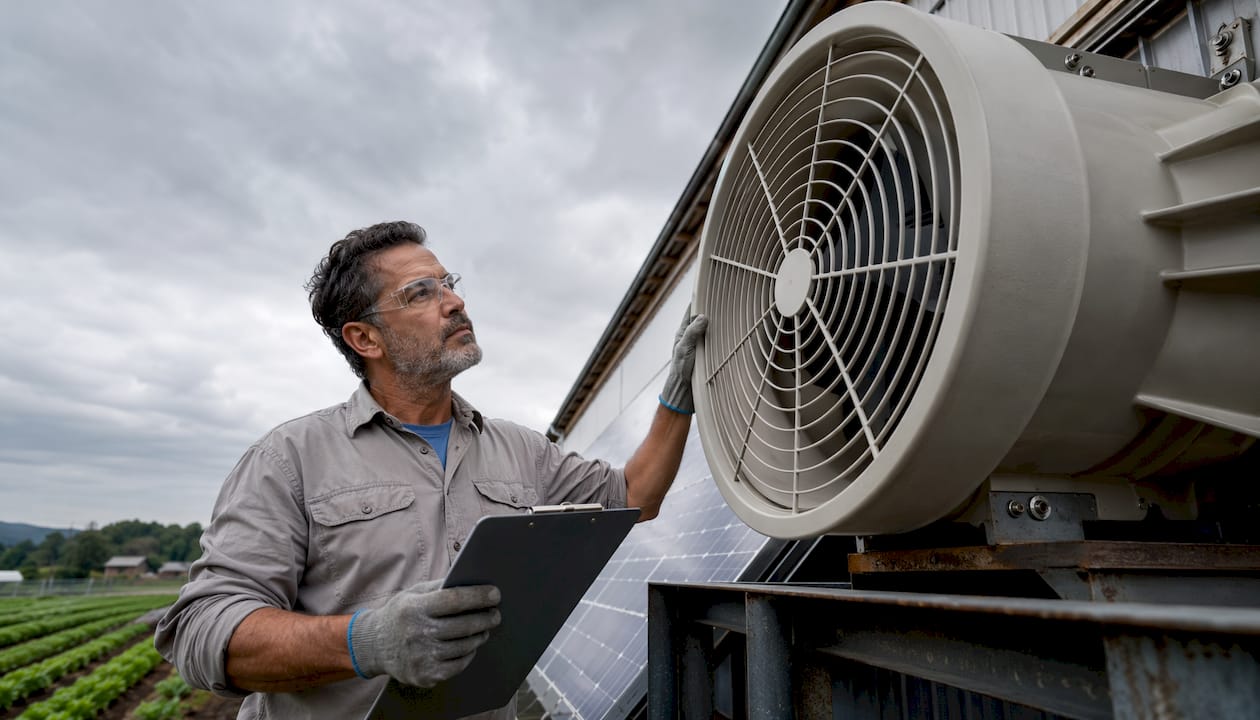
For solar-powered, off-grid barns, greenhouses, and workshops, the most reliable choice is a polymer or FRP centrifugal fan with a DC brushless motor, an IP55-rated housing, and no metal components in the airstream. That combination handles humidity, ammonia, fertilizer vapors, and UV exposure without corroding, and it runs directly from a solar panel or battery bank without an inverter.
- Best fit for agricultural and rural buildings: FRP or all-polypropylene construction resists the full range of barn and greenhouse corrosives, including ammonia, hydrogen sulfide, and fertilizer acids. Pair it with a BLDC motor for direct solar compatibility and expect a well-maintained unit to deliver years of dependable service.
- Recommended next step: Westernharmonics offers solar-ready fan kits designed specifically for off-grid agricultural use. Request a kit or sizing recommendation directly through the site.
DC/BLDC motors are the right choice for direct solar or battery-backed systems because they skip the inverter and run efficiently across a wide voltage range. A properly sized system with an MPPT controller will keep airflow running through most weather conditions without manual intervention.
Table of Contents
- What to verify before you buy a corrosion-resistant fan
- Why corrosion resistance matters in barns, greenhouses, and rural buildings
- Which materials and coatings actually hold up?
- Design features that prevent corrosion-related failure
- How to size a fan for solar or battery-backed systems
- Mounting and installation best practices for barns and greenhouses
- Maintenance schedule and expected service life
- What corrosion-resistant fans and solar kits typically cost
- Why Westernharmonics is built for this application
- Key Takeaways
- What field experience actually teaches you about these fans
- Get started with Westernharmonics solar fan kits
- Useful sources for further reading
What to verify before you buy a corrosion-resistant fan
Before you commit to any unit, run through this checklist against the product page or vendor quote:
- Airstream materials: Confirm the impeller, volute, and housing are FRP, polypropylene, or PVDF. Ask specifically whether any metal component contacts the airstream, since even a single steel fastener can become a corrosion point.
- Motor protection: Look for IP55 or higher, a bearing housing located outside the airstream, and sealed or permanently lubricated bearings.
- Balance and vibration specs: Request the dynamic balance grade. Industrial-grade FRP impellers should meet a vibration limit of ≤ 2.5 mm/s to avoid stress failures under sustained airflow pressure.
- Power compatibility: Confirm DC or BLDC motor availability. If the vendor only offers AC, ask about inverter requirements and efficiency loss. Check the CFM-per-watt rating.
- Warranty and parts: Ask for the warranty term on both motor and housing, and confirm U.S.-based spare parts availability before you order.
Pro Tip: Ask the vendor for a chemical resistance chart specific to your environment. Polypropylene handles most agricultural acids well, but concentrated chlorine or strong oxidizers may require PVDF or FRP.
Why corrosion resistance matters in barns, greenhouses, and rural buildings
Standard fans fail faster in agricultural environments than almost any other setting. The combination of corrosives is relentless: high humidity, ammonia from animal waste, hydrogen sulfide from manure pits, fertilizer acids, and, in coastal or northern states, salt spray from ocean air or road brine. Each of these attacks metal components through different mechanisms, and they often act together.
The failure sequence is predictable. Moisture penetrates an unprotected bearing housing, accelerating oxidation. Ammonia vapors attack copper windings and steel shafts. Fertilizer residue settles in crevices and holds moisture against surfaces that would otherwise dry out. The result is bearing seizure, shaft pitting, enclosure breaches that allow moisture into the motor, and eventually complete airflow loss.
Industry note: Anti-corrosion fan specialists consistently identify stagnant pockets inside fan housings as a primary accelerant of corrosion, regardless of base material. A smooth, crevice-free interior is as important as the material itself.
The operational consequence is not just a replacement cost. In a greenhouse, losing ventilation during a heat event can destroy a crop in hours. In a barn, ammonia buildup without exhaust creates a health risk for animals and workers. Choosing the wrong fan means planning for failure at the worst possible time.
Which materials and coatings actually hold up?
| Material | Best Chemical Resistance | Weight vs. Stainless | Relative Cost | UV Durability |
|---|---|---|---|---|
| Polypropylene (PP) | Acids, alkalis, ammonia | roughly half as much | Lowest | Good with HALS additives |
| FRP / Fiberglass | Chlorine, HCl, SO₂, ammonia | Moderate | Mid-range | Good with gel coat |
| PVDF / Fluoropolymer | Strong oxidizers, halogens | Moderate | High | Excellent |
| 316L Stainless Steel | Salt, mild acids, humidity | Heaviest | High | Excellent |
| Titanium (palladium-alloyed) | Strong reducing acids (HCl, H₂SO₄) | Light for metal | Very high | Excellent |
Polypropylene fans can weigh roughly half as much as comparable stainless units and typically cost significantly less, making them the practical first choice when the chemical exposure falls within polypropylene’s resistance profile. For most barns and greenhouses, that threshold is rarely exceeded.
FRP earns its place when the chemical mix includes chlorine, hydrochloric acid vapor, or sulfur dioxide. Precision-molded FRP impellers and volutes provide a smooth, uniform surface that resists both chemical attack and moisture accumulation. PVDF steps in when oxidizers or halogens are present at concentrations that degrade polypropylene.
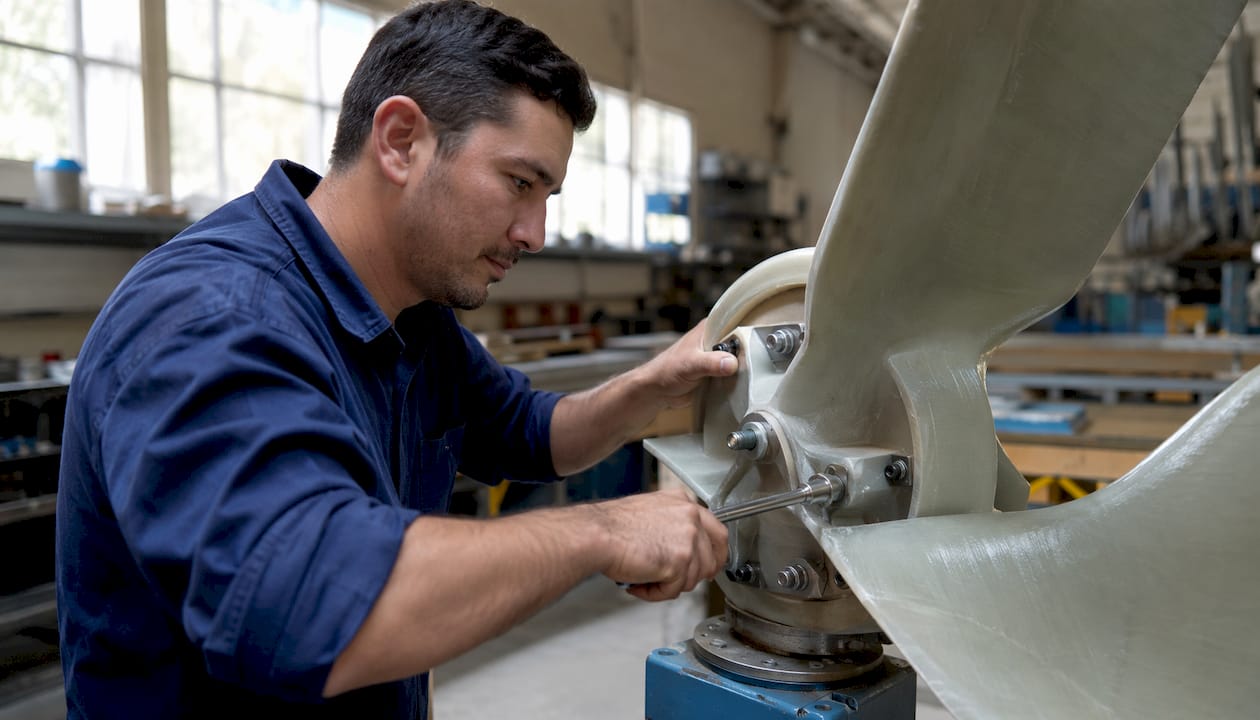
For outdoor installations, HALS additives in polypropylene formulations prevent UV-induced brittleness over time. Without them, sun exposure will eventually cause surface cracking and reduced impact resistance. Epoxy coatings and specialty linings can extend the life of metal components, but they are a secondary measure. Integral corrosion-resistant materials outlast surface coatings in agricultural settings because coatings chip, scratch, and eventually fail at edges and fastener holes.
Titanium alloys with palladium additions of 0.12%–0.25% markedly improve resistance to strong reducing acids. This level of material engineering is rarely necessary for standard farm or greenhouse use, but it is the right answer for extreme chemical processing environments.
Pro Tip: For most U.S. barns and greenhouses, all-polypropylene with HALS is the cost-effective default. Step up to FRP when you’re exhausting fertilizer mixing rooms or spaces with concentrated chemical vapors.
Design features that prevent corrosion-related failure
The material is only part of the equation. How the fan is built determines whether that material actually delivers its rated service life.
- Motor placement: The bearing housing should sit outside the airstream entirely, or the motor must carry an IP55 or higher rating. Moisture and corrosive vapors that reach an unprotected motor will shorten bearing life regardless of how good the housing material is.
- Sealed bearings: Permanently lubricated, sealed bearings eliminate the need to introduce lubricants near the airstream and prevent moisture ingress at the shaft.
- Smooth, crevice-free casings: Integrated volute and impeller molding reduces the internal pockets where corrosive particles and humidity collect. Stagnant zones accelerate degradation even in chemically resistant materials.
- Dynamic balancing: FRP impellers require computer-verified strain analysis and dynamic balancing to the ≤ 2.5 mm/s grade to maintain structural integrity under sustained pressure.
- Corrosion-resistant fasteners: Every bolt, bracket, and coupling in the airstream path should be polymer, 316L stainless, or coated. A single carbon steel fastener can initiate galvanic corrosion in an otherwise clean assembly.
- Explosion ratings: Where volatile chemicals or grain dust are present, look for ATEX or UL-listed explosion-rated options with non-sparking impellers.
How to size a fan for solar or battery-backed systems
DC and BLDC motors are the right choice for direct solar or battery-backed ventilation. They run efficiently across a wide voltage range, integrate cleanly with MPPT controllers, and deliver more CFM per watt than AC motors running through an inverter.
| Sizing Step | What to Calculate |
|---|---|
| CFM target | Volume (cu ft) × air changes per hour |
| 2. Watts continuous | CFM target ÷ fan’s CFM-per-watt rating |
| Daily watt-hours | Watts continuous × hours of operation per day |
| Battery amp-hours | Daily watt-hours ÷ system voltage |
| PV watt rating | Daily watt-hours ÷ peak sun hours |
MPPT controllers are the right pairing for BLDC motors on any system running more than a few hours per day. They extract more power from the panel across varying light conditions compared to PWM controllers, and the efficiency gain compounds over a full season. PWM is acceptable for short-runtime or low-power applications where cost is the primary constraint.
An inverter plus AC fan is a workable fallback when a DC motor option is not available, but expect a 10%–15% efficiency penalty from the conversion. For a barn running ventilation eight or more hours daily, that loss adds up in battery capacity and panel sizing.
Pro Tip: Oversize your PV array by at least 20% beyond the calculated watt requirement. Cloudy days, panel soiling, and seasonal angle changes all reduce real-world output below the nameplate rating.
Mounting and installation best practices for barns and greenhouses
Placement determines both airflow effectiveness and long-term durability. Get it wrong and you pull ammonia fumes directly across animal stalls, or you mount a housing where rainwater pools inside the casing.
- Exhaust placement: Mount exhaust fans high on the leeward wall or roof. Hot, humid, and chemically laden air rises, so high exhaust points remove it before it settles back into the occupied zone.
- Intake placement: Place intakes low and on the windward side, away from manure pits, fertilizer storage, or chemical mixing areas. Never draw intake air across a corrosive source.
- Drainage orientation: Orient housings so any condensation or infiltrating moisture drains out rather than pooling at the motor or bearing housing.
- Weatherproofing: Use UV-stable flashing and sealant at wall penetrations. Insect screens protect the airstream but need quarterly cleaning to prevent airflow restriction.
- Mounting hardware: Use stainless or polymer fasteners and vibration isolation pads between the fan frame and the building structure. Vibration transmitted into wood framing loosens fasteners over time.
- Electrical installation: Run wiring in UV-rated conduit. Install a clearly labeled disconnect within sight of the fan. For solar systems, add surge protection at the controller to guard against lightning strikes.
Pro Tip: In a greenhouse, run a short test with a smoke pencil or incense stick before finalizing fan placement. You want to see a clean sweep from intake to exhaust with no dead zones where heat and humidity stagnate.
Maintenance schedule and expected service life
Corrosion-resistant fans in agricultural settings still need regular attention. The schedule below keeps small problems from becoming replacements.
- Quarterly: Visual inspection of housing, impeller, and fasteners for pitting, cracking, or discoloration. Check bearing temperature by touch during operation. Listen for new vibration or noise. Inspect seals and gaskets for softening or cracking.
- Annually: Clean insect screens and verify airflow output against the original CFM spec. Inspect electrical connections and conduit for UV degradation or moisture intrusion. Confirm motor housing integrity.
- Signs to act on immediately: Unusual vibration, audible grinding, reduced airflow, motor running hot to the touch, or visible softening or pitting in plastic components.
Polypropylene and FRP fans in agricultural settings typically deliver many years of service when maintained properly. Stainless units in the same environments tend to last longer under severe chemical exposure but cost more upfront. Keeping one spare impeller and a set of bearing seals on hand at a remote property is practical insurance against a multi-week wait for parts.
What corrosion-resistant fans and solar kits typically cost
Budget expectations vary significantly by material and motor type. All-polypropylene fans with AC motors represent the entry point. FRP units with DC or BLDC motors sit in the mid-range, and 316L stainless or titanium alloy fans with advanced motor protection carry the highest price tags.
- Polypropylene fans are typically the most affordable option and often the best value when the chemical environment is within their resistance range.
- FRP fans cost more but justify the premium in environments with chlorine, strong acid vapors, or high static pressure requirements.
- Stainless fans make sense for salt-heavy coastal environments or where mechanical durability under impact matters more than chemical resistance alone.
- DC/BLDC motor upgrades add cost but pay back in lower battery capacity requirements and longer panel life over a multi-year horizon.
- Warranty questions to ask: How long does the motor warranty run? Does the housing warranty cover corrosion-through failures specifically, or only manufacturing defects? Are replacement impellers stocked in the U.S.?
Why Westernharmonics is built for this application
Westernharmonics designed its solar fan kits from the ground up for off-grid agricultural and rural use. The product line addresses every item on the checklist above: DC micro-power units that run directly from solar panels, motor designs focused on rugged field durability, and kits that include the controller hardware needed for a complete installation.
- Solar-ready by design: Westernharmonics kits pair DC fans with MPPT-compatible controllers, so you are not sourcing components separately and hoping they work together.
- Off-grid focus: The engineering priority is dependable operation where the grid is unavailable, not laboratory performance under ideal conditions.
- U.S.-based support: Spare parts, sizing help, and warranty service are handled domestically, which matters when a failed fan in a remote barn needs a fast resolution.
- Proven field deployments: Westernharmonics has been operating in barns, greenhouses, and rural workshops across the country since pioneering the U.S. solar fan kit category.
Pro Tip: Before ordering, use the Westernharmonics site’s microgrid design tool to input your building dimensions and daily runtime target. It will output a recommended kit configuration, which saves time and avoids undersizing.
Key Takeaways
For off-grid agricultural ventilation, the right fan material and motor type together determine whether your system runs for years or fails in the first season.
| Point | Details |
|---|---|
| Material first | FRP or all-polypropylene handles most barn and greenhouse corrosives; step up to PVDF or titanium only for extreme acid exposure. |
| Motor protection matters | IP55+ housing and bearing housing outside the airstream are non-negotiable for long service life in humid, chemical environments. |
| DC/BLDC for solar | BLDC motors with MPPT controllers deliver the best CFM-per-watt and integrate cleanly with battery or direct-solar systems. |
| Size conservatively | Oversize your PV array by at least 20% to account for real-world losses. |
| Westernharmonics | Offers complete solar-ready fan kits with DC motors, MPPT controllers, and U.S.-based support for off-grid agricultural use. |
What field experience actually teaches you about these fans
The conventional wisdom in fan selection focuses almost entirely on material chemistry: match the material to the chemical, done. That framing misses half the problem. In real agricultural deployments, the fans that fail early almost always fail at the motor or the fasteners, not the housing. A polypropylene housing can be in perfect condition while a carbon steel mounting bracket has rusted through and allowed the unit to shift out of balance, destroying the bearings in a matter of weeks.
The second thing field experience reveals is that solar sizing errors cause more downtime than fan failures. An undersized battery bank runs the fan at reduced voltage during cloudy stretches, which stresses the motor and reduces airflow exactly when ventilation is most needed. Conservative sizing is not over-engineering. It is the difference between a system that runs unattended for a season and one that needs intervention every few weeks.
My honest recommendation: treat the motor protection spec and the solar sizing calculation as seriously as the housing material. All three have to be right for the system to perform reliably in a remote barn or greenhouse.
Get started with Westernharmonics solar fan kits

Westernharmonics is the original U.S. solar fan kit company, and the product line is built specifically for the environments this article covers: barns, greenhouses, workshops, and rural properties where the grid is not an option. The kits ship with DC fans, MPPT controllers, and the hardware needed for a complete installation, so you are not piecing together components from multiple vendors.
The concrete next step is straightforward. Visit Westernharmonics to browse current kit configurations, use the automated microgrid design tool to size your system, or contact the team directly for a custom sizing recommendation. U.S.-based spare parts and warranty support are part of the package. Order or pre-order through the site and get your ventilation running before the next heat season.
Useful sources for further reading
- Goveco Anti-Corrosion Fans: Material selection guidance, crevice-minimization design principles, and motor/bearing sealing standards for corrosive environments.
- PANLI Corrosion Resistant Fiberglass Fan: FRP impeller construction details, dynamic balance grades, and motor isolation specs for industrial-grade durability.
- Zhicheng Fan Titanium Alloy Series: Material optimization strategies including palladium-alloyed titanium for extreme acid resistance beyond the range of standard plastics or 316L stainless.
- Plastec Ventilation Polypropylene Series: All-polypropylene fan construction, HALS UV stabilizer specifications, and weight and cost comparisons versus stainless alternatives.