

Best Portable Solar Generators for Camping and Emergency Backup
Best Portable Solar Generators for Camping and Emergency Backup
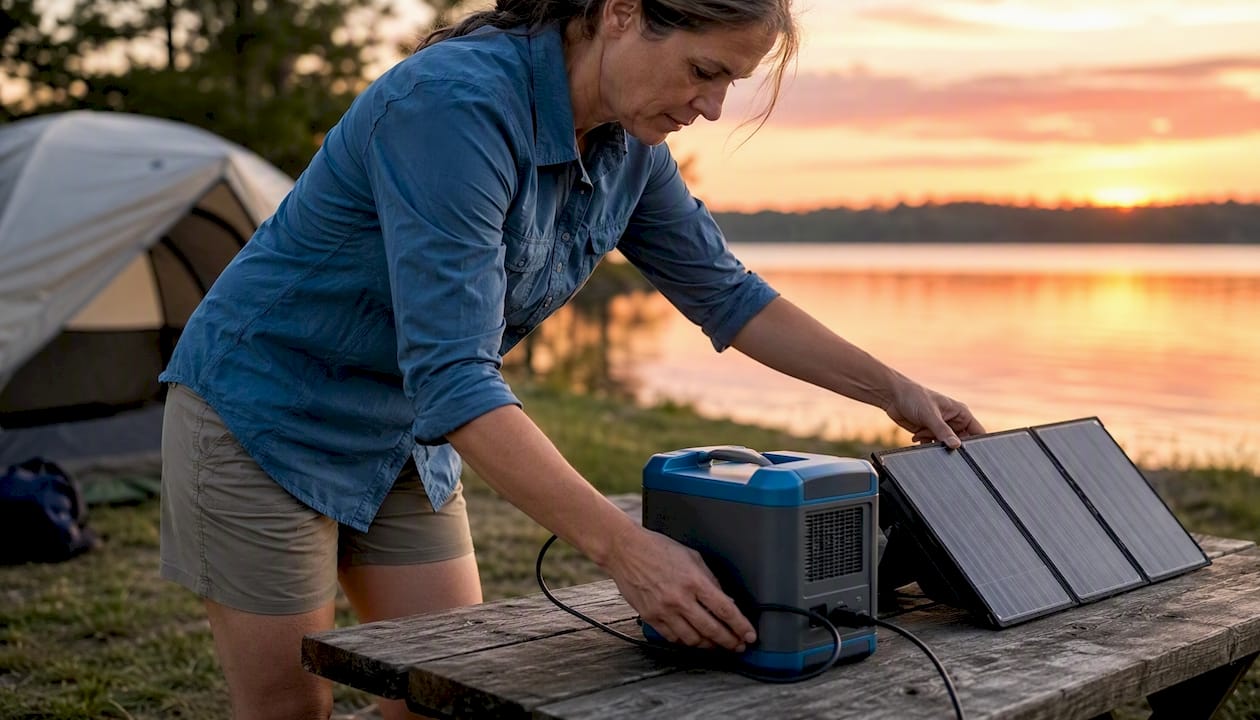
For a day trip or weekend camp, a compact unit suitable for typical small device use handles phones, laptops, and LED lighting without weighing you down. For RV weekends, CPAP backup, or short outages, step up to a midsize station with enough surge headroom for a mini-fridge compressor. Multi-day outages and whole-house critical loads call for larger capacity units with expandable capacity. Across all tiers, LiFePO4 battery chemistry is generally preferred for its higher cycle life compared to older NMC cells, which can reduce long-term ownership costs significantly. The Westernharmonics PowerJam fits the midsize and larger tiers well, particularly for homesteaders and rural buyers who need durability alongside portability.
- Camping/day trips: compact units suitable for small device charging, LiFePO4 preferred, pure-sine inverter for sensitive electronics.
- Weekend RV/short outages: midsize units with continuous output and surge capacity sufficient for typical compressors.
- Multi-day outages/whole-house supplement: larger capacity expandable units with high solar input, MPPT controller, and use of LiFePO4 chemistry for longevity.
Table of Contents
- What size portable solar generator do you actually need?
- Why the Westernharmonics PowerJam fits several buyer profiles
- How we evaluate portable solar generators in this guide
- How to choose the right solar generator for your situation
- How to size solar panels and charge your generator reliably
- Keeping your generator ready: maintenance and storage
- Which generator should you buy? A final verdict
- Key Takeaways
- What field experience actually teaches you about portable solar power
- Westernharmonics PowerJam and DC micro-power units: built for real off-grid work
- Useful sources for deeper research
What size portable solar generator do you actually need?
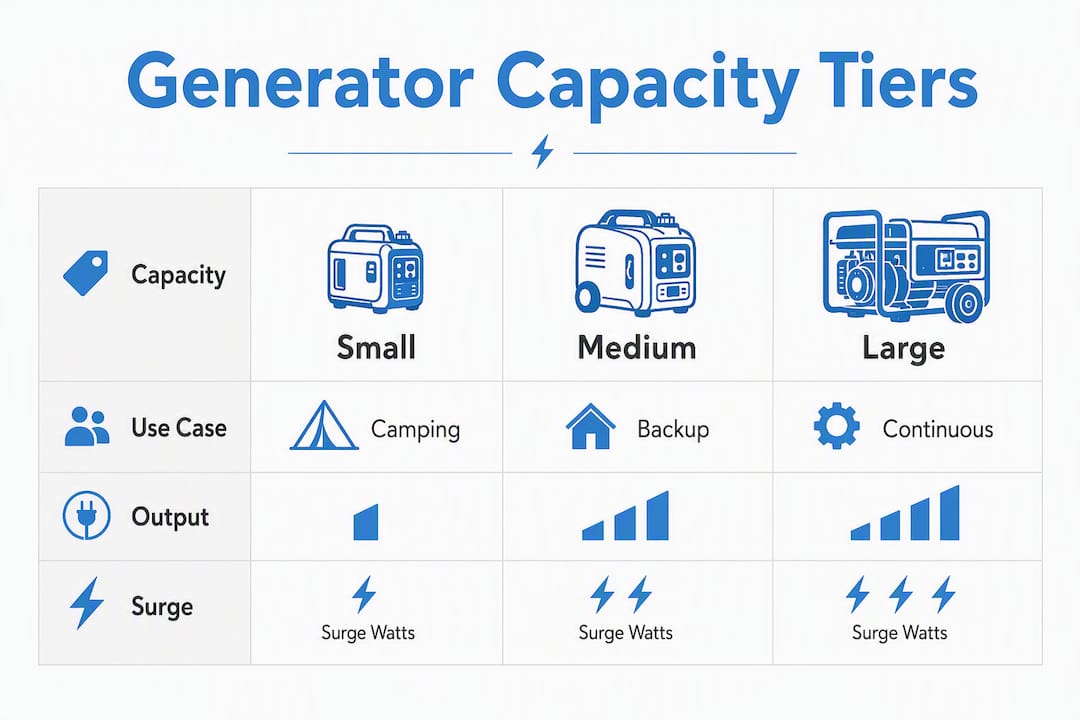
The industry uses three informal tiers, and buying the wrong one is the most common regret we see. Mismatching capacity to device needs — expecting a 300 Wh unit to run a refrigerator for a weekend, for instance — is a documented pattern in buyer feedback across test sites.
| Tier | Capacity | Typical Continuous Output | Typical Surge Headroom | Common Use Cases |
|—|—|—|—|—| | Small | suitable for small device charging | modest continuous output | modest surge capacity | Phone, laptop, LED lights, camera gear | | Midsize | suitable for medium capacity needs | moderate continuous output | moderate surge capacity | CPAP, mini-fridge, RV appliances, short outages | | Large | large capacity units | high continuous output | high surge capacity | Well pumps, refrigerators, whole-house critical loads |
Runtime math is straightforward. Divide usable watt-hours (typically 80–90% of nominal capacity for LiFePO4) by the appliance’s wattage. A 1,000 Wh station with 90% usable capacity gives you 900 Wh. A CPAP at 30 W runs roughly 30 hours. A mini-fridge cycling at an average of 60 W runs about 15 hours. A laptop at 45 W runs around 20 hours. The catch is motorized loads: a mini-fridge compressor may draw 150–180 W at startup even though it runs at 60 W steady-state, so surge capacity matters as much as continuous output.
- Small tier suits campers who charge devices and run LED lighting. No heavy appliances.
- Midsize tier covers most emergency backup scenarios: CPAP, phone bank, small fan, and a mini-fridge if the surge rating is adequate.
- Large tier is for homesteaders, extended outages, or anyone running a well pump or window AC unit.
Why the Westernharmonics PowerJam fits several buyer profiles
Westernharmonics built its reputation on DC micro-power units and solar ventilation systems for barns, greenhouses, and rural infrastructure. The PowerJam extends that engineering philosophy into a portable power station designed for buyers who need durability and real-world reliability, not just a spec sheet number.
PowerJam headline specs and capabilities:
- LiFePO4 battery chemistry for 3,000–4,000 cycle life
- Midsize to large capacity range suited for greenhouse ventilation, homestead backup, and portable emergency kits
- Pure-sine inverter output for sensitive electronics and motor loads
- MPPT solar charge controller for efficient panel input
- Ruggedized housing and molded carry handles for field deployment
- Multiple output ports: AC outlets, USB-C PD, and DC outputs
Westernharmonics DC micro-power units serve a different but complementary role. They are purpose-built for direct DC loads — solar fans, ventilation motors, and low-power control systems in barns and greenhouses — without the inverter overhead. Pairing a DC micro-power unit with a PowerJam gives a homestead two layers of power: direct DC efficiency for ventilation and AC capability for tools, phones, and emergency loads.
A practical example: a greenhouse operator running two DC ventilation fans and a greenhouse thermostat control system can power those loads directly from a DC micro-power unit during the day, while the PowerJam handles laptop charging and provides overnight backup. That split keeps the inverter off when it is not needed, extending runtime.
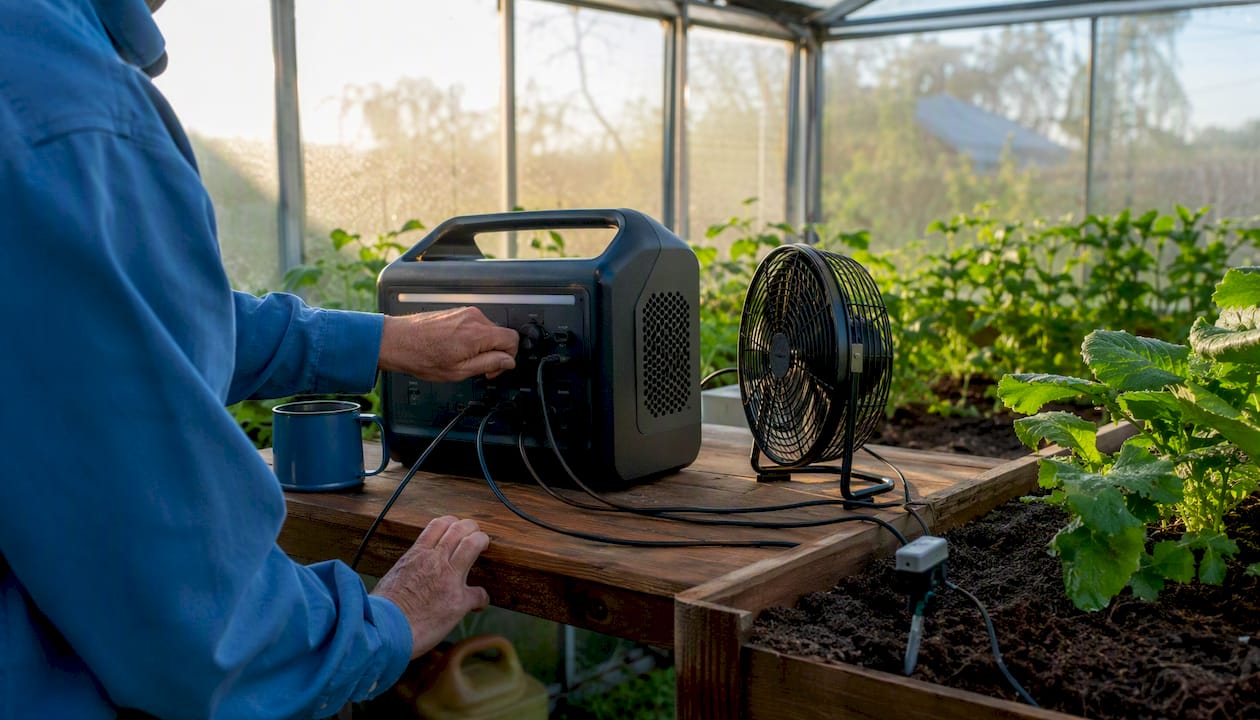
Pro Tip: Buy a quality power station and pair it with efficient panels rather than defaulting to a bundled kit. Independent guidance consistently shows that evaluating battery and inverter specs first, then selecting matched panels, delivers better value than paying a premium for a pre-packaged “solar generator” label.
How we evaluate portable solar generators in this guide
Every unit we assess gets measured against the same criteria. Here is what each one tells you and why it matters.
Core evaluation criteria:
- Usable Wh vs. nominal capacity: LiFePO4 cells typically allow 90%+ depth of discharge; NMC cells are often limited to 80%. A 1,000 Wh LiFePO4 unit gives you more runtime than a 1,000 Wh NMC unit.
- Continuous vs. surge output: Continuous wattage is what the inverter sustains indefinitely. Surge (peak) wattage is what it can deliver for 1–5 seconds at motor startup. Testing protocols now emphasize surge capacity because most field failures happen at startup, not during steady-state operation.
- Inverter type: Pure-sine inverters are required for CPAP machines, variable-speed motors, and sensitive electronics. Modified-sine inverters are cheaper but can damage or degrade certain loads.
- MPPT solar input: MPPT controllers extract more power from panels across varying light conditions compared to PWM controllers. Check the max solar input wattage and the voltage window (Voc range) the unit accepts.
- AC charge time: Bench testing shows that top 1,000–2,000 W-class stations can reach 80% from AC in under an hour. For storm-prep routines, AC charge speed often matters more than solar recharge speed.
- Cycle life and chemistry: LiFePO4 typically has a significantly higher cycle life compared to NMC, which is a major factor in long-term cost per kWh.
- Portability: Weight, handle design, and form factor determine whether a unit actually gets deployed in an emergency.
- Safety certifications: Look for UL listing or equivalent, overload protection, short-circuit protection, and battery management system (BMS) safeguards.
Evaluation checklist for reading spec sheets:
- Find the usable Wh figure, not just nominal capacity.
- Confirm surge wattage, not just continuous output.
- Verify inverter type (pure-sine vs. modified-sine).
- Check MPPT input voltage range and maximum solar wattage.
- Note AC charge time to 80% and to 100%.
- Confirm battery chemistry and warranted cycle count.
- Weigh the unit and check handle design before ordering.
Popular Mechanics and OutdoorGearLab both measure charging performance, port selection, weight, and runtime under realistic loads as standard procedure. Their methodology aligns with the criteria above.
How to choose the right solar generator for your situation
Work through these steps before you buy. Skipping step one is how buyers end up with a unit that cannot run their most critical appliance.
- Inventory your devices. List every device you plan to power and its wattage. Check the label or manufacturer spec sheet, not a generic estimate.
- Calculate daily watt-hours. Multiply each device’s wattage by the hours per day you will run it. Sum the results. Example: CPAP at 30 W × 8 hours = 240 Wh; laptop at 45 W × 4 hours = 180 Wh; LED lights at 20 W × 5 hours = 100 Wh. Total: 520 Wh/day.
- Multiply by days of autonomy. Two days of backup at 520 Wh/day = 1,040 Wh needed. Add 15–20% buffer for inverter losses and partial discharge limits. Target capacity: roughly 1,200–1,250 Wh.
- Check surge requirements. Identify any motorized loads (fridge, pump, fan). Their startup draw is typically 2–3× running watts. A mini-fridge running at 80 W may surge to 200 W. Your station’s surge rating must clear that number with margin.
- Choose battery chemistry. LiFePO4 for any unit you plan to use regularly or store for emergency readiness. NMC only if weight is the overriding constraint and you accept shorter cycle life.
- Plan your solar input. Size panels to roughly 1.5× the station’s maximum rated solar input for reliable recharge under real-world conditions. A station rated for 200 W solar input pairs well with 300 W of panels.
- Evaluate portability. Weigh the unit against your transport scenario. A 30-pound station is manageable for a truck bed; it is not practical for a backpacking trip. Molded handles and organized cable storage matter for emergency deployment.
- Confirm warranty and service. Ask for warranted cycle count, return policy, and whether the manufacturer offers firmware updates or a BMS replacement program.
Red flags to watch for:
- Vague cycle-life claims (“long-lasting battery”) with no specific cycle count.
- Missing surge wattage on the spec sheet.
- Bundled panel wattage that exceeds the station’s stated solar input limit.
- No stated inverter type (pure-sine vs. modified-sine).
Price trade-offs are real. A 1,000 Wh LiFePO4 unit costs more upfront than an NMC equivalent, but at 3,000–4,000 cycles versus 500–1,000, the per-cycle cost is substantially lower over a decade of use.
How to size solar panels and charge your generator reliably
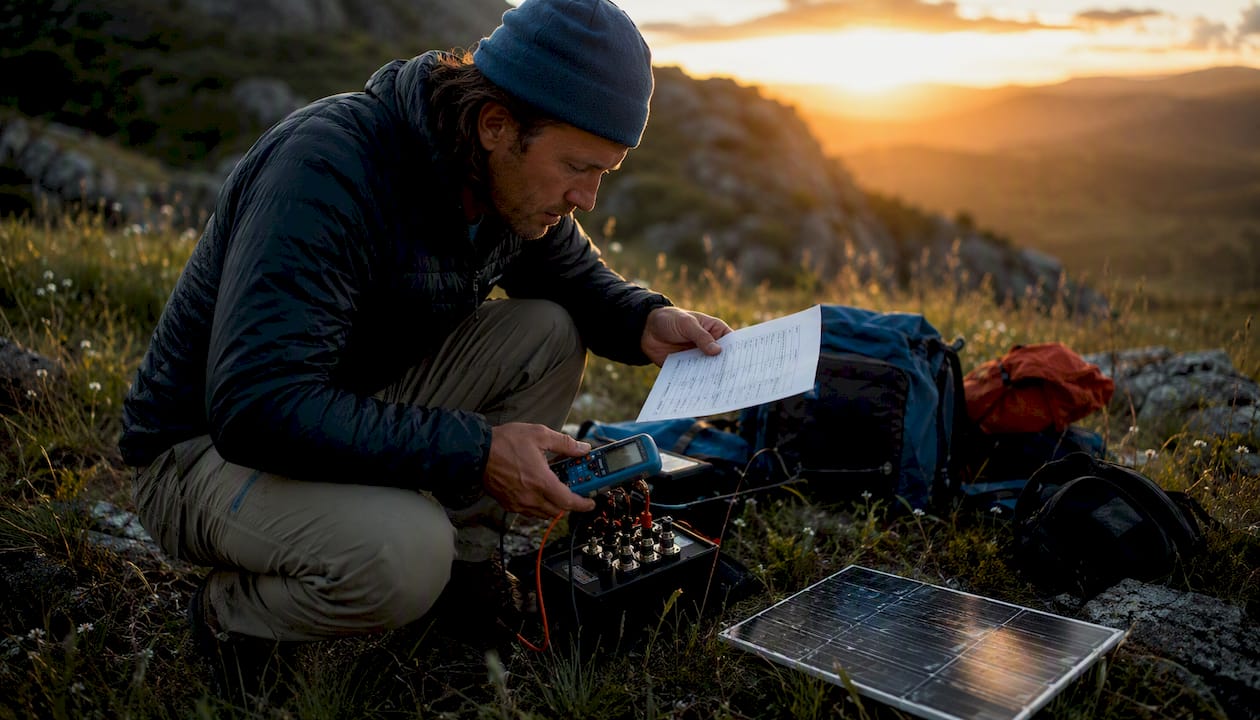
Panel sizing is where most buyers leave performance on the table. The 1.5× rule is the practical starting point: size your panels at approximately 1.5× the station’s maximum rated solar input. A station rated for 200 W solar input benefits from 300 W of panels, which compensates for angle losses, partial shade, and temperature derating.
| Station Solar Input Limit | Recommended Panel Array | Realistic Daily Harvest (5 peak sun hours) |
|---|---|---|
| 100 W | 150 W | 500 Wh |
| 200 W | 300 W | 900–1,200 Wh |
| — | — | 1,000 Wh |
| — | 900 W | 3,000–4,000 Wh |
Realistic daily harvest assumes 5 peak sun hours, which is a reasonable average for much of the continental United States in summer. Winter months and northern latitudes reduce that figure meaningfully.
Panel wiring and field best practices:
- Series vs. parallel wiring affects voltage and current. Series wiring raises voltage (better for long cable runs and MPPT efficiency); parallel wiring raises current. Match the configuration to the station’s Voc input range.
- MPPT controllers track the panel’s maximum power point continuously, recovering 10–30% more energy than PWM controllers in variable light.
- Never exceed the station’s maximum Voc input. Over-voltage trips the BMS and can damage the charge controller.
- In partial shade, a single shaded panel in a series string drags down the entire string’s output. Parallel wiring or shade-tolerant panels mitigate this.
- Secure panels against wind. A portable panel catching a gust in an open field can tip and crack.
Measured real-world panel output runs 10–20% below nameplate rating in typical portable setups due to installation angle, temperature, and partial shade. Plan your harvest estimates accordingly, and do not rely on the peak wattage printed on the panel label as your baseline.
Keeping your generator ready: maintenance and storage
A portable solar generator that sits in a closet for 18 months and then fails during a storm is worse than no generator at all. Proactive battery management is what separates a reliable emergency asset from an expensive paperweight.
Maintenance checklist:
- Store LiFePO4 units at 50–80% state of charge, not fully charged or fully depleted.
- Keep units in a temperature range of 32°F–95°F (0°C–35°C) for storage. Avoid garages that reach 120°F+ in summer or drop below freezing in winter.
- Inspect ports, cables, and connectors monthly for corrosion or physical damage.
- Run a shallow discharge/recharge cycle quarterly to keep the BMS calibrated.
- Check for firmware updates if the unit has a companion app or Bluetooth interface.
- Verify solar input connections and MC4 connector seating before each season.
Storage schedule:
- Monthly: Check state of charge, top up to 60% if below 40%.
- Quarterly: Run a full discharge to 20% and recharge to 80%. Inspect all ports and cables.
- Annually: Full inspection of housing, handle integrity, and inverter output quality. Test under a realistic load for 30 minutes.
Cold-weather storage deserves specific attention. Li-ion and LiFePO4 cells lose capacity temporarily in cold and can be damaged by charging below 32°F. If your storage location drops below freezing, bring the unit indoors before charging. High heat is equally damaging: sustained temperatures above 104°F accelerate cell degradation regardless of chemistry.
Pro Tip: Build a compact go-bag around your portable station. Use a unit with molded handles, and store MC4 adapters, PV cables, and a short extension cord in a labeled pouch attached to the unit. Field reviews consistently show that molded handles and organized cable storage have an outsized impact on deployment speed during an actual emergency.
Safety certifications to verify: UL listing (or equivalent), overload protection, short-circuit protection, and a BMS with cell-level monitoring. Units without a stated BMS spec are a risk in emergency scenarios where you cannot monitor them continuously.
Which generator should you buy? A final verdict
Match the unit to the load, not the other way around. For camping and day trips, a compact 200–500 Wh LiFePO4 unit with a pure-sine inverter covers every device most campers carry. For weekend RV use, CPAP backup, or short outages, a 1,000–1,500 Wh midsize station with a 3,000 W surge rating handles compressor starts without tripping. For multi-day outages, homesteads, or whole-house critical loads, invest in a 2,000 Wh+ expandable system with high solar input and MPPT. LiFePO4 chemistry is the right call for any unit you plan to use more than a few times per year.
Three next steps before you order:
- Calculate your daily Wh load and multiply by days of autonomy plus a 20% buffer.
- Confirm the surge rating clears your highest-draw motorized appliance at 2–3× running watts.
- Contact Westernharmonics if the PowerJam fits your use case, particularly for homestead, greenhouse, or agricultural backup scenarios.
Ready-to-buy checklist:
- Warranty terms and warranted cycle count confirmed in writing.
- Return policy reviewed (especially for large units with freight shipping).
- PV cables, MC4 adapters, and a transport case ordered alongside the unit.
- Panel array sized to 1.5× the station’s solar input limit.
Key Takeaways
LiFePO4 chemistry, correct panel sizing at 1.5× the station’s solar input limit, and a surge rating that clears your highest motorized load are the three decisions that determine whether a portable solar generator actually performs when you need it.
| Point | Details |
|---|---|
| Match capacity to use case | Small (200–500 Wh) for camping, midsize (1,000–1,500 Wh) for CPAP/RV, large (2,000 Wh+) for homestead and outages. |
| Prefer LiFePO4 chemistry | LiFePO4 delivers 3,000–4,000 cycles versus 500–1,000 for NMC, cutting long-term cost per kWh significantly. |
| Size panels to 1.5× solar input | Panels rated at 1.5× the station’s max solar input compensate for angle, shade, and temperature losses in real conditions. |
| Surge rating matters most | Motorized loads draw 2–3× running watts at startup; confirm surge capacity before buying, not after. |
| Westernharmonics PowerJam | A recommended option for homestead, greenhouse, and agricultural backup buyers who need durability and MPPT solar input. |
What field experience actually teaches you about portable solar power
There is a gap between what the spec sheet promises and what a unit delivers on a hot August afternoon in a barn with partial cloud cover. Most roundup articles close that gap with bench numbers. We close it with field context.
The single most underrated spec is surge wattage. We have seen buyers size a midsize station correctly for their daily Wh load, then watch it trip on the first compressor start because nobody checked the surge rating. A 1,500 W continuous unit with a 2,000 W surge ceiling will not start a mini-fridge compressor that pulls 240 W at startup if the compressor is already warm and cycling hard. Size with margin, not with the minimum.
Panel yield in partial shade is the second lesson. A 300 W panel array in full sun delivers close to its rated output. The same array with one panel partially shaded by a roof overhang or tree branch can drop to 40–50% of rated output in a series configuration. Parallel wiring or repositioning the array matters more than buying a higher-wattage panel.
For homesteads integrating portable units into a broader microgrid, the advice is to size conservatively and plan for expansion. A single 1,500 Wh station is a starting point, not a complete system. Pairing it with DC micro-power units for ventilation loads keeps the inverter off during daylight hours and extends the station’s available capacity for nighttime or emergency use. That architecture is what Westernharmonics designs around: engineering simplicity, layered reliability, and hardware that holds up in dusty, hot, demanding environments.
[Note to editor: Chris’s specific credentials, field deployment case studies, and any proprietary test data should be inserted here before publication.]
Westernharmonics PowerJam and DC micro-power units: built for real off-grid work
If you have worked through this guide and your use case involves a barn, greenhouse, homestead, or rural property where grid power is unreliable, Westernharmonics has hardware engineered for exactly that environment. The PowerJam is not a consumer gadget dressed up with solar branding. It is a portable power station built with the same durability philosophy behind our DC micro-power units and solar ventilation systems, which have been running in barns and greenhouses across the country for years.
For buyers who need greenhouse ventilation plus phone and laptop backup, the combination of a DC micro-power unit for direct fan loads and a PowerJam for AC backup covers both needs without oversizing either component. Our automated microgrid design tools can help you map the right configuration before you order. Visit Westernharmonics to explore the PowerJam, DC micro-power units, and our planning tools, or reach out directly for custom microgrid sizing advice. Every unit ships with warranty documentation and cycle-life specs stated clearly, not buried in fine print.
Useful sources for deeper research
These references provide independent test data, panel-sizing methodology, and third-party reviews to supplement the buying criteria in this guide.
- Best Portable Power Stations (Consumer Reports) — Independent lab testing with standardized runtime and charging measurements.
- The 8 Best Solar Generators of 2026 (Popular Mechanics) — Hands-on editorial testing covering portability, ease of use, charging speed, and real-world runtimes.
- Anker Solix C1000 Gen 2 Review (OutdoorGearLab) — Benchmark for fast AC charging performance; useful for understanding charge-time trade-offs between AC and solar.
- Patriot Power Solar Generator Review (Bob Vila) — Field-oriented review with useful notes on portability design, handle ergonomics, and emergency deployment.