

12V DC Distribution: A Practical Guide for Safe Installs
12V DC Distribution: A Practical Guide for Safe Installs
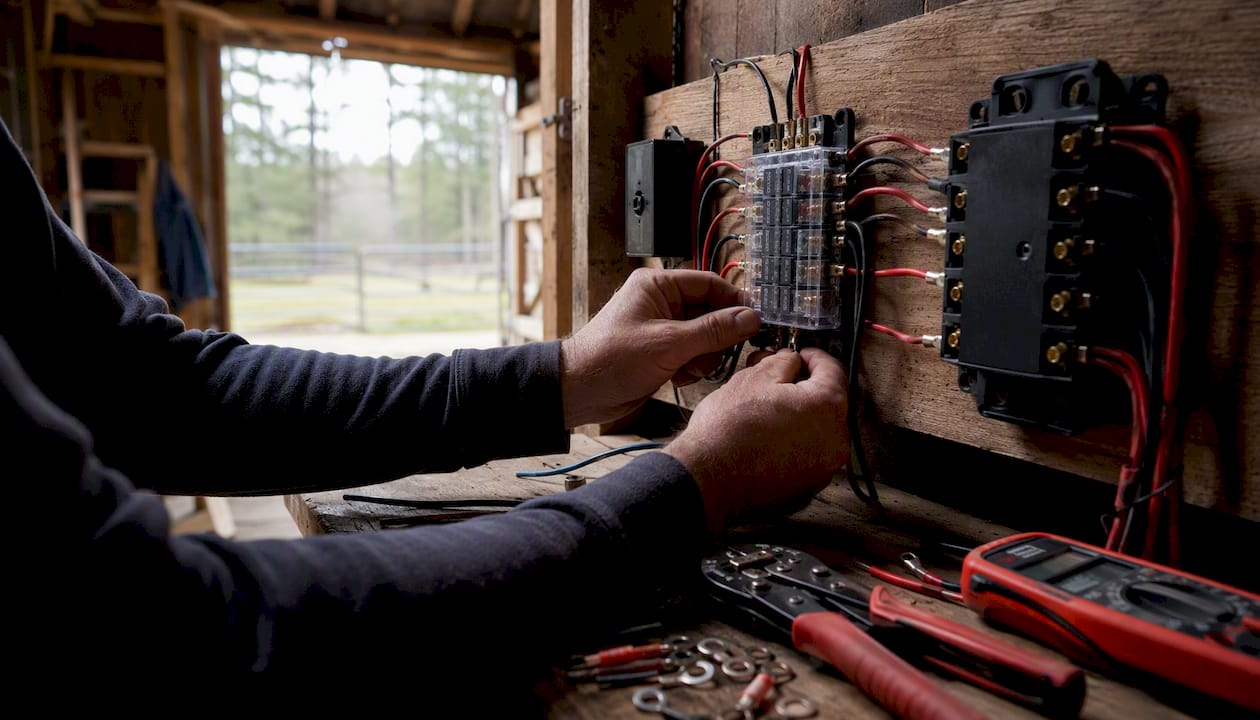
The fastest safe approach to 12V DC distribution is centralizing all outputs through a fused distribution panel or pre-wired distribution box sized to your battery bank and longest wire run. That single decision prevents the most common failures: undersized wire, missing fuses, and loose connections that cause fires or dead circuits in the field.
Here is the short version of what a solid install requires:
- Determine total load and longest run. Add up your circuit amperage, measure the run from battery to the farthest load, and use that to select AWG and size your main fuse.
- Centralize outputs behind fuses or breakers. Every branch circuit gets its own overcurrent protection. The main fuse sits within 18 inches of the battery positive terminal.
- Match connectors to the job. Anderson Powerpole connectors for high-current runs, ATO/ATC blade fuses for accessory circuits, properly crimped ring terminals at busbars. No wire nuts, no tape splices.
For a vehicle or RV, the 12/24V Premium Control Hub Distribution Panel is a turn-key starting point. For marine or permanent installations, Blue Sea Systems CLB panels align with ABYC guidance. For compact off-grid setups, Westernharmonics fan kits with distribution-ready components are purpose-built for exactly this load profile.
Table of Contents
- What 12V DC distribution hardware is available, and which models fit your setup?
- How do you wire a 12V DC distribution system correctly?
- What safety rules and standards apply to 12V DC distribution?
- How do you choose the right 12V DC distribution solution?
- Planning DC distribution for small off-grid systems
- Westernharmonics makes off-grid 12V distribution straightforward
- Sources
What 12V DC distribution hardware is available, and which models fit your setup?
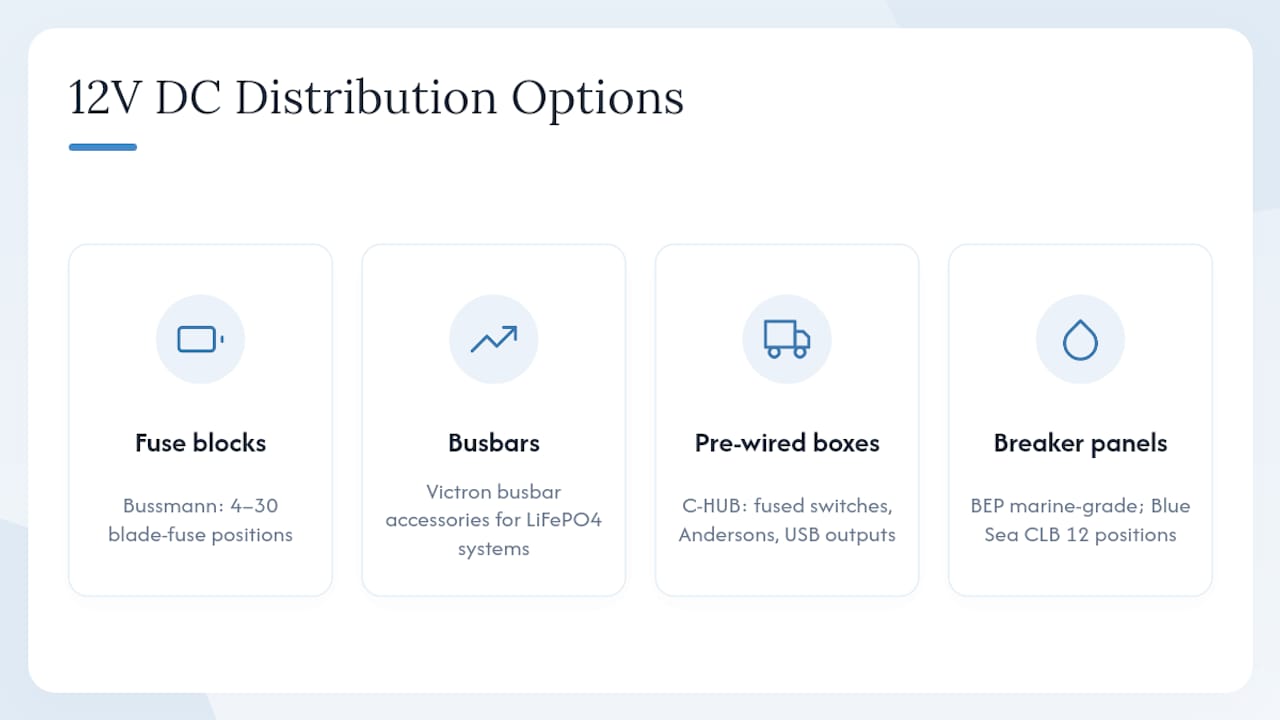
Low-voltage DC distribution hardware falls into four categories: simple fuse blocks, fused busbars, pre-wired distribution boxes, and multi-circuit breaker panels. The right class depends on how many circuits you need, whether the environment is wet, and how much wiring work you want to do yourself.
Westernharmonics Solar Floor Fan 20" Kit is the right starting point for anyone distributing 12V DC to off-grid ventilation loads. The Solar Floor Fan 20" delivers the same air movement as a high-velocity 20" wall plug-in fan, running entirely on solar and battery power. The kits ship with documented compatibility for distribution wiring, so you are not guessing at connector types or fuse ratings.
The HARDKORR 12/24V DC Power Distribution Box (Large) stands out for portable and overland use. It packs multiple Anderson 50A outlets, USB ports, an accessory socket, and a built-in voltmeter into a single enclosure made from UL 94V-0 ABS. That voltmeter alone saves time during commissioning.
The 12 Volt Shop C-HUB is the most complete pre-wired solution for vehicle and RV builders who want a professional control center without custom fabrication. It includes fused rocker switches, USB outputs, Anderson connectors, and mounting provisions for DC-DC chargers and shunt monitor compatibility.
For marine or any permanently wet environment, the BEP multi-circuit panels use marine-grade materials with magnetic/hydraulic or CLB breakers and an integrated negative busbar. Blue Sea Systems CLB panels go a step further, referencing ABYC guidance directly and supporting 12/24V DC systems with resettable breakers across 12 positions.
Lowell Mfg’s DCP-12 targets commercial AV and rack-mount applications rather than vehicle or off-grid use. It is worth knowing about if you are distributing 12V DC in a fixed indoor installation, but it is not the right fit for mobile or wet environments.
Victron Energy products, including SmartShunt and their busbar accessories, are the preferred choice for LiFePO4 battery systems and larger off-grid solar arrays where monitoring and system integration matter as much as distribution itself.
Ancor marine-grade wire and heat-shrink terminals are the wiring component standard for any installation where moisture, vibration, or long service life is a concern. Bussmann (Eaton) fuse blocks cover the widest range of blade-fuse configurations, from 4-position mini blocks to 30-position panels. Anderson Power’s Powerpole connectors handle 15A to 120A per connector and are the field standard for high-current DC connections in off-grid, ham radio, and emergency power applications.
How do you wire a 12V DC distribution system correctly?
Getting the wiring right is not complicated, but the order of decisions matters. Start with wire gauge, then fuse sizing, then connector selection.
AWG selection by current and run length
Choose wire gauge by the maximum current the circuit will carry and the total run length (positive plus negative return).
Run length = one-way distance × 2. Use Ancor or equivalent marine-grade stranded copper wire for any mobile or outdoor installation.
A quick voltage-drop rule: for every 10 feet of 12 AWG wire carrying 20A, you lose roughly 0.5V. At 30 feet, that is 1.5V lost before the load even sees power. Size up one AWG when in doubt.
Fuse sizing
- Size the fuse to protect the wire, not the device. A 12 AWG wire is rated for 20A continuous. Its fuse should be 20A or less, regardless of what the connected device draws.
- Place the main fuse within 18 inches of the battery positive terminal. This is the single most important placement rule. A short circuit anywhere downstream is stopped before it can heat the main cable.
- Size branch fuses independently. Each branch circuit gets its own fuse rated to the wire it feeds, not the total panel capacity.
- Use a main disconnect or master breaker at the distribution panel for service safety. Resettable CLB breakers from Blue Sea Systems or BEP panels serve this function in marine and RV installs.
Connector and termination guidance
Anderson Powerpole connectors are the right choice for any high-current DC connection you will disconnect and reconnect in the field. They are rated to 45A in the standard 30A housing and up to 120A in the 120A housing. They are genderless and do not corrode the way blade connectors do in outdoor environments.
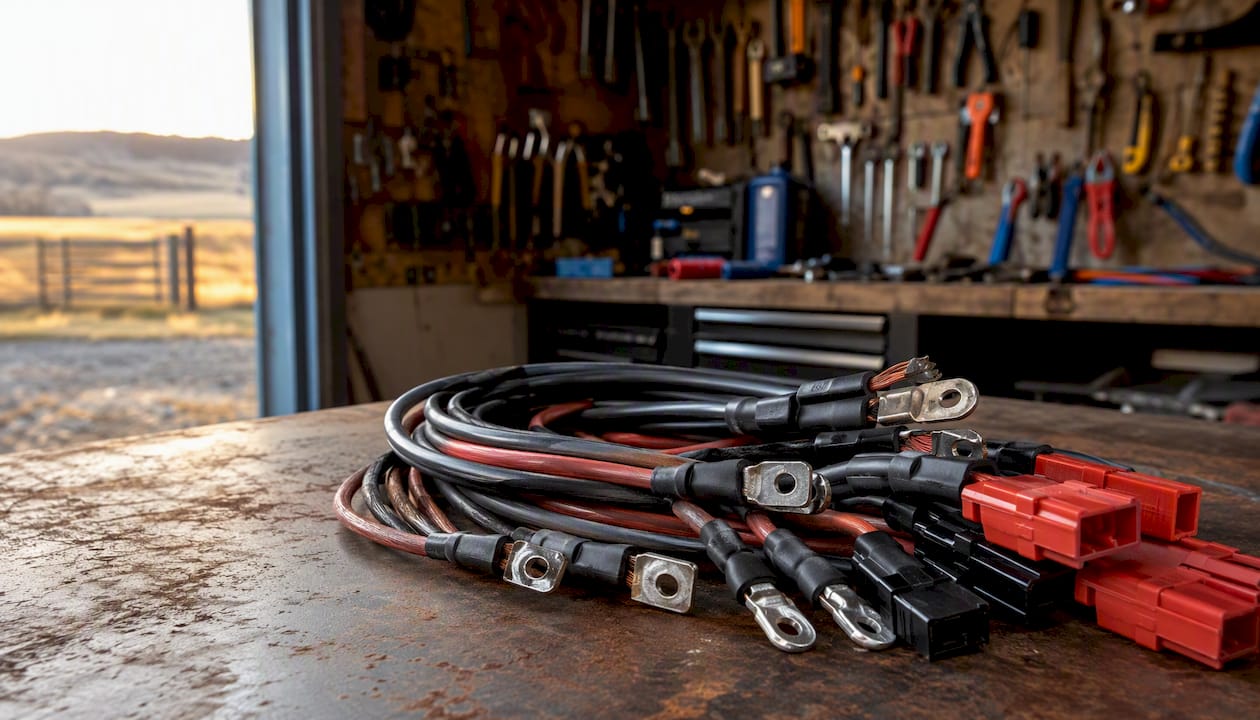
For fixed terminations at a busbar or distribution block, use properly crimped ring terminals. A ratcheting crimper (not a plier-style tool) is required for a gas-tight crimp. Torque terminal screws to the manufacturer’s specification, typically 20–35 in-lb for M5 studs on busbars.
ATO/ATC blade fuses belong in fuse blocks for accessory circuits drawing under 30A. Bussmann (Eaton) fuse blocks are the standard here, available at any auto parts store and most marine suppliers.
Sample wiring layouts
Vehicle or RV layout: Battery (+) → main fuse (within 18" of battery) → distribution panel (Bussmann fuse block or C-HUB) → individual branch fuses → loads. Battery (−) → negative busbar → load returns. All grounds return to the negative busbar, not scattered to chassis.
Small off-grid layout: Solar panel → charge controller → battery (+) → main fuse → distribution block → branch fuses → loads (fans, LED, sensors). Battery (−) → negative busbar → all load returns. A Victron SmartShunt between the battery negative and the negative busbar gives you real-time current monitoring.
Pro Tip: Before closing any panel or junction box, power the system and use a multimeter to verify voltage at the far end of every circuit under load. A reading more than 0.5V below battery voltage on a 12V circuit means the wire is undersized or a connection is loose. Fix it before the panel goes on.
What safety rules and standards apply to 12V DC distribution?
The single most important safety control in any DC distribution system is correct overcurrent protection with the main fuse placed as close to the battery positive terminal as practical. Everything else builds on that.
Safety checklist
- Main fuse at the battery. Within 18 inches of the positive terminal, always. No exceptions for “short runs.”
- Correct AWG for every circuit. Undersized wire is the leading cause of DC fires. Use the AWG table above and do not substitute a smaller gauge to save money.
- Secure all wiring. Use cable clamps or conduit every 18–24 inches. Unsupported wire chafes against metal edges and shorts.
- Ventilate enclosed hubs. Distribution boxes in sealed compartments can overheat under sustained load. Leave at least one ventilation path or derate the panel.
- Reverse-polarity protection. Anderson Powerpole connectors are polarized by design. For other connector types, use a diode or a polarity-protection relay on sensitive loads.
- Label every circuit. A permanent marker on the fuse block and a wiring diagram taped inside the panel cover saves hours during troubleshooting.
- Use marine-rated enclosures in wet environments. A standard ABS box is not sufficient for bilge-adjacent or outdoor-exposed installations. BEP and Blue Sea Systems panels are built to marine-grade standards.
ABYC and UL guidance
The American Boat and Yacht Council (ABYC) publishes Standard E-11, which governs DC electrical systems on boats and is the most detailed U.S. guidance for low-voltage DC wiring in mobile environments. It covers wire sizing, fuse placement, grounding, breaker types, and connector ratings. Blue Sea Systems designs its CLB panels to align with ABYC E-11, which is why those panels are the default choice for marine installers.
UL 1500 and UL 2089 cover ignition protection and battery charger safety for marine applications. For consumer products in RV and off-grid use, UL 508 (industrial control equipment) and UL 94V-0 flame ratings on enclosure materials (as used in the HARDKORR distribution box) are the relevant benchmarks.
Red flags to watch for
- Connectors or wire insulation that feel warm after 30 minutes of normal operation
- Voltage at the load more than 0.5V below battery voltage under load
- Fuses that blow repeatedly without an obvious overload (sign of a marginal wire size or intermittent short)
- Non-marine-rated enclosures in engine bays, bilges, or outdoor-exposed locations
- Missing fuse at the battery positive terminal
How do you choose the right 12V DC distribution solution?
Match the product class to your load, environment, and installation skill before looking at specific models.
- Define your total load and use case. Add up all circuit amperage. Identify whether the environment is dry, mobile, or wet. A greenhouse fan system has different demands than a marine nav station.
- Pick the product class. Entry fuse blocks handle simple accessory circuits. Pre-wired distribution boxes suit mobile and off-grid installs. Marine breaker panels belong in boats and permanent RV builds. Modular systems with monitoring (Victron) fit larger off-grid arrays.
- Match connectors and IP rating. Anderson outputs for high-current field connections. Marine-rated enclosures for wet environments. USB-C PD for modern accessory loads.
- Plan wiring and fusing before buying. Know your longest run, your main fuse size, and your negative bus location before ordering a panel.
Price ranges by product class
| Product Class | Typical U.S. Price Range | Notes |
|---|---|---|
| Entry fuse block (Bussmann, 4–12 position) | $15–$50 | DIY wiring required; no enclosure |
| Pre-wired distribution box (HARDKORR, Tuff Terrain) | $80 and above | Plug-and-play; includes voltmeter and USB |
| Pre-wired control hub (C-HUB) | $200 and above | Charger and shunt mounting; professional finish |
| Marine breaker panel (BEP, Blue Sea Systems) | starting at around $150 | ABYC-aligned; resettable breakers |
| Modular monitoring system (Victron) | starting at a few hundred dollars | Full monitoring; LiFePO4 compatible |
| Portable power station (Westernharmonics PowerJam) | Per pre-order spec | Temporary distribution and testing |
Questions to ask before buying:
- What is the maximum continuous amperage per output and total panel?
- Are breakers resettable, or do I need to stock replacement fuses?
- Does the enclosure carry a marine or IP rating for my environment?
- Is the panel compatible with LiFePO4 battery chemistry (some older breakers are not)?
- How much mounting space does the panel require, and does it include a negative busbar?
For most off-grid barn and greenhouse builds, a pre-wired distribution box or a Bussmann fuse block paired with Westernharmonics fan kits covers the load cleanly. For marine installs, start with Blue Sea Systems or BEP and follow ABYC E-11. For temporary or test setups, the Westernharmonics PowerJam portable power station gives you multiple DC outputs without permanent wiring.
Where to buy in the U.S.: Blue Sea Systems and Bussmann products are stocked at West Marine, Amazon, and most marine suppliers. HARDKORR and Tuff Terrain ship from Australia but are available through specialty off-grid retailers. Westernharmonics ships direct from the U.S. For anything requiring professional installation, a certified marine electrician (ABYC-certified) or an RV technician is the right call when the system exceeds 100A or involves LiFePO4 batteries.
Planning DC distribution for small off-grid systems
Small off-grid systems, those under 3 kW, benefit most from simple central distribution and modular components you can service without shutting down the whole array. A single fused busbar or pre-wired box, a clear negative bus, and labeled branch circuits will outlast any complicated multi-panel arrangement in a barn or greenhouse environment.
Worked example: greenhouse fan, sensor, and night LED
Loads:
- Westernharmonics Solar Floor Fan 20": 5A at 12V (60W)
- Temperature/humidity sensor: 0.5A
- Night LED strip (4 meters): 2A
- Total: 7.5A continuous
A 100W solar panel in a U.S. average of 4–5 peak sun hours replenishes 33–42Ah per day, which covers the fan load comfortably through summer and marginal in winter months.
Main fuse: 30A, placed within 18 inches of the battery positive terminal. This protects the 10 AWG main cable.
Branch fuses:
- Fan circuit: 10A (on 14 AWG wire)
- Sensor circuit: 2A (on 18 AWG wire)
- LED circuit: 5A (on 16 AWG wire)
Wire runs: Fan is 15 feet from the distribution block. LED strip is 20 feet; 16 AWG at 2A is within spec.
Distribution block: A 4-position Bussmann fuse block with a separate negative busbar handles this load with room to add a fourth circuit later.
The Westernharmonics Solar Floor Fan 20" is the right fan for this scenario. It moves the same volume of air as a high-velocity 20" wall plug-in fan, running entirely on 12V DC from solar and battery. For ceiling-mounted applications in the same greenhouse, the Solar Hanging Fan 20" kit fits the same distribution design.
Where PowerMosaics.com fits versus manual spreadsheets
Manual spreadsheet design works for a single-circuit system like the example above. Once you add a second load zone, a DC-DC charger, and a battery monitor, the interdependencies multiply fast. Changing the battery size changes the main fuse, which changes the cable AWG, which changes the voltage drop calculation for every branch.
PowerMosaics.com is designed specifically for sub-3 kW DC systems, covering wire sizing, fuse selection, and PV/battery matching in an integrated tool rather than a chain of separate spreadsheet tabs. For a greenhouse or barn build with three or more load zones, it saves meaningful time compared to manual iteration. For the single-zone worked example above, a spreadsheet is sufficient.
For deeper background on how batteries, charge controllers, and distribution components interact in a small off-grid system, the Westernharmonics microgrid components guide covers the planning sequence clearly.
Loads always grow. A sensor becomes two sensors, a fan becomes two fans. Building in headroom at the start costs less than rewiring later.*
For off-grid charging strategy in grid-down or remote scenarios, the solar charging in a grid-down scenario guide from Toddra covers practical battery management that applies directly to the greenhouse and barn use cases above.
What pros do differently in 12V DC installs
Experienced installers make one decision early that most DIYers skip: they draw the full wiring diagram before buying a single component. That diagram forces every fuse size, every wire gauge, and every connector type to be decided on paper, where changes cost nothing.
Three habits that separate reliable installs from callbacks:
- Label everything before it goes in. A label maker on every wire at both ends and a circuit directory inside the panel cover. Six months later, when a fuse blows, you will know exactly which circuit it is without tracing wire.
- Torque terminal screws to spec. A loose M5 stud on a busbar carrying 50A will fail. Manufacturers publish torque specs for a reason. Use a torque screwdriver, not a feel.
- Prefer resettable breakers on frequently-used circuits. A fan circuit that trips in summer heat should reset with a button press, not require a fuse replacement in a dark barn. CLB breakers from Blue Sea Systems or BEP panels handle this cleanly.
A common failure pattern: a vehicle owner installs a fuse block under the dash, runs wires to the battery, and leaves the main cable unfused because “it’s only a short run.” Three months later, a chafed wire shorts against the firewall. Without a main fuse, the cable carries fault current until the insulation burns. The fix is always the same: a 30A or 50A inline fuse within 18 inches of the battery, installed before the first accessory circuit goes live. It costs $5 and takes ten minutes.
Westernharmonics makes off-grid 12V distribution straightforward
If you are building a ventilation or power system for a barn, greenhouse, or workshop, Westernharmonics has done the hard sizing work for you. Our solar-powered fan kits ship with 12V DC components matched to real off-grid load profiles, so you are not starting from a blank spreadsheet.

The Solar Floor Fan 20" and the Solar Hanging Fan 20" kit are built for exactly the kind of distribution design covered in this guide. Both run on 12V DC, both are compatible with standard fuse blocks and Anderson connectors, and both deliver the airflow of a high-velocity wall plug-in fan without touching the grid. For a complete system with battery and solar already matched, the 200W Solar Hanging Fan Kit with Battery Backup and the Solar & Battery Greenhouse Exhaust Fan Kit are ready to wire in.
Browse the full Westernharmonics catalog to find the kit that matches your load, or contact our support team for wiring help on a custom layout.
Key Takeaways
Safe, reliable 12V DC distribution requires a centrally fused panel sized to the battery and longest run, with every branch circuit protected independently and all grounds returned to a dedicated negative busbar.
| Point | Details |
|---|---|
| Main fuse placement | Place the main fuse within 18 inches of the battery positive terminal on every install. |
| AWG by run length | Use the AWG table: a 20A circuit at 20 feet needs 10 AWG to stay under 3% voltage drop. |
| Branch fuse sizing | Size each branch fuse to protect the wire it feeds, not the device it powers. |
| Connector choice | Use Anderson Powerpole for high-current field connections; crimped ring terminals at busbars. |
| Westernharmonics fit | Westernharmonics Solar Floor Fan 20" kits are pre-matched for 12V DC distribution in off-grid barn and greenhouse systems. |
Sources
Before buying or wiring, confirm specs from the manufacturer’s own documentation:
- 12/24V Premium Control Hub Distribution Panel